
How to Choose the Right Bathroom Vanity
The bathroom vanity is the anchor of the entire room. It sets the visual tone, defines how the space functions day to day, and accounts for a significant portion of any renovation budget. Whether you’re updating a powder room or overhauling a full ensuite, the vanity you choose will shape everything from morning routines to resale value.
For Ottawa homeowners, the decision involves a few extra considerations: humidity extremes between seasons, the wide range of bathroom sizes in older homes, and hard water common in many parts of the city. Getting this choice right pays dividends for years. Getting it wrong means living with frustration — or funding an early replacement.
This guide walks through every factor worth considering before you buy: size and layout, storage needs, materials, style, plumbing configuration, and realistic budgeting.
Measure First, Shop Second
The single most common vanity mistake is skipping a thorough measurement. Homeowners often fall in love with a piece online, order it, and discover it clears a door by half an inch — or doesn’t clear it at all.
Before looking at a single product, record these five dimensions:
- Width of the available wall space, including any obstructions (baseboard heaters, outlets, trim)
- Depth from the wall to the edge of any toilet, door swing, or traffic zone
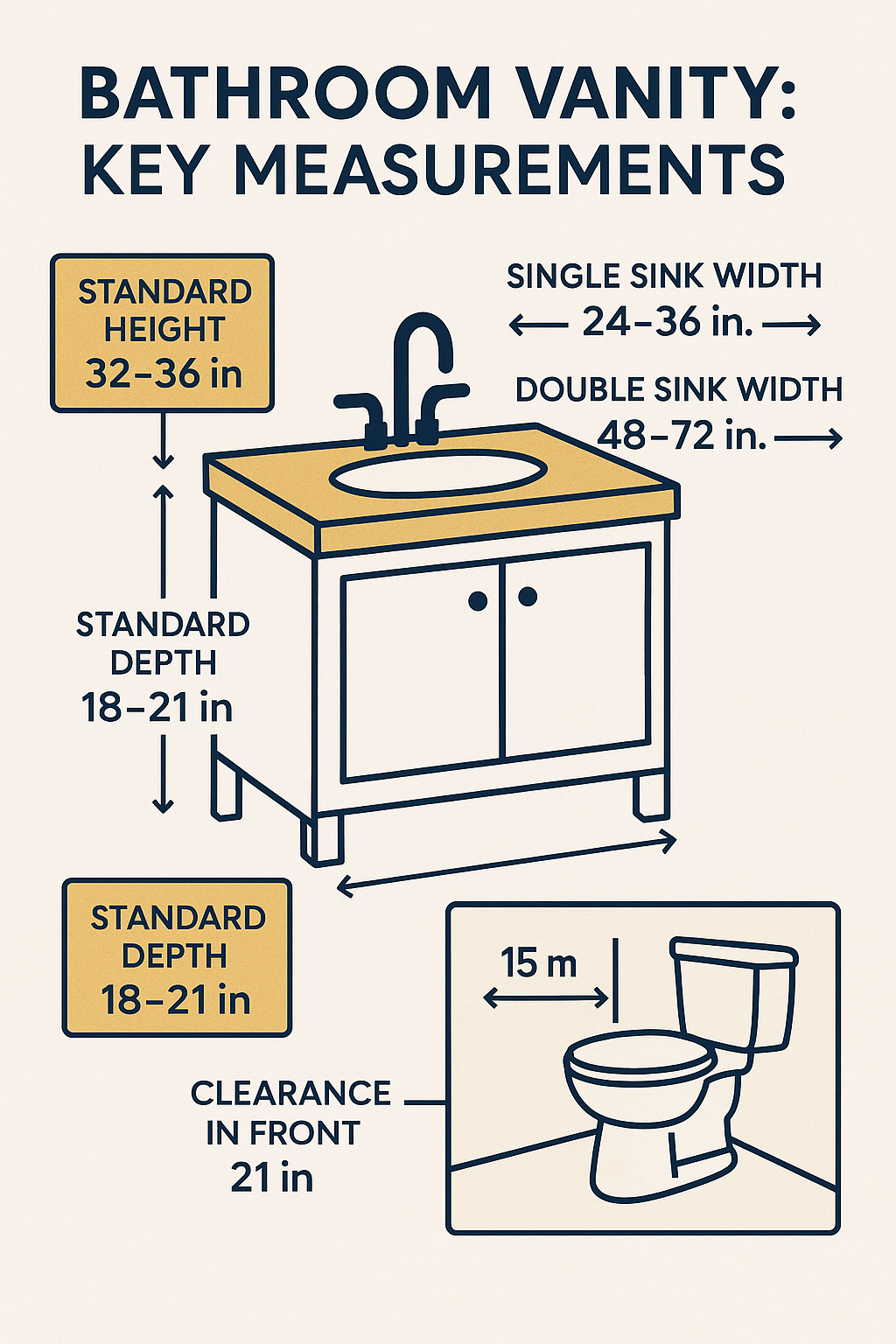
- Height of the rough-in plumbing — standard is 18–21 inches from the floor to the centre of the drain
- Ceiling height, which affects whether a tall mirror or medicine cabinet will fit above
- Door swing radius for both the bathroom entry door and any cabinet doors on the vanity itself
Standard vanity widths run from 18 inches for a compact powder room up to 72 inches or more for a double-sink ensuite. Depth is typically 18–22 inches, though wall-mounted floating vanities can be shallower, which helps in tight spaces.
Pro Tip: Tape the footprint of your target vanity on the floor with painter’s tape before ordering. Walk around it for a few days. You’ll quickly discover if the depth feels tight or if the door swing becomes a problem.
In older Ottawa homes — particularly those built before the 1980s — bathrooms were often smaller than today’s standards, and plumbing rough-ins don’t always match modern vanity dimensions. If your drain isn’t centred where a new vanity expects it, factor in plumber fees for relocation before finalizing your choice.
Single Sink or Double: Choosing the Right Configuration
The choice between a single-sink and double-sink vanity comes down to two things: how many people share the bathroom, and how much wall space you actually have.
Single-sink vanities work well for:
– Powder rooms and guest baths
– Ensuites used by one person
– Narrow bathrooms where a double would feel cramped
– Maximizing counter space on one side
Double-sink vanities make sense when:
– Two people regularly use the bathroom at the same time
– The bathroom is 60 inches wide or more
– You have the plumbing capacity (two supply lines, two drains)
– The renovation is aimed at improving resale appeal
Be realistic about how your household actually uses the bathroom. Many couples who install double sinks find one goes largely unused, while a single sink with generous counter space on both sides would have served them better.
Pro Tip: If budget is tight and you’re renovating a shared ensuite, prioritize a wide single-sink vanity with a long counter before defaulting to a double. A 48-inch single often provides more usable surface area than two cramped 18-inch sinks side by side.
Storage: What You Actually Need vs. What You Think You Need
Start by inventorying what the vanity needs to hold: toiletries and daily-use items, cleaning supplies stored under the sink, towels if no linen closet is nearby, and hair tools or medications.
Cabinet configurations to know:
- Single door with one shelf — basic and inexpensive, works for powder rooms
- Two-door with adjustable shelves — the most versatile option for most households
- Drawers — far more practical than shelves for small items; soft-close drawers are worth the premium
- Combination — a drawer bank on one side and a cabinet on the other covers most needs
Wall-mounted medicine cabinets and side towers supplement under-sink storage when the vanity cabinet is limited by plumbing.
Pro Tip: Deep single-basin sinks with a large P-trap assembly dramatically reduce usable cabinet space. Measure the interior clearance with the plumbing in place before deciding how much of your storage plan depends on that cabinet.
Materials and Finishes: Built for the Bathroom Environment
A bathroom vanity endures more moisture, temperature swings, and humidity than almost any other piece of furniture in your home. Ottawa winters make this worse: forced-air heating drops indoor humidity sharply, then steam from showers spikes it. Materials that can’t handle this cycle will warp, delaminate, or discolour within a few years.
Cabinet box construction — from best to worst for bathrooms:
- Plywood is the preferred mid-range material — dimensionally stable, holds screws well, resists moisture better than particleboard
- Solid wood handles humidity well and is refinishable, but costs more and requires sealed joints
- MDF takes paint smoothly and is cost-effective, but swells when exposed to water — avoid in high-moisture zones
- Particleboard is the least moisture-resistant; common in budget vanities and prone to swelling at the toe kick and under-sink areas
Countertop options:
- Engineered quartz is exceptionally durable, non-porous, and easy to maintain — the top choice for most Ottawa bathrooms
- Porcelain is highly resistant to moisture, stains, and heat
- Cultured marble is affordable and seamless (good for moisture resistance) but yellows over time
- Natural stone is beautiful but requires regular sealing — avoid in busy family bathrooms unless you’re committed to maintenance
- Laminate is budget-friendly but ages poorly in wet conditions
According to CMHC’s home improvement guidance, moisture management is one of the most common sources of premature bathroom fixture failure in Canadian homes — making material selection a long-term investment, not just an aesthetic choice.
Pro Tip: Ottawa has moderately hard water. Choose countertop materials and sink basins that resist mineral deposit buildup. Lighter-coloured surfaces and matte finishes hide water spots far better than dark, polished materials.
Style and Finish: Matching Your Bathroom’s Design Direction
A vanity that’s functionally perfect but visually mismatched will always feel off. Today’s market offers styles from traditional to highly contemporary across most price points.
Common style directions:
- Traditional / Transitional — raised-panel or recessed-panel doors, furniture-style legs, warm wood tones or painted finishes; pairs well with chrome or brushed nickel hardware
- Modern / Contemporary — flat-front doors, integrated or undermount sinks, floating configuration, matte finishes; pairs with matte black or brushed gold hardware
- Farmhouse / Cottage — shaker doors, open shelf base, apron-front sinks, white or soft colour palettes
- Mid-Century Modern — tapered legs, walnut veneer, clean lines; floating mount preferred
Hardware finish is a small detail with a large visual impact. Match your faucet, towel bars, and light fixtures to one or two finishes at most. Mixing three or more looks unplanned.
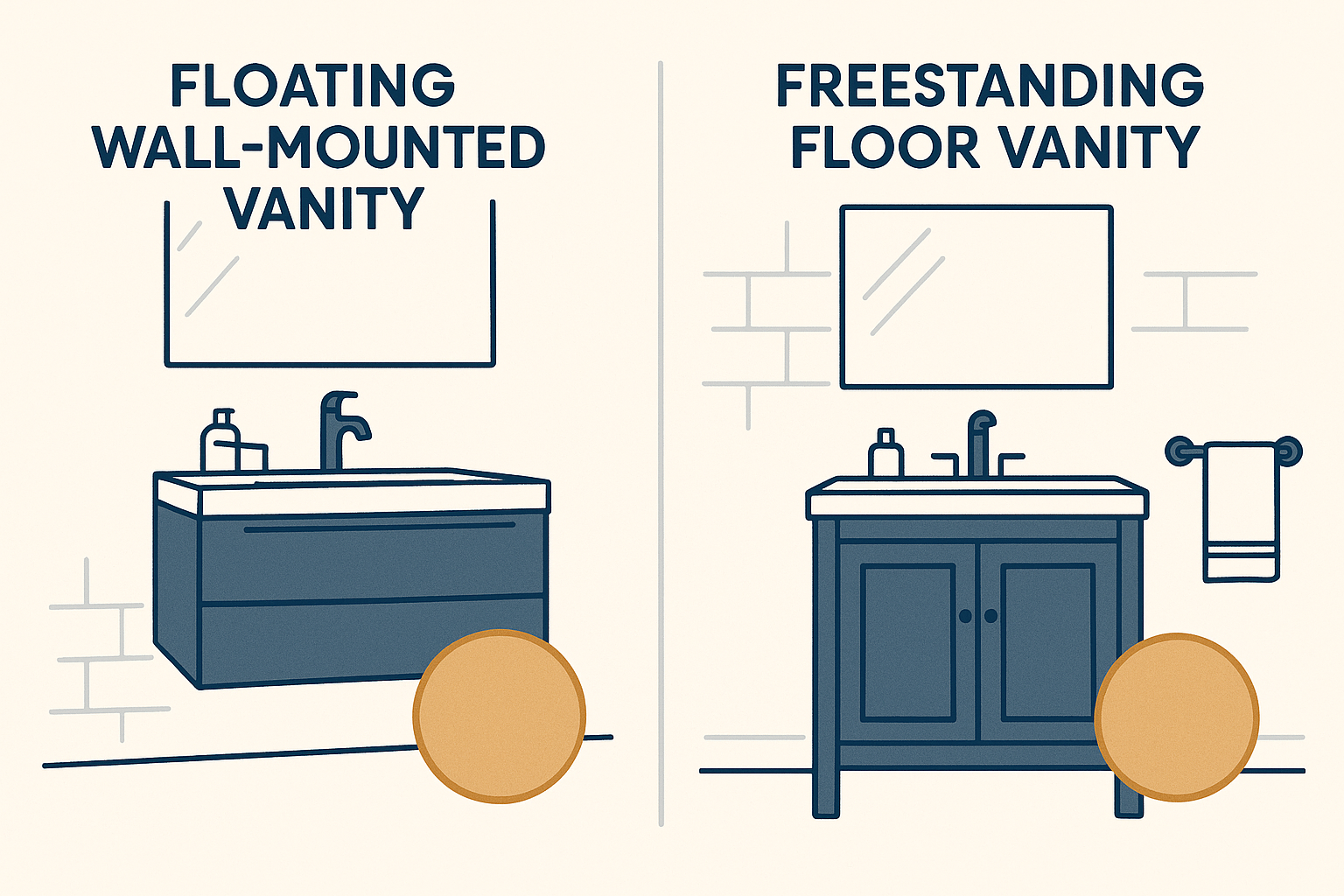
Floating vanities deserve special mention for Ottawa bathrooms: they make the floor easier to clean, visually enlarge smaller spaces, and allow custom height installation — a real benefit for households with accessibility considerations. The trade-off is that they require wall blocking for proper support, which adds labour cost. For a full bathroom renovation in Ottawa, discussing floating vs. floor-mounted early with your contractor avoids surprises during rough-in.
Pro Tip: If you’re planning to sell within five years, lean toward neutral transitional vanity styles in white, grey, or warm wood tones. Bold design choices narrow your buyer pool more than most homeowners expect.
Budget Realities: What You Get at Each Price Point
Vanity pricing in Canada spans an enormous range. Understanding what you’re buying at each level prevents both overspending and disappointment.
| Price Range | What to Expect |
|---|---|
| Under $400 | Particleboard construction, basic hardware, limited finish options; suitable for rental properties or short-term use |
| $400–$900 | Plywood or MDF box, more finish options, soft-close hinges starting to appear; solid choice for guest baths |
| $900–$2,000 | Solid wood or quality plywood, dovetail drawers, soft-close everything, better countertop options; appropriate for primary bathrooms |
| $2,000–$5,000+ | Custom or semi-custom sizing, premium countertops, designer finishes, integrated sinks; for ensuite renovations where longevity and aesthetics matter |
These are vanity-only prices. Add faucets ($80–$600+), mirror or medicine cabinet ($100–$800+), installation labour ($200–$600), and plumbing modifications if the drain or supply lines need moving ($300–$1,200+).
A realistic all-in budget for a mid-range primary bathroom vanity installation in Ottawa — including the vanity, faucet, mirror, and labour — typically falls between $1,500 and $3,500. HomeStars reports similar ranges for bathroom fixture installations across Ontario.
Pro Tip: Don’t cut corners on the faucet. A $150 vanity paired with a $350 faucet will look and feel better than a $350 vanity with a $60 faucet. The faucet is touched dozens of times a day and is among the first things guests notice.
Frequently Asked Questions
What size bathroom vanity do I need?
Measure your available wall space and subtract at least 2–3 inches on each side for clearance. Also measure the depth available before any door swing, toilet, or traffic zone. Standard vanity depths are 18–22 inches. In tight bathrooms, a wall-mounted floating vanity with a shallower profile (16–18 inches deep) frees up floor space without sacrificing counter room.
What is the best material for a bathroom vanity in Canada?
Plywood-core construction is the best balance of moisture resistance, durability, and cost for Canadian bathrooms. Solid wood is excellent but costs more. Avoid particleboard in any bathroom with significant steam or humidity — it swells and fails quickly. For countertops, engineered quartz is the top choice for Ottawa bathrooms: non-porous, hard-wearing, and available in a wide range of colours and finishes.
Should I choose a floating or floor-mounted vanity?
Floating (wall-mounted) vanities make floors easier to clean, visually enlarge smaller bathrooms, and allow custom height installation. They require wall blocking during construction, which adds cost if not planned early. Floor-mounted vanities are simpler to install and often less expensive. For new renovations, floating vanities are worth the additional planning — for a simple vanity swap, floor-mounted is usually the easier path.
How much does vanity installation cost in Ottawa?
Labour for a straightforward vanity swap in Ottawa typically runs $200–$400. If the plumber needs to relocate a drain or supply lines, add $300–$1,200. If the electrician needs to move an outlet or update the lighting circuit, add $200–$500. A full vanity installation including all trades, the vanity, faucet, and mirror typically costs $1,500–$3,500 at mid-range finishes.
Can I install a bathroom vanity myself?
Swapping a vanity for a same-size replacement — with no plumbing or electrical changes — is achievable for a homeowner comfortable with basic tools. You’ll need to disconnect and reconnect supply lines and the drain P-trap, which doesn’t require a licensed plumber in Ontario for a like-for-like replacement. Any work that involves moving drain lines, adding new water supply, or changing electrical is licensed trade work and requires a permit in Ontario.
Choosing the right bathroom vanity is equal parts practical planning and personal expression. If you’re undertaking a broader renovation and want guidance on how the vanity fits into your overall layout, material selections, and budget, the team at Miracle Dream Homes has been helping Ottawa homeowners get these decisions right since 2004. Request a free quote and we’ll walk through the options that make sense for your home.