
How to Move Plumbing in a Bathroom Renovation
Moving plumbing is the single most expensive and disruptive element in a bathroom renovation. It transforms what might otherwise be a surface renovation — replace tile, swap fixtures, update finishes — into a structural project that opens floors, walls, and ceilings. Understanding what moving plumbing actually involves helps you make an informed decision about whether the layout change you want is worth the cost.
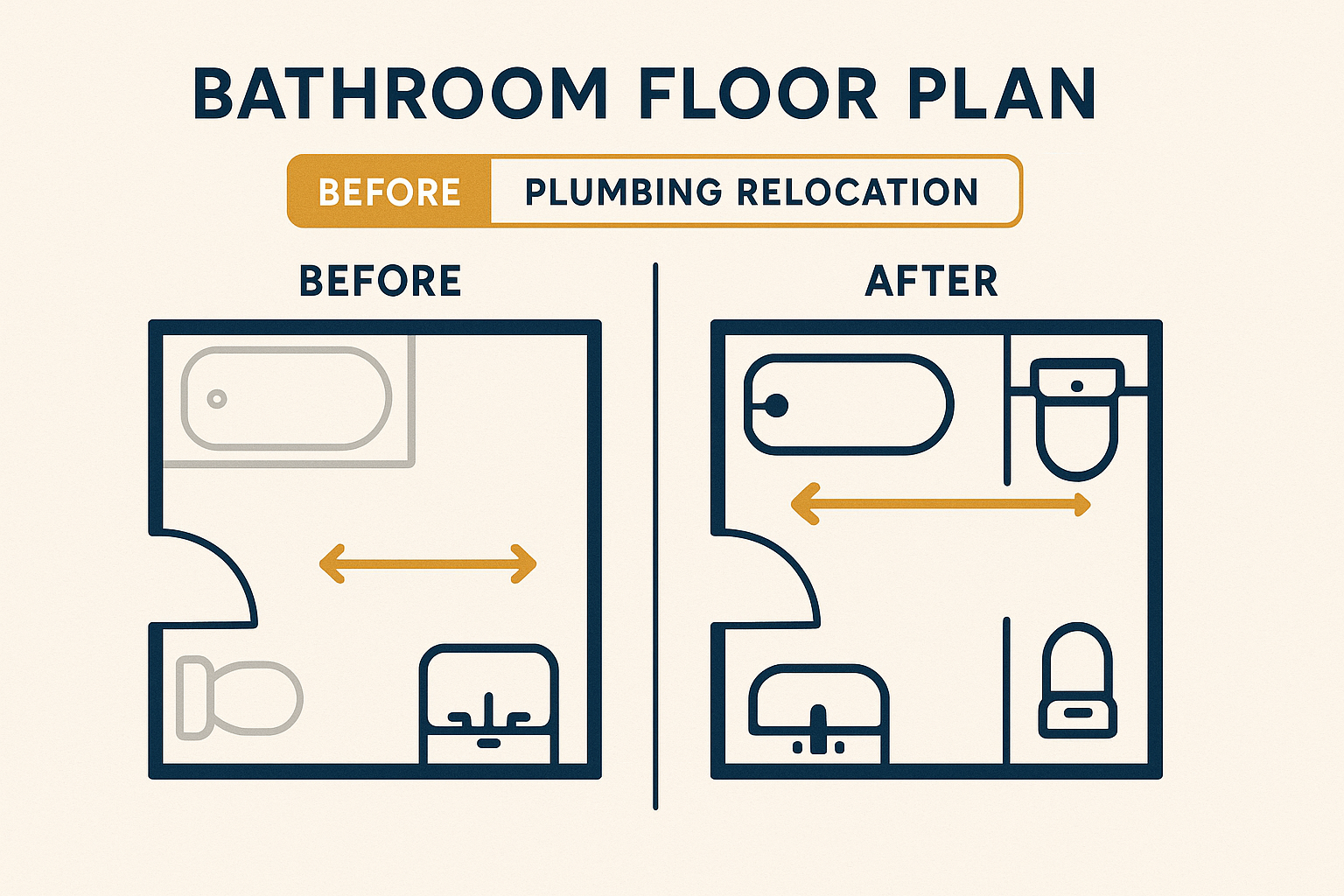
Why Moving Plumbing Is Complex
The complexity comes from two requirements that do not apply to supply plumbing: gravity and venting.
Supply lines (the pressurized pipes that deliver hot and cold water) are relatively easy to extend or reroute. They run under pressure, so they can go up, down, around corners, and through walls without complicated slope calculations. Extending a supply line is a plumber’s routine work.
Drain lines operate entirely on gravity. Waste water moves through drain pipes because the pipes slope downhill — specifically, at a minimum of 1/4 inch per foot (about 2%) toward the main drain stack. Moving a toilet, shower, or sink means the drain line at the new location must maintain this slope all the way back to the main stack. If the distance is long, the slope requirement may require the drain line to drop through floor joists — or even below the concrete slab in a basement.
Venting is the other constraint. Every fixture branch drain must be vented — connected to a vent pipe that extends to the roof or to an air admittance valve. This venting prevents siphoning of trap water and allows gases to escape. Adding a new fixture location requires either routing new vent pipe to the existing vent stack (or creating a new penetration through the roof) or installing an air admittance valve approved under the Ontario Building Code.
The Most Common Plumbing Moves
Moving the Toilet
Toilet relocation is the most requested plumbing move in bathroom renovations. A toilet at a different position on the same wall, or on a different wall, requires:
– A new 75 mm (3 inch) drain line from the new toilet position to the existing main stack, maintaining slope throughout
– A new 32 mm (1.25 inch) vent connection, or air admittance valve at the new location
– New supply connection (straightforward)
– Patching, subfloor repair, and potentially opening the ceiling below if this is an upper-floor bathroom
Moving a toilet 30–60 cm on the same wall is the easiest version. Moving it to a different wall, or more than 60 cm, increases complexity proportionally.
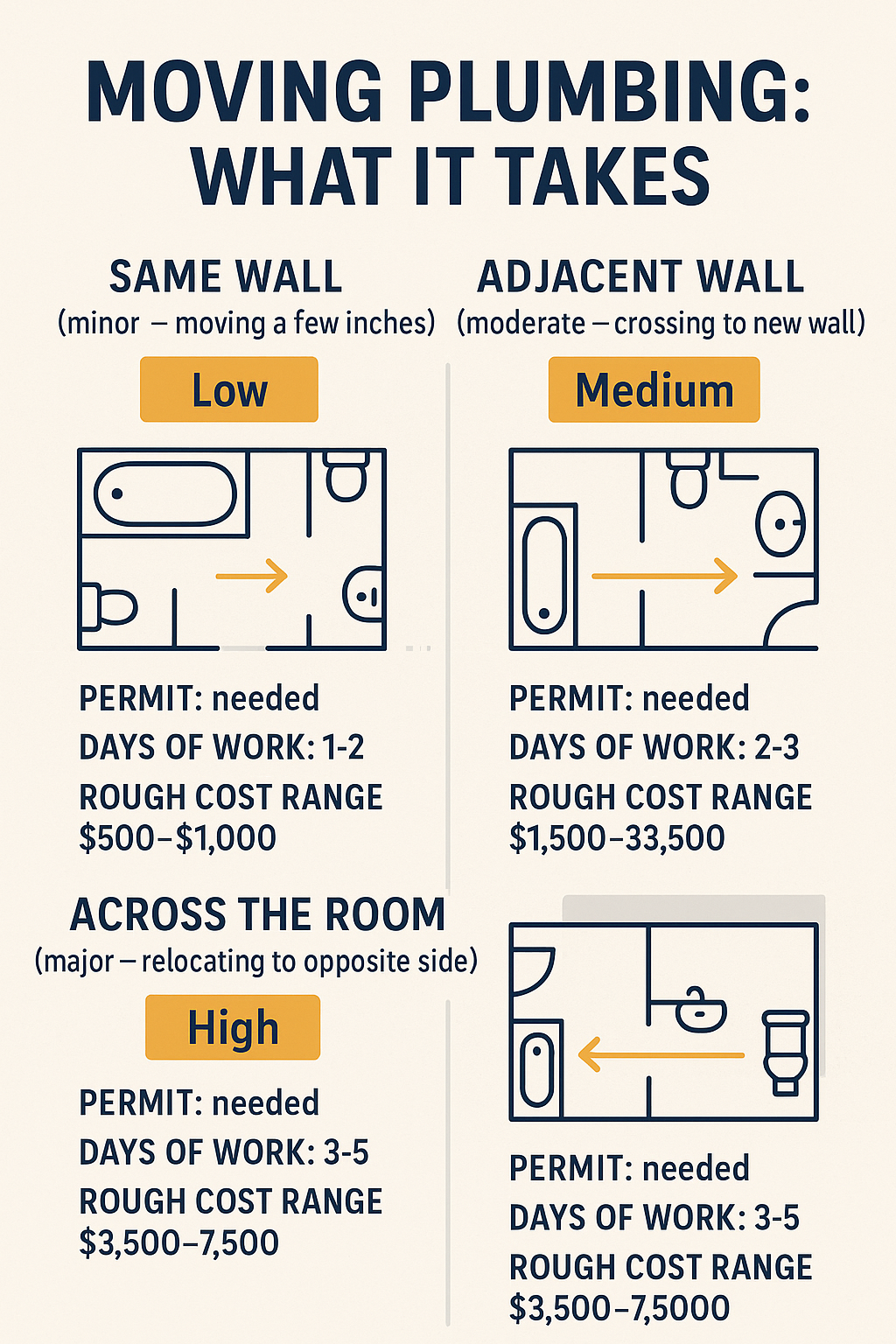
Typical cost: $800–$2,500 for a toilet relocation within the same bathroom, depending on distance, floor construction, and access.
Moving the Shower or Tub
Moving a shower involves relocating both the drain (typically 50 mm / 2 inch for a shower) and the supply rough-in for the valve. Because shower pans and bases are larger than a toilet footprint, the drain relocation involves more floor work.
On an upper floor, shower drain relocation requires either opening the ceiling below or working from above by removing flooring and subfloor. Both approaches add cost and restoration work beyond the bathroom itself.
Typical cost: $1,200–$3,500 for shower drain relocation, depending on access and distance.
Moving the Vanity/Sink
Moving a vanity is the simplest plumbing move. The supply lines are small (12 mm PEX or copper) and easy to extend. The drain is 38 mm (1.5 inch) and, for reasonable moves on the same wall, the existing drain stub can often be extended without opening the floor. The P-trap configuration is flexible.
Moving a vanity to a completely different wall requires more work on both supply and drain, and potentially a new vent connection.
Typical cost: $400–$1,200 for a vanity relocation, depending on distance and configuration.
When Moving Plumbing Makes Sense
Moving plumbing is worth the cost when the layout change delivers a meaningful functional improvement that cannot be achieved otherwise. Common justified cases:
- The toilet is immediately visible from the entry. Relocating the toilet to remove it from the primary sightline improves both aesthetics and privacy.
- The current shower position makes the bathroom feel cramped. Repositioning the shower to a corner or end wall can open floor space significantly.
- Adding a bathroom addition where all plumbing is being installed new. In this case, “moving” plumbing means routing new rough-in rather than relocating existing.
- Basement bathroom installation where the drain is below the main building drain level and an upflush system or pump is required.
Moving plumbing for purely cosmetic reasons — to achieve a slightly different fixture arrangement that could be addressed through design without moving — rarely delivers value commensurate with the cost.
The Basement Bathroom Challenge
Basement bathroom plumbing presents a unique challenge: the basement floor is typically below or close to the level of the main building drain, which means gravity drainage may not work without special measures.
Upflush toilets (macerating toilets): Grind waste and pump it upward to the main drain. Lower installation cost than breaking concrete. The pump requires maintenance and replacement over its lifespan (typically 10–15 years). A practical solution for a basement bathroom that will be used occasionally.
Breaking the slab: Breaking the concrete basement floor to install below-slab drain lines that connect to the main building drain. More expensive and disruptive, but results in a conventional gravity-drain bathroom with no pump to maintain. Appropriate for a basement bathroom that will see regular daily use.
Our team at Miracle Dream Homes handles the full scope of basement bathroom renovations, including the plumbing evaluation that determines which drainage approach is appropriate. For whole-bathroom renovation projects involving layout changes, our bathroom renovation page covers how we approach the design and planning phase.
For Ontario plumbing code requirements governing drain slope, venting, and fixture connections, Ontario Building Code Division B Part 7 is the authoritative reference. The Ontario College of Trades provides guidance on licensed plumber requirements.
Frequently Asked Questions
How much does it cost to move plumbing in a bathroom renovation?
Moving a toilet typically costs $800–$2,500. Moving a shower drain costs $1,200–$3,500. Moving a vanity costs $400–$1,200. These ranges reflect licensed plumber labour in Ottawa and the typical floor or wall access work required. Complex situations — long runs, concrete slab penetration, or ceiling access below — add cost.
Can I move plumbing without a permit?
No. Plumbing work that involves moving or adding drain lines, vent connections, or new fixture rough-in requires a plumbing permit and inspection by the City of Ottawa. Unpermitted plumbing work creates liability at resale and may void home insurance coverage for related water damage claims.
Does moving plumbing require opening the ceiling below?
For upper-floor bathrooms, drain line relocation often requires access from below, which means opening the ceiling of the room below. Some contractors can work from above by removing flooring and subfloor, but this adds its own restoration work. The access approach should be discussed with your contractor before scope is confirmed.
Is a macerating (upflush) toilet appropriate for a basement bathroom?
An upflush toilet is appropriate for a basement bathroom with occasional or guest use. For a primary bathroom used daily by multiple people, a conventional below-slab drain installation is the more reliable long-term choice. The pump in an upflush system requires periodic maintenance and eventual replacement — a factor in the long-term cost comparison.