
Vanity Lighting: How to Light a Bathroom Mirror Properly
The vanity mirror is where the most demanding visual tasks in the bathroom happen: applying makeup, shaving, checking hair, or examining the complexion. Every one of these tasks requires accurate, even light on the face. A single bar light mounted above the mirror — the default in most builder-grade bathrooms — fails at all of them.
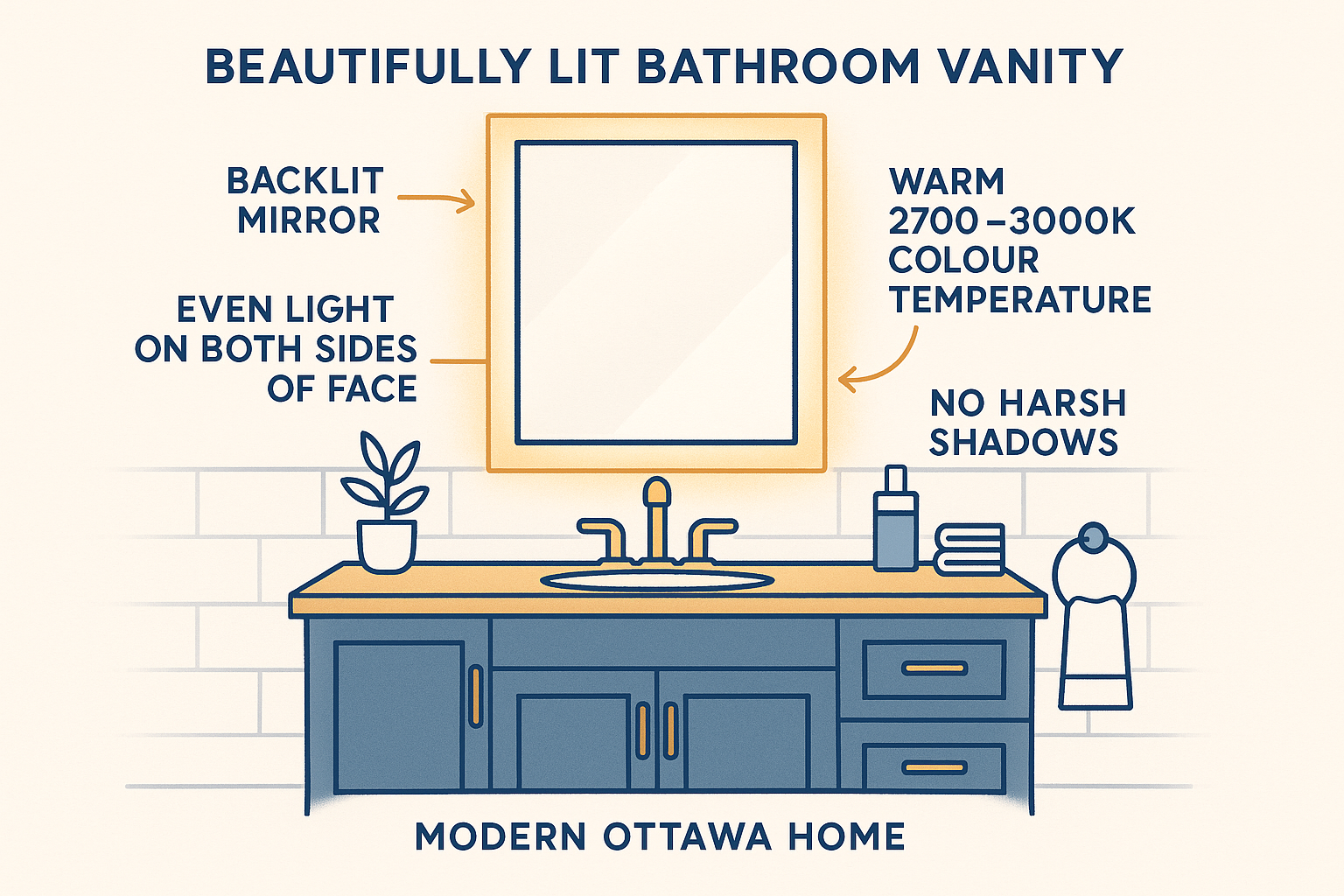
This guide covers how to position vanity lighting correctly, which fixture types produce the best results, and the technical specifications that make the difference between good and poor face illumination.
The Problem With Light Positioned Above
When light comes from directly above the mirror — whether a single fixture or a bar of three or four bulbs — it creates shadows that work against face visibility rather than for it.
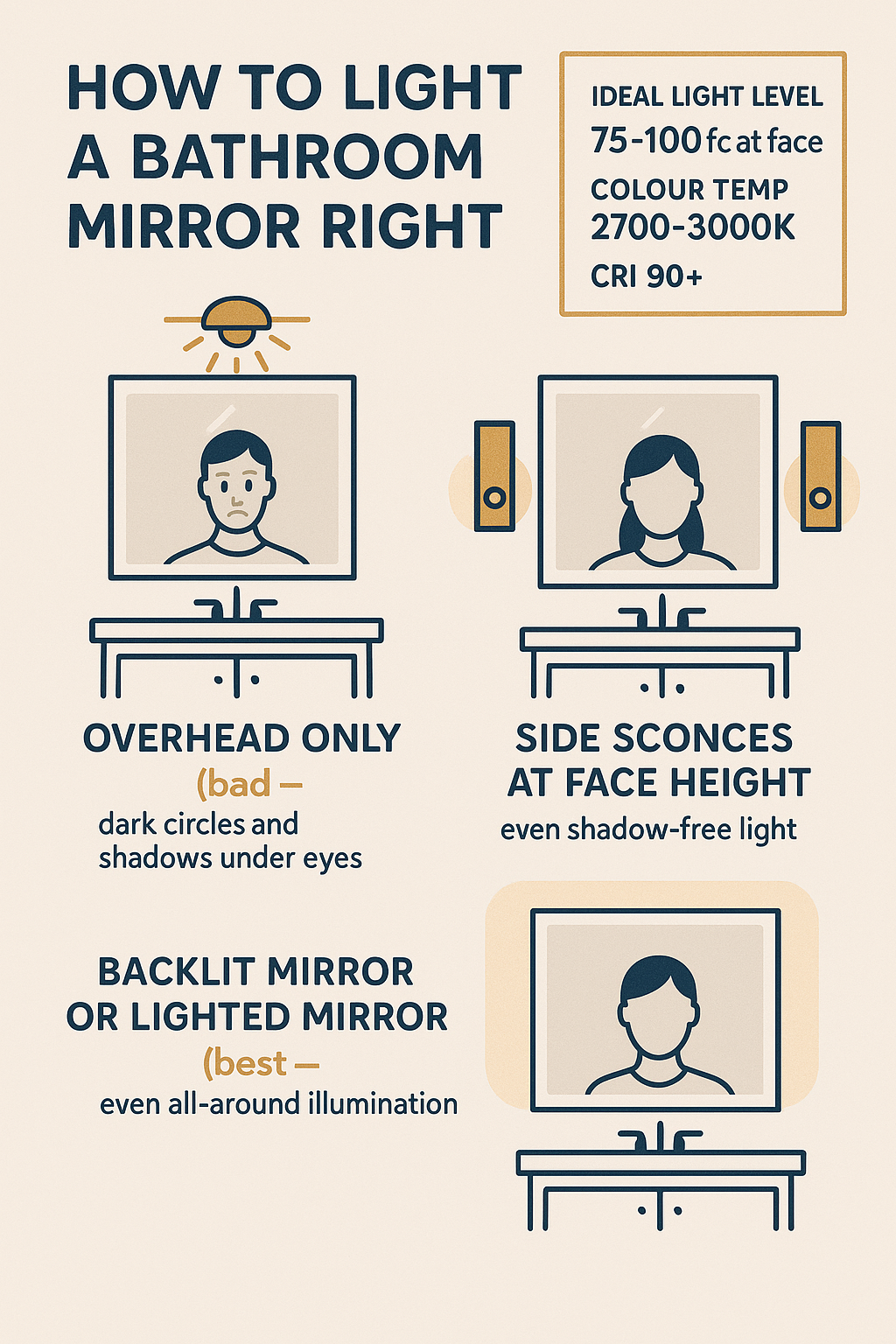
Downward light from above casts shadows into the eye sockets, under the nose, and beneath the chin. These are the same shadows that make a face look gaunt or theatrical in dramatic stage lighting. In a bathroom mirror, they make it harder to see what you are doing — shaving against the grain of a beard becomes guesswork, makeup application in shadow areas is unreliable, and any task requiring accurate colour assessment is compromised.
The solution has been known in professional makeup and film production for decades: light the face from the sides at eye level, not from above.
The Correct Position for Vanity Lighting
Side-mounted sconces at eye level. Two fixtures mounted on the wall flanking the mirror, at approximately 150–165 cm above the finished floor, produce even illumination across both sides of the face. The diffused light from each side fills the shadow created by the other, resulting in almost shadowless face illumination.
The exact height depends on the average user’s eye level. 150–155 cm suits users between 160–170 cm tall. 160–165 cm suits users between 170–180 cm. For households with significant height variation, 155–160 cm is a reasonable middle point.
Fixtures should be positioned:
– On either side of the mirror, ideally at the edge of the mirror or within 5–10 cm of it
– At the same height on both sides
– The diffuser or light source at approximately face height for the user — not the top of the fixture
When Side Sconces Are Not Possible
In bathrooms where wall space flanking the mirror is not available — often the case with a large mirror that spans the full width of the vanity — a bar light or Hollywood-style fixture across the top of the mirror is the practical alternative.
A bar light above the mirror is better than a single pot light above the mirror, because the distributed light source reduces the concentration of shadows. A Hollywood strip (multiple individual exposed bulbs across a bar, from 60 cm to 180 cm wide) provides the most even top-mounted illumination because the light sources span the full width of the mirror.
If only top-mounted lighting is possible: Position the fixture as close to the mirror’s top edge as the mounting allows, rather than several centimetres above. The closer to mirror height, the less severe the downward shadow angle.
Lighted Mirrors and Backlit Mirrors
A lighted mirror — a mirror with integrated LED strip lighting around the perimeter or behind the mirror face — provides a practical middle ground between top-mounted fixtures and full side sconces.
Backlit mirror: LED strips behind the mirror edge create a glow around the perimeter. This provides some facial illumination from the lower, side, and top edges simultaneously. It does not replace side sconces for accuracy but is significantly better than top-only lighting.
Front-lighted mirror (integrated strip on the face): LED strips on the front face of the mirror, typically at the top and sides, shine directly toward the user. This is closer in effect to side sconces when the side strips are present, and better than a single top fixture.
Lighted mirror prices range from $200 for basic backlit models to $1,500+ for premium front-lit options with dimmers, colour temperature adjustment, and integrated defogging.
Colour Temperature for Vanity Lighting
Colour temperature significantly affects how faces look in the mirror and how accurately colours are rendered.
- 2,700K (warm white): Flattering but slightly colour-shifted toward yellow. Not ideal for makeup application where accurate colour assessment is needed. Good for a relaxing bathroom ambiance.
- 3,000K (warm-neutral white): A practical balance. Renders skin tones warmly without significant colour distortion. Appropriate for most households.
- 3,500K (neutral white): Better colour accuracy for makeup application. The slight move toward cool tones is tolerable in most bathroom environments.
- 4,000K (neutral to cool white): Best for makeup and medical-accuracy tasks. Can feel harsh in a bathroom used for relaxation — consider putting this circuit on a dimmer.
For most households, 3,000K for vanity lighting is the right compromise between accuracy and comfort.
CRI: The Detail That Matters Most
CRI (Colour Rendering Index) measures how accurately a light source renders colours relative to natural daylight. A CRI of 100 is perfect colour rendering (daylight standard). Lower CRI shifts colours in ways that are not visible until you are under better light.
For vanity lighting:
– CRI 90+: The professional standard. Ensures that makeup, skin tones, and hair colour look in the mirror as they will look in daylight.
– CRI 80–89: Acceptable for general bathroom lighting, but noticeable colour shift in detailed tasks.
– CRI below 80: Clearly insufficient for a vanity application.
CRI is listed on the product specification sheet of any quality LED fixture. It is not visible on the fixture itself, and box labelling is not always consistent. Buy from suppliers who provide specification sheets, and confirm CRI before purchasing vanity fixtures.
Fixture Types for Vanity Lighting
Wall sconces: Available in hundreds of styles. Choose a sconce with a diffuser (not an exposed bulb) for even, soft light. The diffuser spreads the light source across a larger area, reducing hotspots and shadows.
Vertical bar lights: A rectangular or cylindrical fixture mounted vertically beside the mirror. These are purpose-designed for side-of-mirror installation and come in widths that suit 15–30 cm mounting spaces.
Bath bars (horizontal): Mounted above the mirror. Available in 2-light, 3-light, 4-light, and 6-light configurations. A 6-light bar across a wide mirror is significantly better than a 2-light bar because the light source is distributed.
Recessed adjustable downlights: Recessed pot lights aimed at the face from an angle above provide more targeted illumination than a standard overhead pot light, but still cannot match side-mounted fixtures for shadowless results.
For vanity lighting selection and installation as part of a full bathroom renovation in Ottawa, our team at Miracle Dream Homes handles fixture specification and placement. See our bathroom renovation page for more information on how we approach bathroom design. For powder room renovations where lighting has an outsized impact on a small space, visit our powder room renovation page.
For lighting design standards and CRI specifications, the Illuminating Engineering Society (IES) and Energy Star Canada provide authoritative guidance on residential lighting quality.
Frequently Asked Questions
What is the best position for vanity lighting?
Side-mounted sconces flanking the mirror at approximately 150–165 cm above the floor produce the most even, shadow-free face illumination. This positioning lights both sides of the face equally and avoids the downward shadow problem created by top-mounted fixtures.
What colour temperature should vanity lighting be?
3,000K (warm-neutral white) is the best balance between accuracy and comfort for most households. For dedicated makeup application, 3,500K provides slightly better colour rendering. Avoid anything above 4,000K for general bathroom use — it creates an uncomfortable, clinical quality.
What CRI should I look for in vanity lighting?
CRI 90 or above. At CRI 90+, the light source renders skin tones, makeup, and clothing colours as they appear under natural daylight. At CRI 80 and below, colour shift is noticeable in detailed tasks and only becomes apparent when you compare appearances under better light.
Are lighted mirrors a good alternative to separate vanity fixtures?
Yes, particularly models with front-mounted LED strips on both the top and sides of the mirror face. They provide distributed light that partially replicates side-sconce placement and are easier to install than separate sconces. They are an especially practical choice when wall space flanking the mirror is not available.