
Bathroom Electrical Requirements in Ontario: What the Code Requires
Bathroom electrical work in Ontario is regulated by the Ontario Electrical Safety Code (OESC) and enforced by the Electrical Safety Authority (ESA). The requirements exist because bathrooms are wet environments where water and electricity coexist — a combination that creates significant safety risk when electrical installations are not done correctly.
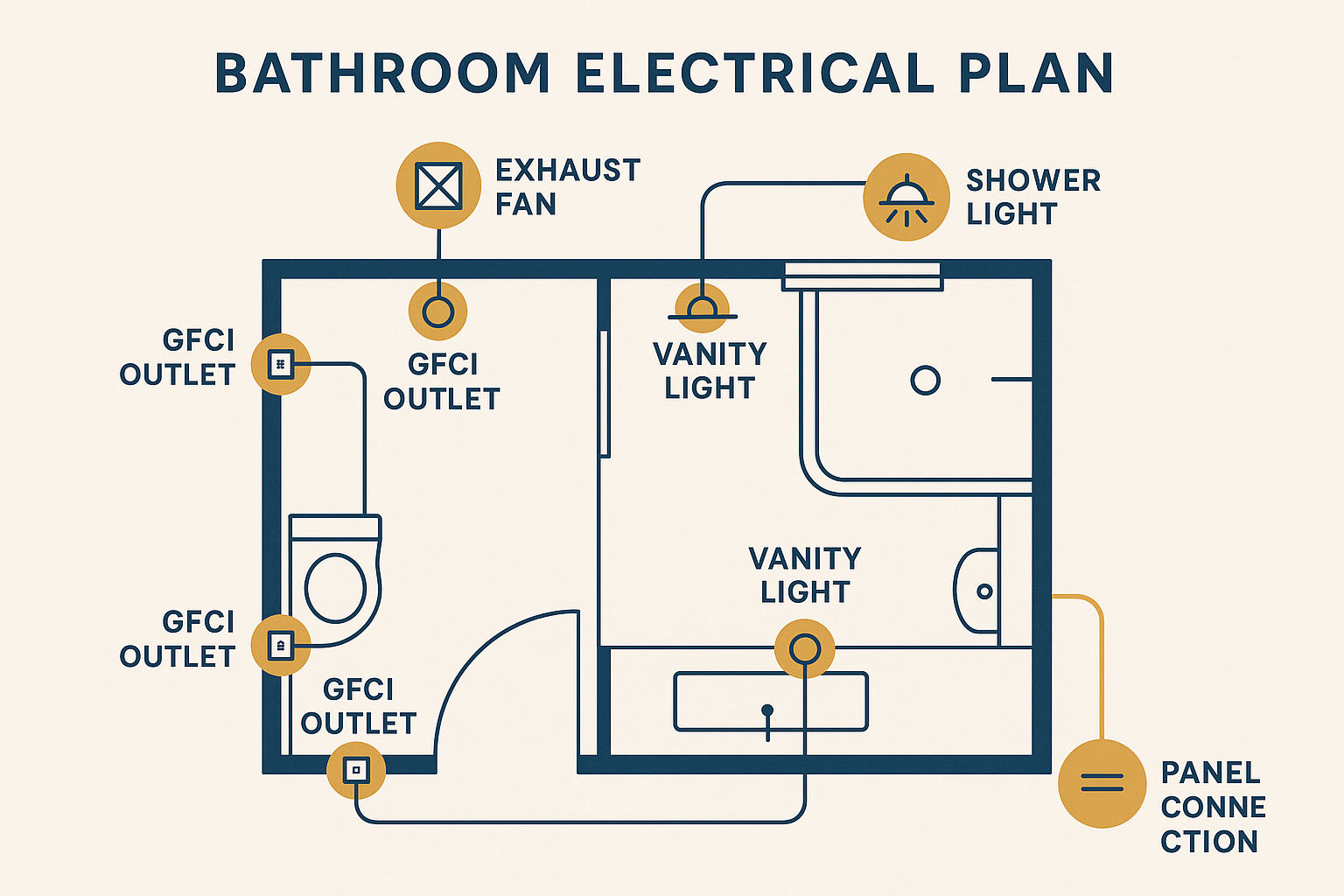
This guide covers the key electrical code requirements for Ontario bathrooms, what triggers an ESA permit, and what homeowners need to know before starting a renovation.
GFCI Protection: Where It Is Required
Ground Fault Circuit Interrupter (GFCI) protection is the most fundamental bathroom electrical requirement. A GFCI outlet or GFCI breaker monitors current flow and trips the circuit within milliseconds if it detects a ground fault — the condition that causes electrocution when electrical current takes an unintended path through a person.
The OESC requires GFCI protection for:
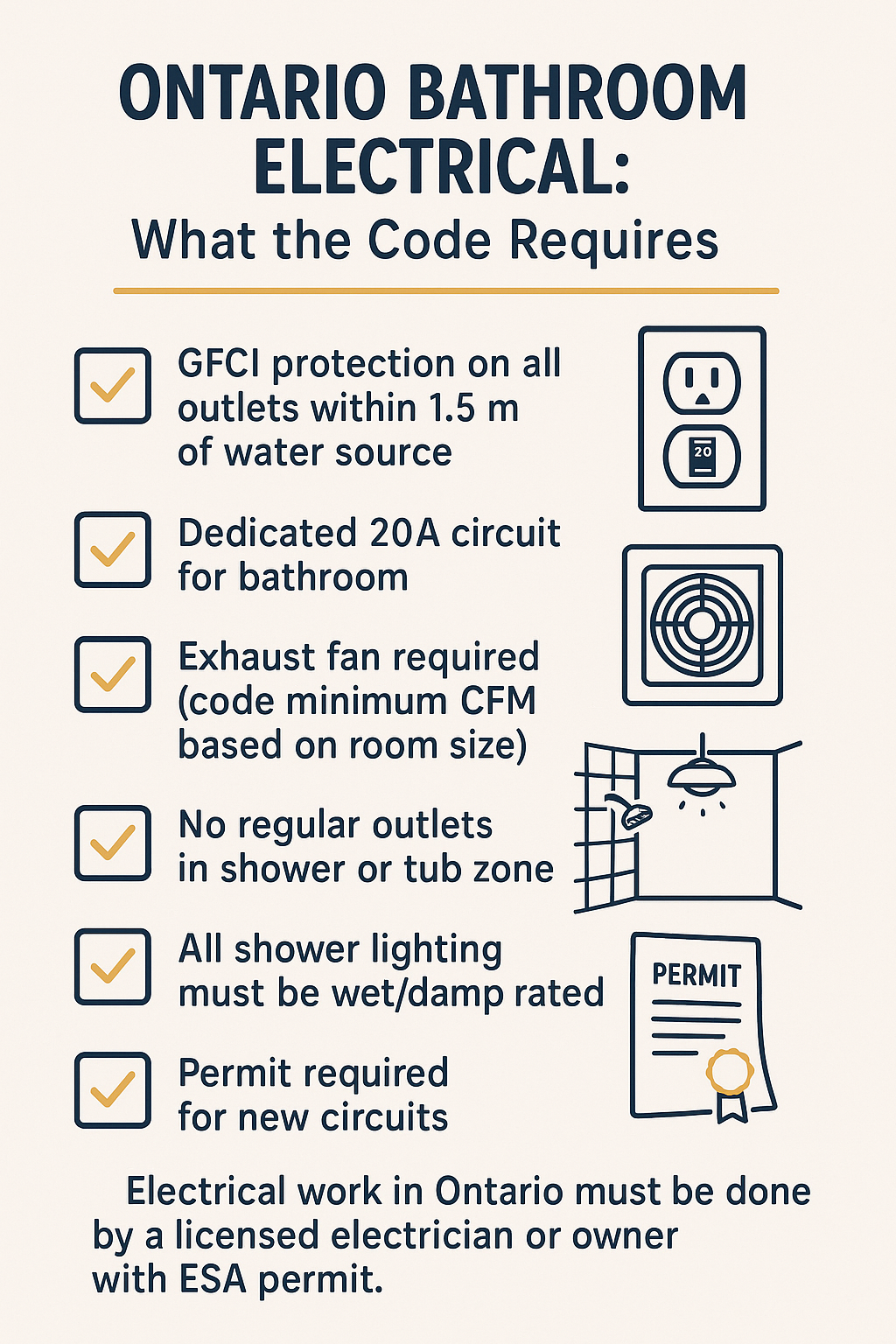
– All receptacles (outlets) within 1.5 metres of the bathtub or shower basin
– All receptacles in the bathroom, regardless of distance from water, under most interpretations of current editions
In practice, all bathroom receptacles in new installations or renovations should be GFCI-protected. This is accomplished either with a GFCI receptacle (the style with TEST and RESET buttons on the face) or with a GFCI circuit breaker at the panel that protects the entire circuit.
An older home that still has standard outlets in the bathroom (no GFCI) is not up to current code. Any electrical work in that bathroom during a renovation triggers the requirement to bring the outlet protection up to current standard.
Dedicated Circuits
The OESC requires that bathroom outlets be on a circuit dedicated to bathroom use — not shared with outlets or fixtures in other rooms. The purpose is to ensure that a load from another room does not trip the bathroom circuit and leave the bathroom without power.
In older homes, bathroom outlets are sometimes on circuits shared with hallway lighting or other rooms. A renovation that includes electrical work is an opportunity to correct this — and in many cases, the licensed electrician performing the renovation work will identify and correct this condition as part of bringing the electrical to code.
Outlet Placement Requirements
At least one GFCI-protected outlet is required adjacent to the bathroom vanity. The outlet must be readily accessible and within reach of the vanity for normal personal care appliance use (hair dryers, shavers, etc.).
Outlets are prohibited:
– Inside bathtub or shower enclosures
– Within reach of a person in the bathtub (within 1 metre horizontally from the tub edge at the same level, per OESC Section 26-712)
A shaving outlet installed inside a vanity mirror cabinet is permitted only if it is a special-purpose shaving outlet rated for the application.
Lighting Requirements in Wet Zones
The OESC divides bathrooms into zones based on proximity to water, similar to the international IEC 60364 standard:
Zone 0 (inside the bathtub or shower basin): Only 12V SELV (Safety Extra Low Voltage) equipment permitted. Standard 120V fixtures absolutely prohibited.
Zone 1 (above the tub/shower to 2.25 m height): Fixtures must be rated for wet locations (IP equivalent). Standard bathroom fixtures with no wet-location rating are not permitted in this zone.
Zone 2 (area adjacent to tub/shower): Fixtures must be suitable for damp locations at minimum.
Outside zones: Standard fixtures permitted.
In practice, this means:
– The recessed light in a shower must be a wet-rated recessed fixture
– A light fixture directly above a bathtub must be wet-rated
– Standard pot lights in the bathroom ceiling outside the wet zone are compliant
– A light fixture in or immediately over a shower stall requires a wet-rated, sealed fixture
Bathroom Exhaust Fan Requirements
The Ontario Building Code (OBC) requires mechanical ventilation in bathrooms without operable exterior windows. The OESC governs the electrical installation of exhaust fans.
An exhaust fan circuit may be:
– Combined with the bathroom lighting circuit
– On a dedicated circuit (required if a higher-capacity fan is installed)
The fan must vent to the exterior — not into the attic, wall cavity, or other enclosed space. This is an OBC requirement (not OESC), but it is consistently identified during renovation inspections.
Combined fan/light units must have the fan wired to operate independently from the light if the fan serves a ventilation purpose. Some older installations wired the fan and light on a single switch — the fan only runs when the light is on. This is not ideal (occupants who turn the light off immediately after a shower leave the fan off), but it is not a code violation.
ESA Permit Requirements
The following bathroom electrical work requires an ESA permit and inspection:
– New electrical circuit installation (new dedicated bathroom circuit)
– New outlet installation or relocation
– New light fixture circuit or new fixture on a new circuit
– New exhaust fan installation on a new circuit
– New heated floor installation
– Any panel work (new breaker, breaker upgrade)
The following typically does not require an ESA permit:
– Replacing an existing outlet with a GFCI outlet on the same existing circuit
– Replacing a light fixture like-for-like on the same circuit with no wiring changes
– Replacing an exhaust fan with a new fan of the same rating on the same circuit
When in doubt, contact the ESA directly or have a licensed electrician advise. Performing regulated work without a permit results in an ESA compliance notice and the requirement to have the work inspected or corrected.
For bathroom renovations in Ottawa that include electrical upgrades — GFCI installation, new lighting circuits, heated floors — our team at Miracle Dream Homes coordinates licensed electrician work as part of the full project. Learn more at our bathroom renovation page or our bathroom addition page.
For current Ontario electrical code requirements, the Electrical Safety Authority (ESA) provides homeowner guidance on permit requirements, and the Ontario Electrical Safety Code is available through the Ontario government publications portal.
Frequently Asked Questions
Do I need a permit to replace a bathroom outlet with a GFCI outlet?
Replacing a standard outlet with a GFCI outlet on an existing circuit in the same location generally does not require an ESA permit. However, if the replacement is part of a larger electrical scope (new circuits, new fixtures), the entire scope requires a permit. When in doubt, contact the ESA or have a licensed electrician advise.
What happens if my bathroom electrical is not up to code during a renovation?
If a licensed electrician identifies code deficiencies during a renovation (no GFCI, circuit shared with other rooms, improper wiring), they are typically required to bring those elements up to current code as part of completing the work. This may add cost beyond the original scope — budget for it as part of the renovation contingency.
Can I install my own bathroom electrical in Ontario?
Homeowners are permitted to perform electrical work on their own principal residence, but the work must be inspected and approved by the ESA. In practice, most bathroom electrical work during a renovation is performed by a licensed electrician as part of the renovation contract. DIY electrical in a bathroom wet zone carries the highest safety risk of any DIY electrical work.
How many outlets does a bathroom need?
The OESC requires at minimum one GFCI-protected outlet adjacent to the bathroom vanity. Most modern bathrooms have two outlets — one on each side of the vanity or mirror — which is more practical for simultaneous use by two people. Additional outlets (e.g., near the toilet for a bidet seat power supply) are permitted and do not require dedicated circuits.