
Bathroom Ventilation Basics: Why It Matters and What the Code Says
Bathroom ventilation is the least visible but most consequential long-term decision in a bathroom renovation. A bathroom without adequate mechanical ventilation produces chronic excess humidity that causes mould on grout and caulk within months, deteriorates painted surfaces over years, and can damage structural components over the course of a decade.
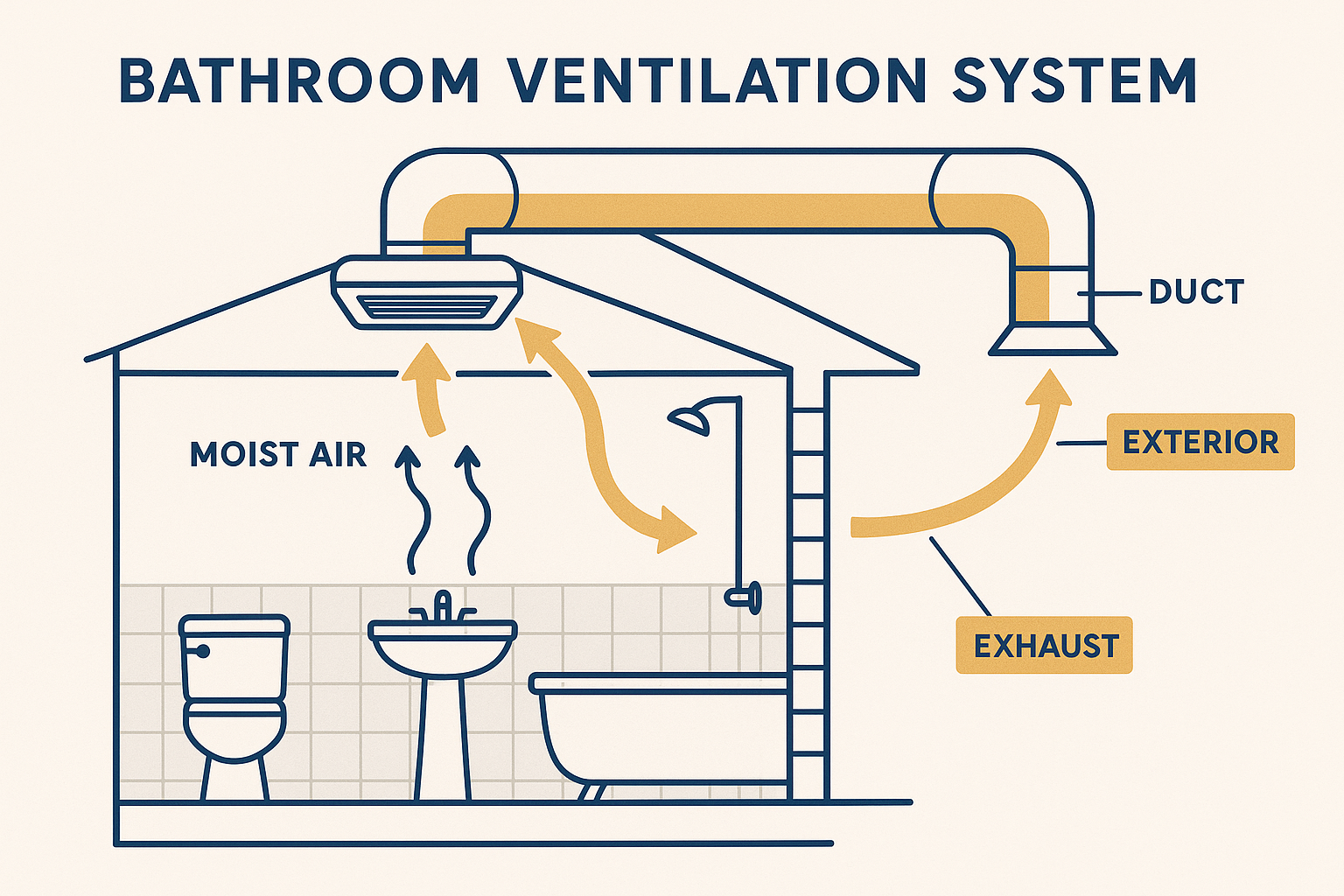
The cost of adequate ventilation — a quality exhaust fan properly installed and vented to the exterior — is modest relative to the rest of a bathroom renovation. The cost of the mould and moisture damage it prevents is not.
Why Bathroom Humidity Is a Problem
A standard shower generates approximately 2–4 grams of water vapour per minute. A 10-minute shower adds 20–40 grams of water vapour to bathroom air. In an unventilated bathroom, this humidity has nowhere to go — it condenses on cold surfaces (mirrors, tiles, windows, walls) and creates the conditions for mould and mildew growth.
Short-term effects of inadequate ventilation:
– Mould on grout lines and silicone caulk (visible within 3–6 months in poorly ventilated bathrooms)
– Foggy mirrors that take 30+ minutes to clear
– Musty odour in the bathroom
– Peeling paint on walls and ceiling
Long-term effects:
– Mould behind tile (in the wall cavity) from condensation penetrating grout and drywall seams
– Deterioration of drywall and insulation in the wall cavities
– Structural damage to framing in extreme cases
– Elevated humidity spreading to adjacent rooms
What the Ontario Building Code Requires
The Ontario Building Code (OBC) and the National Building Code of Canada require mechanical ventilation in all bathrooms that do not have an operable exterior window.
For bathrooms with no operable window:
– A mechanical exhaust system (fan) vented to the exterior is mandatory
For bathrooms with an operable window:
– Natural ventilation through the window is accepted as meeting the minimum requirement
– However, in an Ottawa winter, opening a window for ventilation after a shower is not practical — mechanical ventilation is the functional standard regardless of window presence
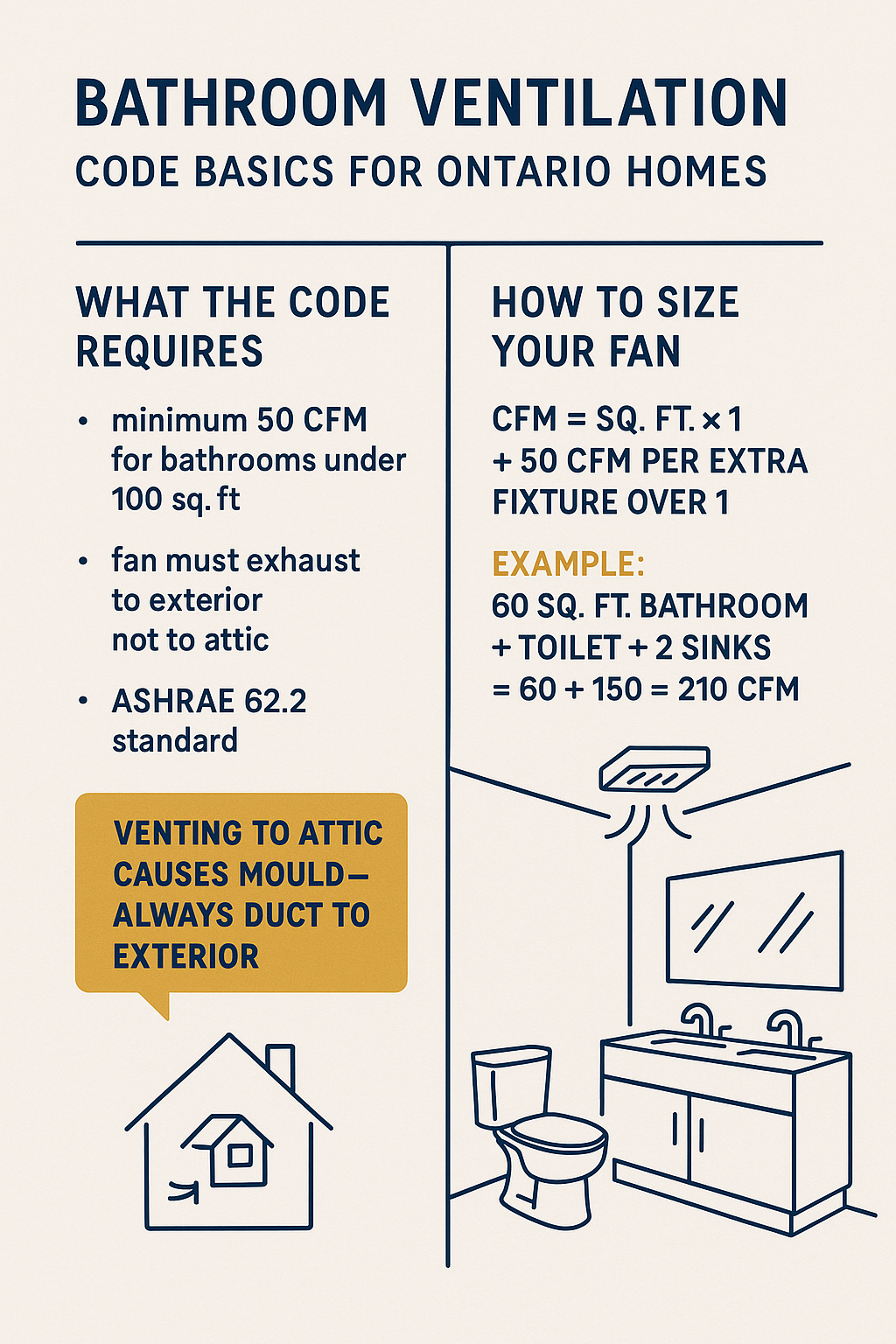
Minimum exhaust rate: The code specifies a minimum intermittent exhaust rate of 25 litres per second (approximately 50 CFM) for residential bathroom mechanical ventilation.
Duct termination: The exhaust duct must terminate to the exterior of the building — not into the attic, wall cavity, soffit, or any enclosed space. Venting into the attic is a common installation deficiency in older homes and a building code violation that causes significant attic moisture damage over time.
The CFM Calculation
CFM (Cubic Feet per Minute) is the standard measure of exhaust fan capacity. The general rule for residential bathrooms:
Minimum CFM = Bathroom square footage
A 50 square foot (4.6 m²) bathroom: 50 CFM minimum.
A 80 square foot (7.4 m²) bathroom: 80 CFM minimum.
A 100 square foot (9.3 m²) bathroom: 100 CFM minimum.
For bathrooms with a steam shower or a high-use household, increase by 25–50% above the room-size calculation.
Most residential exhaust fans are rated at 50–110 CFM. A quality fan sized appropriately for the bathroom space removes moisture effectively without being excessively noisy.
The Duct Path and Its Effect on Performance
Fan capacity ratings are measured under ideal conditions. Real-world performance depends significantly on the duct path:
Straight, short duct runs to the exterior preserve most of the fan’s rated capacity.
Long duct runs with bends reduce effective airflow. Each 90-degree elbow in the duct is equivalent to approximately 5 feet of straight duct in terms of resistance. A duct with multiple bends on a long run to the exterior significantly reduces the delivered CFM below the fan’s rated capacity.
Flex duct is common for bathroom exhaust installation because it is flexible and easy to route through tight spaces. However, flex duct that is kinked, compressed, or has excessive bends restricts airflow substantially. Smooth rigid metal duct (4-inch round for most residential applications) provides significantly better airflow than flex duct for the same length and number of bends.
The most common ventilation deficiency in Ottawa homes is not the fan itself but the duct path: a fan rated at 80 CFM connected to a long flex duct run with multiple bends terminating through a soffit may deliver only 30–40 CFM in actual operation.
Where Bathroom Fans Should Be Located
The exhaust fan should be positioned to capture moisture at its source — the shower or bathtub. Placing the fan over the toilet (a common builder default) rather than over the wet zone means steam has to travel the length of the room to reach the exhaust, and a significant fraction of the moisture condenses on surfaces before being exhausted.
Ideal location: Directly above or immediately adjacent to the shower or tub. This position captures steam at the source and minimizes the distance moisture must travel before exhaustion.
Secondary location: Centred in the bathroom ceiling, equidistant from the shower and toilet. An acceptable compromise when placing the fan over the wet zone is not practical.
How Long Should a Bathroom Fan Run?
A bathroom exhaust fan should run for at least 15–20 minutes after a shower to fully exhaust the accumulated moisture. A timer switch or humidity sensor switch is the most reliable way to ensure this happens:
Timer switch: Runs the fan for a preset interval after the switch is pressed. Available in 5, 10, 20, and 30-minute timer configurations.
Humidity sensor: Activates automatically when humidity exceeds a set threshold and runs until humidity returns to normal. More expensive than a timer switch but fully automatic — the fan runs as long as needed without user action.
For bathroom renovation projects in Ottawa that include fan replacement, our team at Miracle Dream Homes handles the full scope — fan selection, duct routing to the exterior, and electrical connection. See our bathroom renovation page and our basement bathroom renovation page for more information.
For Ontario Building Code ventilation requirements, the Ontario Building Code Act and CMHC’s ventilation guidelines are the authoritative references for residential mechanical ventilation requirements.
Frequently Asked Questions
Does my bathroom need an exhaust fan if it has a window?
Under the Ontario Building Code, a bathroom with an operable exterior window meets the minimum ventilation requirement without a mechanical exhaust fan. In practice, opening a window for 20 minutes after a winter shower in Ottawa is not realistic — a mechanical fan provides the consistent, weather-independent ventilation that actually protects the bathroom from moisture damage.
What CFM bathroom fan do I need?
A general rule: CFM should equal or exceed the bathroom’s square footage. A 50 sq ft bathroom needs a minimum 50 CFM fan. For a bathroom with a steam shower, high daily use, or limited duct efficiency due to long runs, increase the rating by 25–50% over the room-size calculation.
Can a bathroom exhaust fan vent into the attic?
No. Venting into the attic is a code violation and causes attic moisture damage that can lead to mould, insulation deterioration, and structural damage. The duct must terminate through a proper roof or wall vent to the exterior. This is a common deficiency in older homes that is easy to correct during a bathroom renovation.
How often should a bathroom exhaust fan be replaced?
Quality bathroom exhaust fans have a lifespan of 10–15 years with regular cleaning. Fans that run loudly, vibrate, or deliver noticeably less airflow than when new should be replaced. Most bathroom renovations include fan replacement as a standard scope item — the new installation is connected properly to the exterior, which resolves any duct deficiency in the previous installation.