
Aging-in-Place Bathroom Design: A Complete Guide for Ottawa Homeowners
The bathroom is the highest-risk room in the home for falls. Falls in the bathroom account for a significant proportion of home injury incidents — particularly for adults over 65 — and they are one of the primary reasons seniors lose independence and require care transitions. A bathroom designed for aging-in-place directly addresses this risk while preserving the dignity and independence of the person using the space.
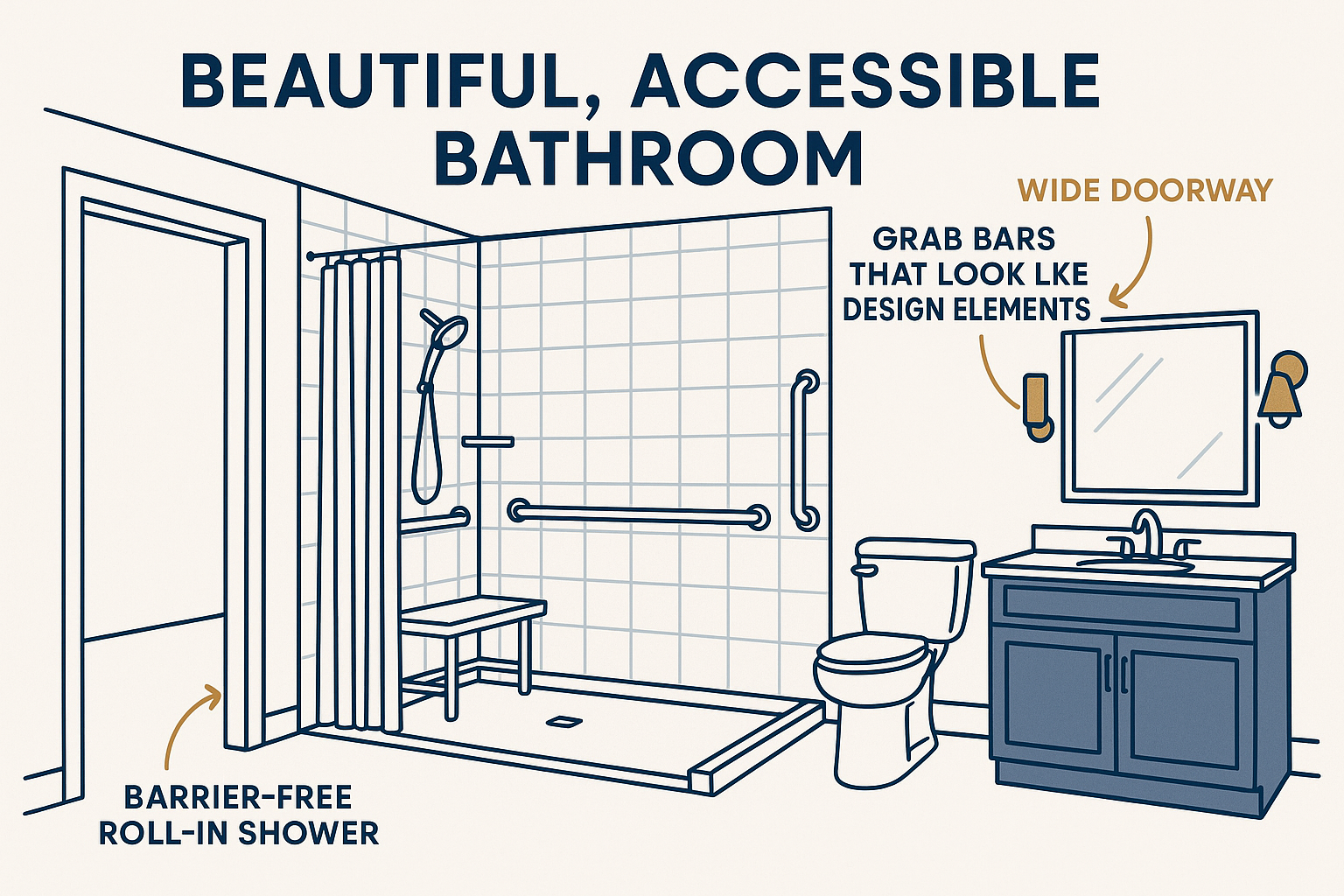
Aging-in-place bathroom design does not mean creating a clinical, institutional space. Modern accessible bathrooms use the same quality materials and finishes as any premium renovation. The difference is in the planning decisions — fixture placement, clearances, grab bar blocking, shower entry design, and floor surface selection — that allow the bathroom to be used safely across decades of changing physical capability.
This guide covers the key design features for an aging-in-place bathroom, with a focus on what Ottawa homeowners should plan for during a bathroom renovation.
Why Plan Now
The best time to incorporate aging-in-place features is during a bathroom renovation — not after a fall or health event that forces a rushed retrofit.
During a renovation, adding grab bar blocking (reinforced wall structure that supports bar installation later), a curbless shower threshold, or a comfort-height toilet adds minimal cost to the overall project. Retrofitting these features after the walls are tiled and the layout is set is significantly more expensive and disruptive.
A 55-year-old homeowner renovating a bathroom can design for the next 30 years at minimal incremental cost. The same features benefit any household member with temporary injury, illness, or mobility limitation — the accessible design serves the whole household, not only the aging member.
The Core Features
Curbless or Low-Threshold Shower Entry
A standard shower with a 100–150 mm curb at the entry is a trip hazard for anyone with limited leg lift or balance. A curbless shower — where the floor is continuous from the bathroom floor to the shower floor, with a linear drain at the threshold or within the shower — eliminates this barrier entirely.
A curbless entry also accommodates a shower chair or shower wheelchair in the future, if needed, without any modification to the bathroom.
Installing a curbless shower requires proper floor slope to the drain (typically 2% gradient across the shower floor) and a drain system designed for the water volume. This is a decision made during rough-in, not after tile installation.
For homeowners converting a tub to a walk-in shower as part of aging-in-place planning, a tub-to-shower conversion is the most common aging-in-place renovation — replacing a tub that requires stepping over a high rim with a curbless walk-in shower.
Grab Bars
Grab bars are the most cost-effective safety feature in an accessible bathroom. Properly anchored grab bars beside the toilet and in the shower provide support during the moments of highest fall risk — transitions between standing and seated, and when wet surfaces create instability.
Shower grab bar placement:
– Horizontal bar at 33–36 inches (840–915 mm) from the floor, on the wall adjacent to the entry side
– A second horizontal or angled bar on the shower back wall at the same height
– A vertical bar at 54–66 inches (1,370–1,680 mm) provides support when entering and exiting
Toilet grab bar placement:
– Side wall grab bar at 33–36 inches (840–915 mm) from the floor, extending 24 inches (610 mm) along the wall from the front of the toilet
– Rear grab bar (if space allows) at 33–36 inches height behind the toilet
Blocking: Grab bars must be anchored into wall framing or into blocking panels installed in the wall. Drywall anchors are not adequate — a grab bar supporting a falling person applies significant force. The standard solution in aging-in-place renovation is to install reinforced wall blocking during renovation (when walls are open) so bars can be installed at any point in the future without opening walls again.
Comfort-Height Toilet
A comfort-height toilet (also called ADA height or chair height) sits 430–480 mm (17–19 inches) from floor to seat — significantly higher than a standard toilet at 380 mm. The higher seat reduces the effort of sitting and rising, and accommodates most adults more comfortably regardless of age.
Comfort-height toilets are available in every style and price range. Specifying comfort height during a bathroom renovation adds no cost over a standard-height selection.
Walk-In Shower with Bench
A built-in bench in the shower — either a fold-down bench or a fixed bench — allows the user to shower seated. This feature accommodates temporary post-surgery recovery as well as long-term mobility limitation.
A shower seat does not need to look clinical. A tile bench built into the shower wall, at 430–480 mm seat height and at least 450 mm deep, provides a comfortable and visually integrated seating surface. A fold-down bench is space-efficient in smaller showers.
Slip-Resistant Flooring
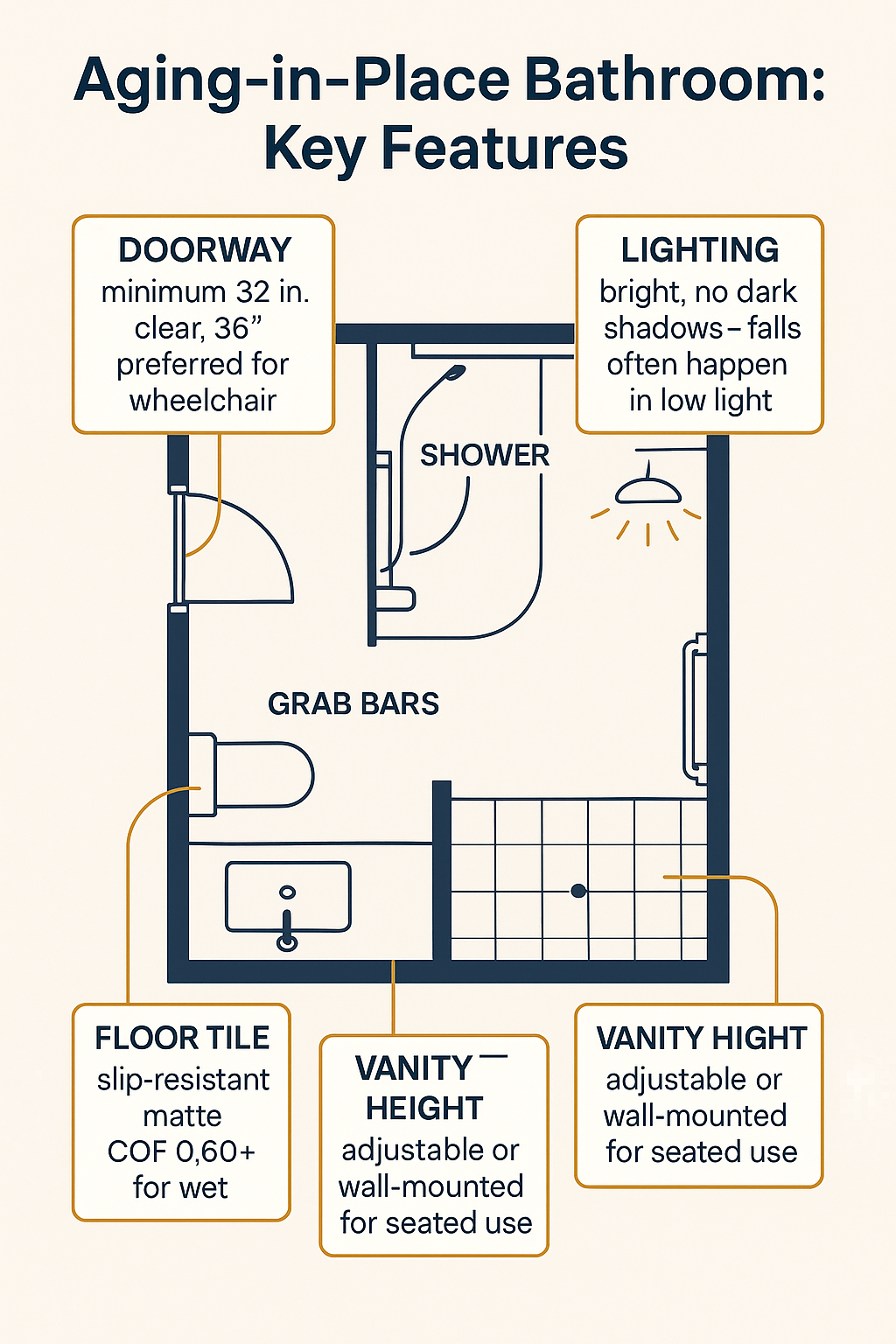
All bathroom floors should be slip-resistant, but the standard is particularly important in aging-in-place design. Tiles rated for wet areas (DCOF above 0.42) and textured surfaces reduce the risk of slipping on wet floors.
Mosaic tile provides more grout-line texture than large-format tile. Matte porcelain provides more traction than polished surfaces. A bath mat on the floor outside the shower provides additional friction at the exit point.
Adequate Clearance
Ontario Building Code minimum clearances are not always sufficient for mobility aid access. Aging-in-place design targets:
- 900 mm clear beside the toilet (for side transfer from wheelchair or walker)
- 1,500 mm clear floor space adjacent to the shower entry (turning radius for a walker or wheelchair)
- Minimum 800 mm clear door width (ideally 900 mm) for wheelchair access
- Outward-swinging or sliding bathroom door (an inward-swinging door blocked by a fallen occupant creates an entrapment risk)
These clearances may require adjusting the bathroom layout — moving the vanity, changing the toilet position, or enlarging the bathroom footprint. Planning for this during a renovation is far less expensive than reconfiguring after the fact.
Accessible Vanity Height
A standard vanity height of 850–900 mm suits standing use but is too high for seated use from a wheelchair. If seated vanity access is a current or anticipated need, a vanity height of 680–720 mm with knee clearance below the counter provides seated access.
A variable-height wall-hung vanity — adjustable at installation — allows the height to be set for the household’s current needs and adjusted later.
Cost Expectations
The incremental cost of aging-in-place features in a bathroom renovation is modest:
- Curbless shower entry: $0–$500 incremental (part of standard shower design if specified from the start)
- Grab bar blocking: $200–$500 for reinforced blocking behind all anticipated bar locations
- Comfort-height toilet: $0–$100 incremental over standard height selection
- Wider doorway: $500–$1,500 if the rough opening needs widening
- Grab bars themselves: $100–$400 per bar installed
The total incremental cost for a full aging-in-place feature set in a bathroom renovation is typically $1,000–$3,000 — a small addition to a $15,000–$30,000 renovation scope.
For aging-in-place bathroom renovations in Ottawa, our team at Miracle Dream Homes integrates accessibility features into standard renovation planning. We advise on which features add the most value for each household’s specific circumstances.
For Canadian accessibility standards, CSA Group B651 (Accessible Design for the Built Environment) and the Rick Hansen Foundation Accessibility Certification provide the residential accessibility standards used in Canadian renovation practice.
Frequently Asked Questions
What is the most important aging-in-place feature in a bathroom?
Grab bars and a curbless shower entry are the two highest-impact aging-in-place features. Grab bars provide immediate fall prevention support during the moments of highest risk — transitions between standing and seated on the toilet, and entering and exiting a wet shower. A curbless shower eliminates the trip hazard of a curb. Both features are inexpensive to incorporate during renovation and expensive to retrofit afterward.
Do aging-in-place bathrooms look clinical or institutional?
No. Modern aging-in-place design uses the same quality tile, fixtures, and finishes as any premium bathroom renovation. Grab bars in brushed nickel, matte black, or brushed gold match contemporary hardware finishes. A curbless shower entry is a contemporary design standard, not an accessibility concession. A comfort-height toilet is visually identical to a standard toilet. The accessible features are functional, not visible as medical equipment.
Does adding aging-in-place features hurt a home’s resale value?
Generally, no — and for Ottawa homes with buyers in the 50+ demographic, aging-in-place features are often viewed positively. A curbless shower, grab bars, and a comfort-height toilet suit anyone’s daily use regardless of age or mobility. They do not signal disability; they signal thoughtful design. In Ottawa’s aging population, accessible bathrooms are increasingly standard rather than exceptional.
Is the Home Accessibility Tax Credit available for bathroom renovations in Ottawa?
Yes. The Government of Canada’s Home Accessibility Tax Credit (HATC) provides a 15% non-refundable tax credit on eligible renovation expenses up to $20,000 per year ($10,000 prior to 2023) for qualifying individuals — those eligible for the Disability Tax Credit or individuals 65 and older. Eligible expenses include the cost of accessibility modifications such as grab bars, walk-in showers, wider doorways, and accessible fixtures. Consult Canada Revenue Agency guidance or a tax advisor for current eligibility details and expense documentation requirements.