
Shower Valve Types: Pressure Balance vs. Thermostatic
The shower valve is the control centre of your shower. It regulates water temperature, flow, and in more sophisticated configurations, distributes water across multiple outlets. Most homeowners pay less attention to the valve than to the shower head, handle, or trim, yet the valve has more impact on daily shower experience and safety than any visible component.
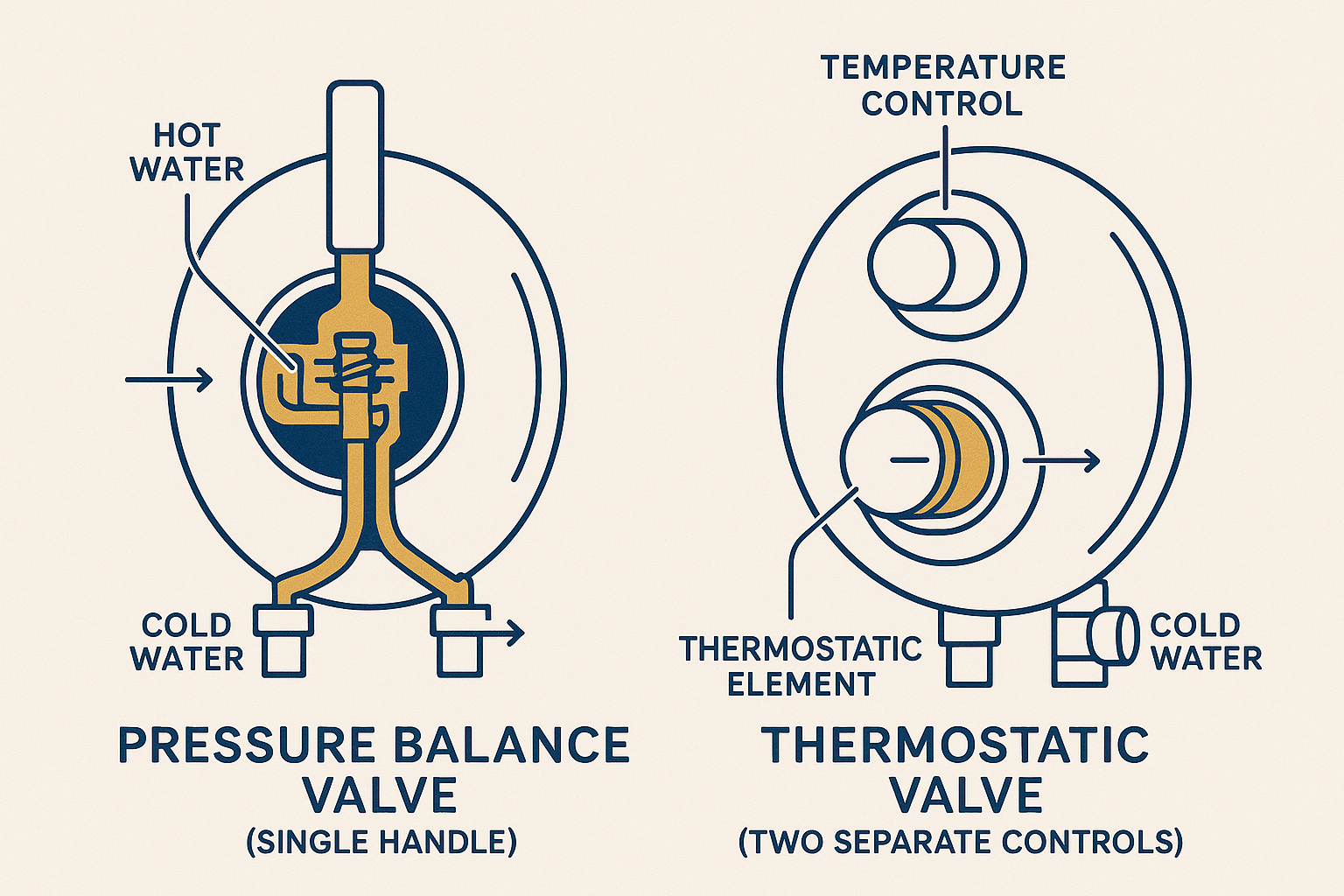
There are two fundamentally different valve types used in residential shower installation: pressure-balance valves and thermostatic valves. Understanding the difference helps you choose correctly — and helps you understand what is included (or not) in a renovation quote.
The Temperature Problem Valves Solve
In a residential plumbing system, water pressure can fluctuate when multiple fixtures are used simultaneously. Flushing a toilet while someone is showering drops cold water pressure momentarily, causing the shower to run hotter until the pressure equalizes. This temperature spike — the sudden hot blast when someone flushes — is a comfort issue in most cases and a burn hazard for children and seniors.
Both pressure-balance and thermostatic valves address this problem, but in different ways and with different levels of control.
Pressure-Balance Valves
A pressure-balance valve maintains a constant ratio between hot and cold water supply pressure. When cold pressure drops (toilet flush), it simultaneously restricts the hot supply to maintain the same ratio, keeping the outlet temperature stable.
How it works: A spool or disc mechanism inside the valve continuously balances the inlet pressures. The user sets a temperature by turning the handle (which changes the hot/cold mix ratio), and the valve holds that ratio constant regardless of pressure fluctuations elsewhere in the supply system.
What a pressure-balance valve provides:
– Protection against sudden temperature spikes
– Simple, single-handle operation
– One control manages both temperature and flow
– Reliable and low-maintenance
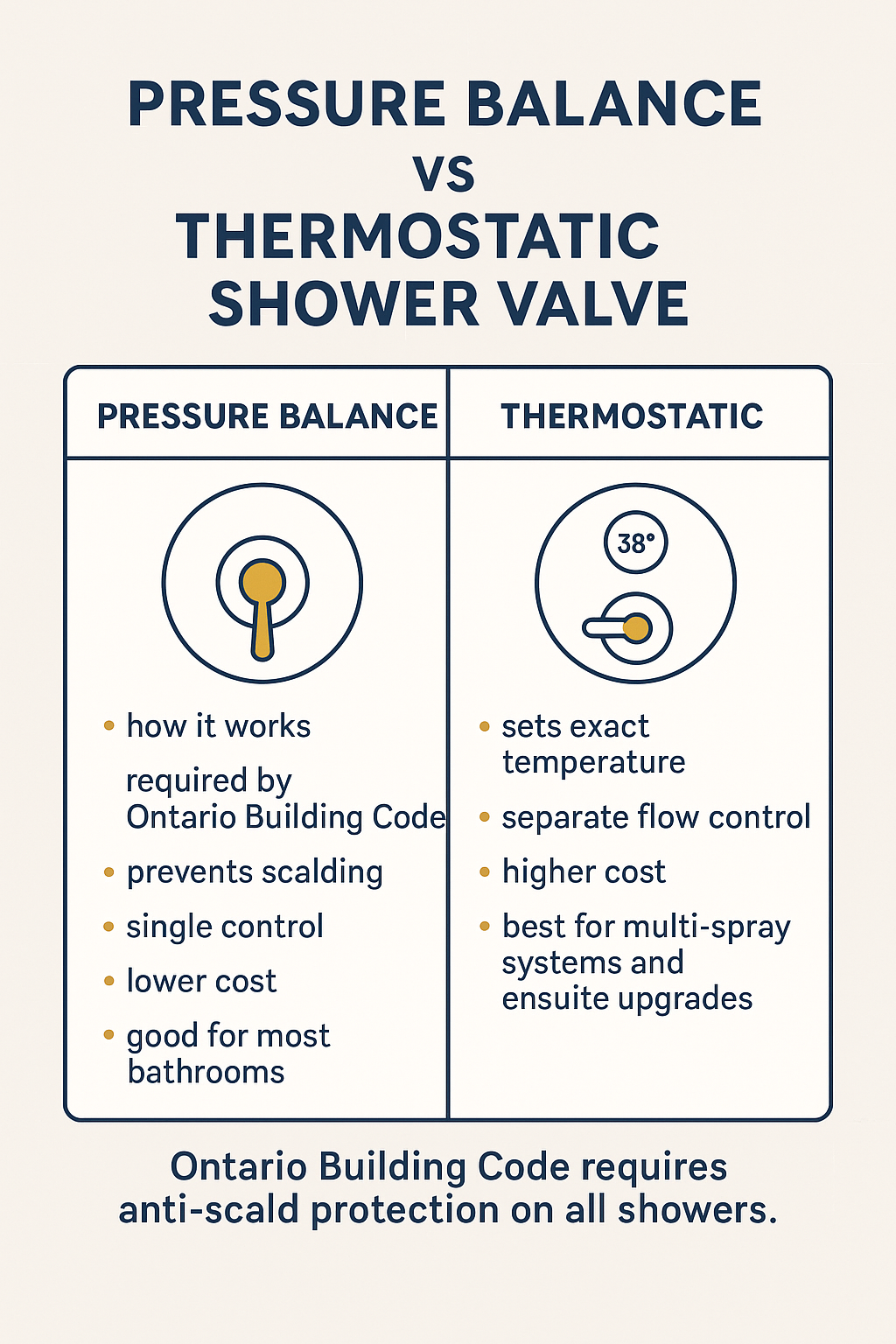
– Required by building code in Canada for new shower installations (ANSI/CSA B125.1)
What it does not provide:
– True temperature accuracy (it maintains a pressure ratio, not a fixed temperature)
– If both hot and cold pressure drop equally, the ratio stays constant but temperature can still shift
– Separate volume and temperature control
– Ability to operate multiple outlets independently
Pressure-balance valves are the standard in the vast majority of Canadian residential showers. A quality pressure-balance valve from Moen, Delta, or Kohler costs $150–$400 for the valve body, plus trim kit.
Thermostatic Valves
A thermostatic valve uses a wax element or bimetal coil that responds to water temperature directly. It automatically adjusts the hot/cold mix to maintain the set temperature regardless of pressure or temperature fluctuations in the supply system.
How it works: The thermostatic element expands when hot and contracts when cold, physically adjusting the valve opening to maintain a constant outlet temperature. If the hot water supply temperature changes (water heater fluctuation, cold inlet temperature change), the valve compensates.
What a thermostatic valve provides:
– True temperature control: the valve holds a set temperature accurately (typically within ±1°C)
– Separate volume and temperature controls — often a dedicated volume valve and temperature valve
– Ability to operate multiple outlets (body sprays, rain head, handheld) independently or simultaneously
– Pre-set scald protection temperature (thermostatic valves have a maximum temperature limiter)
– Immediate hot water — on re-entry after a brief pause, the preset temperature is maintained
What it does not fully solve:
– If the hot water supply runs out (large household, small water heater), the thermostatic valve cannot produce hot water it does not have
Thermostatic valves are used in premium shower configurations: multiple shower heads, rain head plus handheld plus body jets, or any shower where precise temperature control and simultaneous multi-outlet operation is desired.
A quality thermostatic valve body costs $400–$1,200 for the valve, plus additional volume controls at $150–$400 each, plus trim.
Valve Bodies and Trim Kits
Both valve types use a “rough” valve body that is installed in the wall during rough-in and covered with a finished trim kit after tile installation. The rough valve body and the trim kit are typically sold separately and must be compatible with each other.
This matters because: The valve body is permanent — it is set in the wall behind the tile and cannot be replaced without opening the wall. The trim kit (handle, cover plate, diverter) can be replaced without opening the wall and is available in various finishes to match other bathroom hardware.
When selecting a shower valve, choose the valve body with confidence in the manufacturer’s long-term availability. Major manufacturers (Moen, Grohe, Hansgrohe, Kohler, Delta) maintain compatible trim availability for at least 10–15 years after valve body production. Smaller or imported brands may not.
Code Requirements in Ontario
Ontario’s plumbing code (as part of the National Plumbing Code of Canada) requires anti-scald protection on all new shower installations. This is satisfied by a pressure-balance valve (which limits temperature spike) or a thermostatic valve with a scald-protection limiter. The 2015 and later editions of the code explicitly require that shower controls limit maximum mixed water temperature to 49°C in residential applications.
Any shower renovation that involves valve replacement must meet this requirement. A pressure-balance valve complies as designed. A thermostatic valve must be set with the maximum temperature limiter at 49°C.
For shower renovation including valve replacement as part of a tub-to-shower conversion or full bathroom renovation in Ottawa, our team specifies the appropriate valve type for each project scope and handles rough-in to trim installation.
For detailed technical specifications on pressure balance and thermostatic valves, manufacturer resources from Moen, Kohler, and Grohe provide product-specific installation guides and code compliance information.
Frequently Asked Questions
What is a pressure-balance shower valve and why is it required?
A pressure-balance valve maintains a constant ratio of hot and cold water pressure in the shower supply, preventing sudden temperature spikes when pressure changes elsewhere in the system (e.g., when a toilet is flushed). It is required by Canadian building code in all new shower installations as anti-scald protection.
When is a thermostatic valve worth the extra cost?
A thermostatic valve is worth the investment in a primary ensuite shower with multiple outlets — rain head, body sprays, and a handheld — where simultaneous operation and precise temperature control are desired. It is also appropriate for households with young children or seniors who benefit from a locked maximum temperature setting. For a standard single-outlet shower, a quality pressure-balance valve performs well.
What is the difference between the valve body and the trim kit?
The valve body is the internal mechanical component installed in the wall during rough-in — it contains the pressure-balance or thermostatic mechanism and is permanent once the wall is tiled. The trim kit is the visible external component: the handle, escutcheon plate, and diverter. Trim kits are available in multiple finishes and can be replaced without opening the wall.
Can a shower have two shower heads with a pressure-balance valve?
A pressure-balance valve can feed two shower heads through a diverter — but a diverter allows only one outlet at a time. To run two outlets simultaneously (rain head and handheld at the same time), a thermostatic valve system with two volume controls is required.