
Grout Types for Bathroom Tile: Which One Lasts Longest
Grout is one of the least glamorous decisions in a bathroom renovation, and one of the most consequential. The right grout for a shower floor is different from the right grout for a bathroom floor, and different again from the right choice for a kitchen backsplash. Using the wrong type — or installing the right type incorrectly — leads to cracking, staining, mould, and eventual tile failure.
This guide covers the main grout types used in bathrooms, their performance differences, and when to use each.
What Grout Does
Grout fills the joints between tiles. It prevents water, debris, and microorganisms from getting behind the tile assembly, accommodates minor movement between tiles, and — from a design standpoint — defines the visual character of the tile layout.
A grout failure is not just aesthetic. Cracked or deteriorated grout in a shower allows water to penetrate behind the tile, saturate the substrate, and cause mould and structural damage over time. Grout integrity is a waterproofing element in a shower, not just a finishing detail.
The Three Main Grout Types
1. Cement-Based Grout
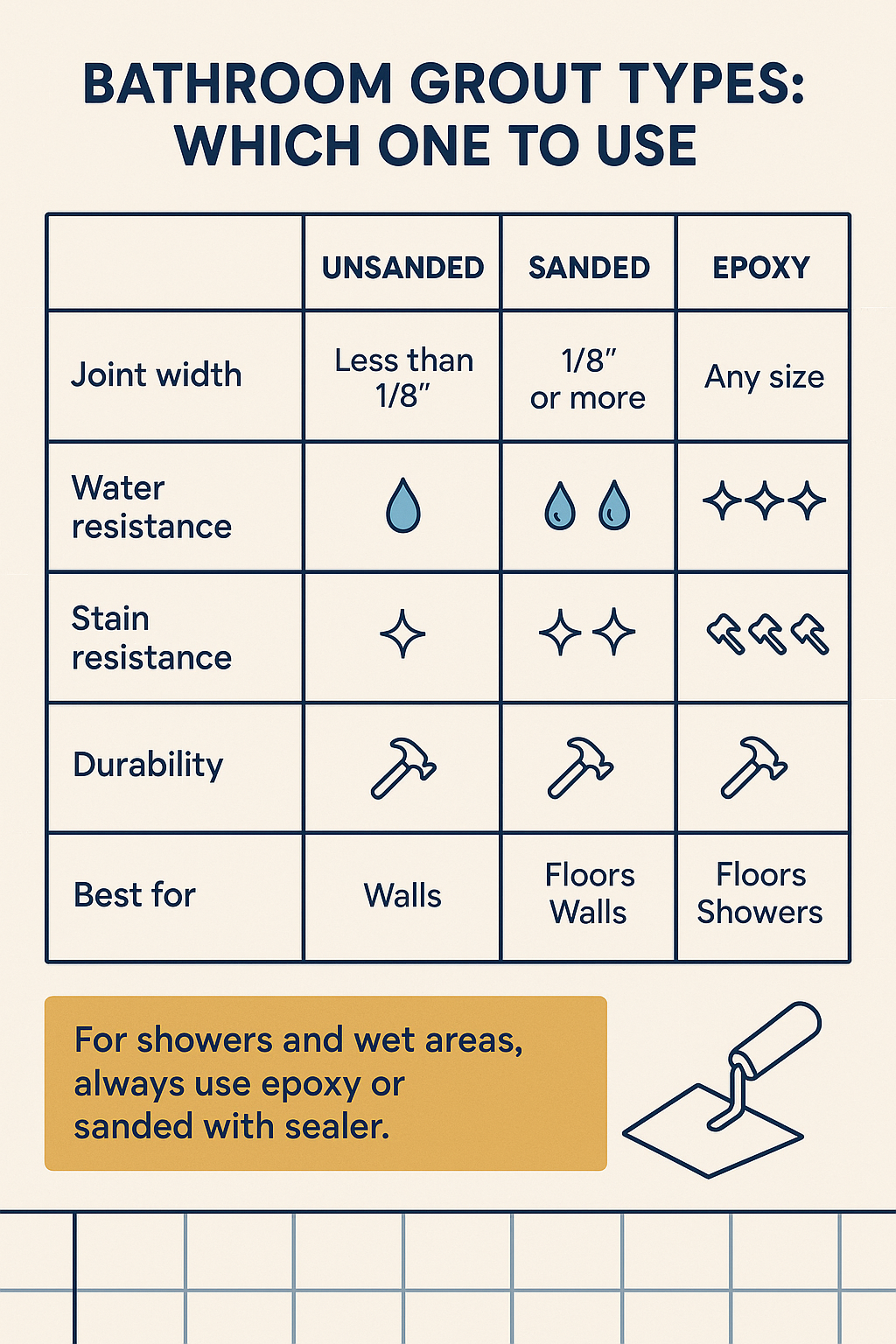
Cement grout is the most widely used grout type in residential tile installation. It is made from Portland cement, sand, and additives. It comes in two sub-types:
Sanded cement grout: Contains fine sand aggregate. Used for joints wider than approximately 3 mm. The sand adds structural stability in wider joints and prevents cracking. Used for most floor tile applications and any wall tile with grout joints above 3 mm.
Unsanded (non-sanded) cement grout: No sand aggregate. Used for narrow joints of 1–3 mm — typically with rectified tile installed with tight joints. Also used on polished stone or glass tile where the sand in standard grout could scratch the tile surface.
Performance:
– Porous — absorbs water, stains, and soap residue unless sealed
– Should be sealed after installation and re-sealed annually in high-use bathrooms
– Susceptible to cracking over time, particularly in areas with subfloor movement
– Stains with coloured substances (coffee, red wine, iron in water)
– Available in a wide range of colours
– Cost: $0.20–$0.50 per linear metre of joint (material only)
Best for:
– Bathroom floors outside the shower (with sealing)
– Wall tile applications above the direct wet zone
– Any application where the homeowner is prepared for annual sealing
2. Epoxy Grout
Epoxy grout is a two-component system — a resin and a hardener mixed together at the time of installation. When cured, it forms an extremely hard, non-porous surface that is highly resistant to staining, chemicals, and moisture.
Performance:
– Non-porous — does not absorb water or staining materials
– Does not require sealing
– Highly resistant to mould and mildew
– Chemical-resistant — appropriate for commercial kitchens, pools, and anywhere cleaning products are used aggressively
– Extremely durable — does not crack or crumble under normal conditions
– More difficult to install than cement grout — must be worked quickly before the material begins to set
– More difficult to clean off tile faces during installation
– Higher cost than cement grout
Best for:
– Shower floors and walls where moisture exposure is daily and continuous
– Bathroom floors in high-use bathrooms
– Any application where minimal long-term maintenance is a priority
– Bathrooms with hard water (high mineral content in Ottawa municipal water)
Cost: $1.50–$4.00 per linear metre of joint (material only). Labour cost may also be slightly higher due to installation difficulty.
3. Premixed/Acrylic Grout
Premixed grout comes ready to use out of the container — no mixing required. It typically uses an acrylic or latex binder rather than Portland cement. Some premixed products claim to be mould-resistant and non-porous, but these claims vary significantly by product.
Performance:
– Convenient but performance varies widely by product
– Most premixed products are not as durable or stain-resistant as epoxy grout
– Some premium premixed products with microban or similar antimicrobial additives perform well for wall tile
– Not recommended for shower floors or high-wet-exposure applications in most products
– Easier to install than epoxy
Best for:
– Low-moisture applications (wall tile, backsplash above the tile line)
– Small repair and touch-up work where mixing a full batch of cement or epoxy grout is not practical
Grout Joint Width and Its Effect on Performance
Grout joint width is determined by tile format and installation specification. It affects both appearance and performance.
Narrow joints (1–3 mm): Used with rectified porcelain and polished tile. Creates a near-seamless surface. Requires consistent tile sizing (rectified tile) and precise installation. Narrower joints have less grout surface to stain but also less flexibility to accommodate movement.
Standard joints (3–6 mm): The most common joint width. Compatible with most tile formats. Provides some tolerance for tile size variation.
Wide joints (6–15 mm): Required with handmade or non-rectified tile. Creates a more traditional or rustic look. More grout surface means more maintenance.
Grout Colour Selection
Grout colour is a design decision with maintenance implications.
White and near-white grout: Brightens the tile field and emphasizes the tile pattern. Shows staining and discolouration prominently. Higher maintenance in showers.
Mid-tone grout (grey, taupe, beige): The most practical choice. Hides typical soil, mineral deposits, and soap scum without appearing obviously dirty.
Dark grout (charcoal, black, dark brown): Creates strong visual contrast with light-coloured tile. Graphically effective. Shows white mineral deposits from hard water very prominently — this is a real maintenance consideration in Ottawa where municipal water has moderate mineral content.
Colour-matched grout: Matching grout colour to tile tone creates a nearly seamless surface, making the floor or wall appear as one continuous plane. Effective for large-format tile where minimal joint interruption is desired.
Maintenance and Long-Term Performance
Regardless of grout type, grout performance depends on installation quality:
– Correct joint width for the grout type selected
– Full joint packing (no voids)
– Correct cure time before exposure to water
– Sealing where specified
For cement grout in showers, the realistic maintenance expectation is:
– Initial seal at installation
– Annual re-seal
– Grout cleaning 2–4 times per year with appropriate products
– Re-grouting after 10–15 years in high-use shower applications
Epoxy grout eliminates the sealing and re-sealing requirement and extends the maintenance interval significantly.
For tile and grout installation as part of a full bathroom renovation in Ottawa, our team at Miracle Dream Homes uses the appropriate grout system for each application — epoxy in direct wet zones, sealed cement grout where appropriate. Learn more about our renovation approach at our bathroom renovation page, or explore tub-to-shower conversions for shower-specific information.
For technical grout specifications, the Tile Council of North America (TCNA) and product technical data sheets from manufacturers such as Laticrete provide authoritative installation and performance guidance.
Frequently Asked Questions
What is the best grout for a shower floor?
Epoxy grout is the best-performing option for shower floors. It is non-porous, does not require sealing, and resists staining and mould far better than cement-based grout in a high-moisture environment. The higher installation cost is offset by significantly reduced maintenance over the life of the bathroom.
Does grout need to be sealed?
Cement-based grout — which is porous — should be sealed after installation to reduce water absorption and stain susceptibility. Epoxy grout does not need sealing. Re-sealing cement grout in a shower is recommended annually or when a water droplet test shows the grout is absorbing water rather than beading.
Why does grout crack in bathrooms?
Grout cracks most commonly from subfloor movement, improper substrate preparation, or using the wrong grout type (unsanded grout in a joint that requires sanded). Minor cracks along wall-to-floor transitions are often caused by differential movement — the floor and wall move independently, and grout cannot accommodate that movement. These transitions should be caulked rather than grouted.
How long does grout last in a shower?
With proper installation and maintenance, cement grout in a shower lasts 10–15 years before re-grouting is needed. Epoxy grout, if installed correctly, effectively does not deteriorate under normal conditions. Premature grout failure is almost always traceable to installation problems — incorrect mix ratio, insufficient joint filling, or exposure to water before full cure.