
How to Apply for the Home Accessibility Tax Credit in Canada
The Home Accessibility Tax Credit (HATC) is a federal non-refundable tax credit available to qualifying Canadians who make eligible accessibility renovations to their home. For Ottawa homeowners planning a bathroom renovation that includes accessibility modifications, the HATC can provide a meaningful reduction in the net cost of the project.
This article outlines who qualifies, what expenses are eligible, the claim process, and how the credit applies to bathroom renovations specifically.
What the HATC Provides
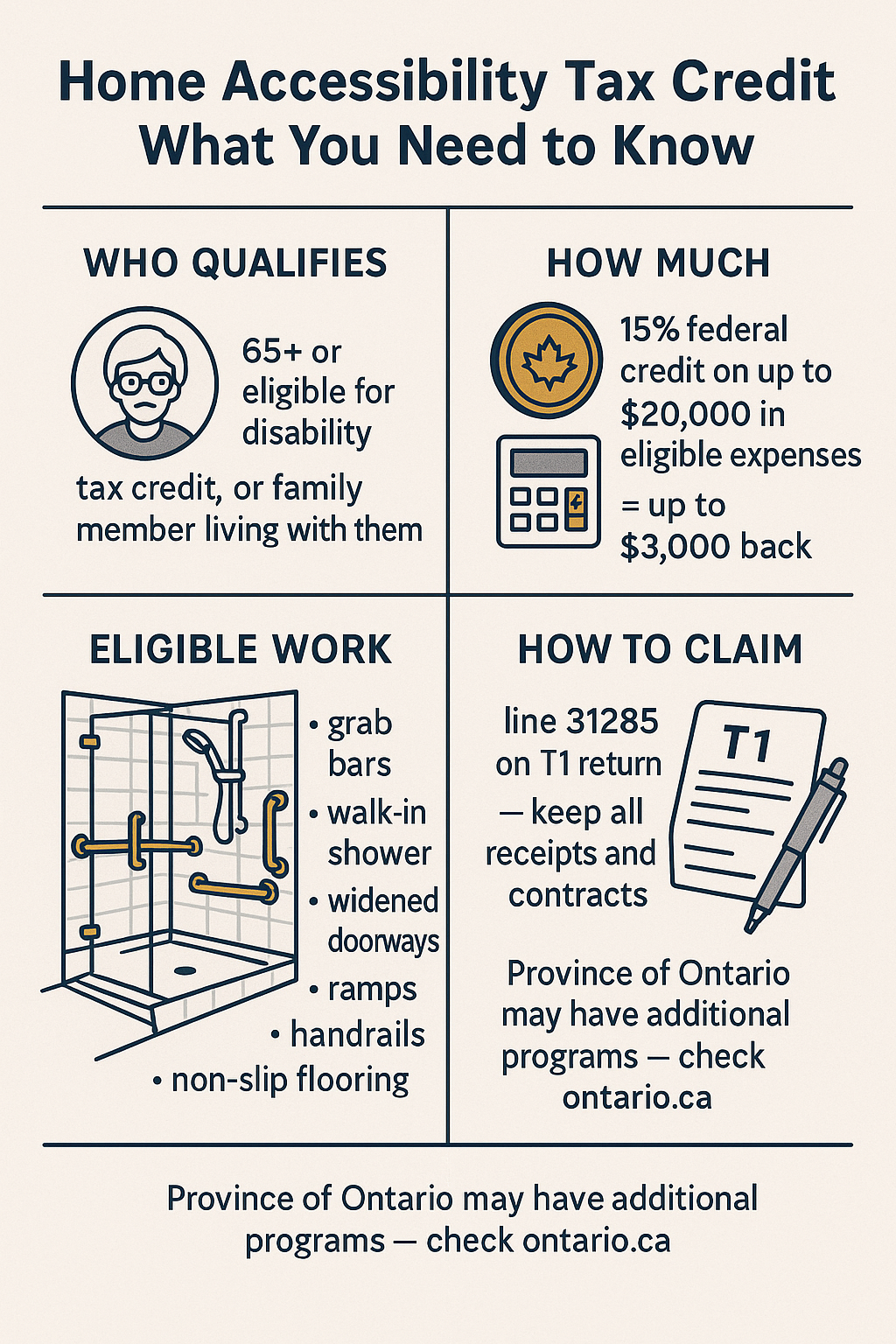
The HATC provides a 15% non-refundable federal tax credit on eligible home accessibility expenses, up to a maximum of $20,000 in eligible expenses per year (increased from $10,000 for expenses incurred after 2021).
The maximum annual credit is $3,000 (15% of $20,000).
The credit is non-refundable — it reduces federal income tax owing, but does not generate a refund beyond the taxes owed. If a qualifying individual has low income and owes less than $3,000 in federal tax, the credit reduces their tax to $0 but does not produce a cash refund.
Supporting family member rule: A qualifying family member — a spouse, common-law partner, or a person who is dependent on the taxpayer for support — who makes eligible expenses on their home or on the qualifying individual’s home may also claim the credit.
Who Qualifies
The HATC is available to two categories of eligible individuals:
1. Individuals eligible for the Disability Tax Credit (DTC): People who have been certified by a medical practitioner as having a severe and prolonged mental or physical impairment, and who have been approved by the Canada Revenue Agency for the DTC.
2. Individuals 65 years of age or older (as of December 31 of the taxation year in which the expenses are incurred).
If neither the homeowner nor a qualifying family member meets one of these criteria, the HATC does not apply — regardless of what accessibility features are installed.
What Expenses Are Eligible
Eligible expenses are those that:
- Allow the qualifying individual to gain access to or to be mobile or functional within the home
- Reduce the risk of harm to the qualifying individual within the home, or
- Allow the qualifying individual to perform the tasks of daily living
Eligible expenses include labour and materials for qualifying renovations.
Examples of eligible bathroom renovation expenses:
- Grab bars and the cost of installation
- Walk-in shower or bathtub installation with accessibility features (curbless entry, accessible dimensions)
- Widening of bathroom doorways for wheelchair or walker access
- Roll-in shower installation
- Non-slip flooring installation in a bathroom
- Adjustable-height or roll-under vanity installation
- Comfort-height toilet installation
- Removal of a tub and replacement with an accessible shower (tub-to-shower conversion for accessibility)
What is NOT eligible:
- Expenses for maintenance or cosmetic upgrades that do not have an accessibility purpose
- Appliances (not permanently attached)
- Work performed by a family member unless they are in the business of providing such services professionally
- Expenses also claimed under the Medical Expense Tax Credit (you cannot double-claim the same expense under both credits — but you may be able to split expenses strategically between the two)
The CRA evaluates eligibility based on whether the primary purpose of the modification is accessibility, not whether the renovation is also aesthetically desirable.
How to Claim the HATC
Step 1: Confirm eligibility
Verify that you or a qualifying family member meet the DTC or age (65+) criteria. If claiming based on DTC eligibility, confirm the DTC certification has been approved by the CRA before claiming.
Step 2: Keep receipts and documentation
Retain all invoices, contracts, and receipts for eligible renovation work. The documentation should clearly identify the nature of the work performed and the address of the qualifying home. Your renovation contractor provides invoices that describe the work scope — request a breakdown that separately identifies accessibility-related work if the renovation includes both accessibility and non-accessibility scope.
Step 3: Complete Form T1Home (Line 31285)
The HATC is claimed on line 31285 of the T1 General income tax return (Home Accessibility Expenses). Enter the total eligible expenses paid in the tax year, up to the $20,000 maximum. Calculate the credit as 15% of the eligible amount and enter it on Schedule 1.
If the expenses are shared between multiple eligible individuals (for example, a spouse who is 65+ and an adult child who is also an eligible supporting family member), the total combined eligible expenses across all claimants cannot exceed $20,000 for the qualifying home.
Step 4: Retain documentation for at least six years
The CRA may request documentation supporting the claim during a review. Keep all contracts, invoices, and receipts for at least six years after the taxation year of the claim.
How the HATC Applies to Bathroom Renovations
A bathroom renovation that includes accessibility modifications is a common application of the HATC. Consider a $20,000 tub-to-shower conversion in Ottawa that includes a curbless shower entry, grab bars with blocking, a built-in bench, a hand-held showerhead, and a comfort-height toilet replacement.
If the homeowner is 65 or older, or holds an approved DTC certification:
- Eligible expenses: $20,000 (full renovation cost, where the primary purpose is accessibility)
- Tax credit: 15% × $20,000 = $3,000 federal tax credit
For a renovation that includes both accessibility and non-accessibility elements — for example, a full gut bathroom renovation that also updates tile, vanity, and finishes in addition to accessibility features — only the portion of expenses with an accessibility purpose qualifies. Working with a tax advisor to apportion the expenses correctly is advisable for larger renovations.
For accessibility-focused bathroom renovations in Ottawa, our team at Miracle Dream Homes can advise on which renovation elements are likely to qualify for the HATC. See also our tub-to-shower conversion page for information on accessibility-focused shower conversions.
For authoritative HATC guidance, the Canada Revenue Agency publishes the current eligibility criteria, eligible expense definitions, and the claim process for Line 31285.
Frequently Asked Questions
Do I have to be disabled to claim the Home Accessibility Tax Credit?
No. Individuals who are 65 years of age or older as of December 31 of the tax year are eligible regardless of disability status. Disability Tax Credit (DTC) eligibility is the second path to eligibility, but age alone qualifies. A 67-year-old homeowner who installs grab bars, a walk-in shower, or a wider bathroom doorway can claim the HATC without a DTC certification.
Can I claim both the HATC and the Medical Expense Tax Credit for the same renovation?
Generally, you cannot claim the same expense under both credits. However, you can allocate expenses strategically between the two credits if the renovation qualifies under both — claiming a portion under the HATC and a different portion under the Medical Expense Tax Credit (METC). Because the HATC is a 15% non-refundable credit and the METC threshold and rate work differently, a tax advisor can help determine the optimal allocation for your specific tax situation.
Does the HATC apply to work done by the homeowner themselves (DIY)?
The HATC covers labour costs paid to third-party service providers. For work done by the homeowner themselves, only the material costs qualify — not the value of the homeowner’s own labour. Work done by a family member qualifies only if that family member is in the business of providing such services professionally (a licensed contractor or tradesperson). Document all paid labour and materials separately.
Is there a provincial accessibility tax credit in Ontario in addition to the federal HATC?
As of the current date, Ontario does not have a standalone provincial tax credit equivalent to the HATC. However, the Ontario Seniors’ Home Safety Tax Credit — which ran from 2021 to 2023 — was a temporary provincial program. Check the current Ontario Ministry of Finance guidance for any active provincial credits that may apply to accessibility renovations, as provincial programs change. The federal HATC remains available annually on the T1 return for qualifying individuals.