
Bathroom Vanity Materials: Wood, MDF, PVC, and What Holds Up Best
A bathroom vanity cabinet is exposed to humidity, temperature swings, and cleaning products on a daily basis. The material the cabinet box and door are made from determines how well it holds up over a decade or more of that exposure. A cabinet that looks great at installation but warps, delaminate, or swells within 3–5 years in a humid bathroom is not a good renovation investment regardless of the price paid.
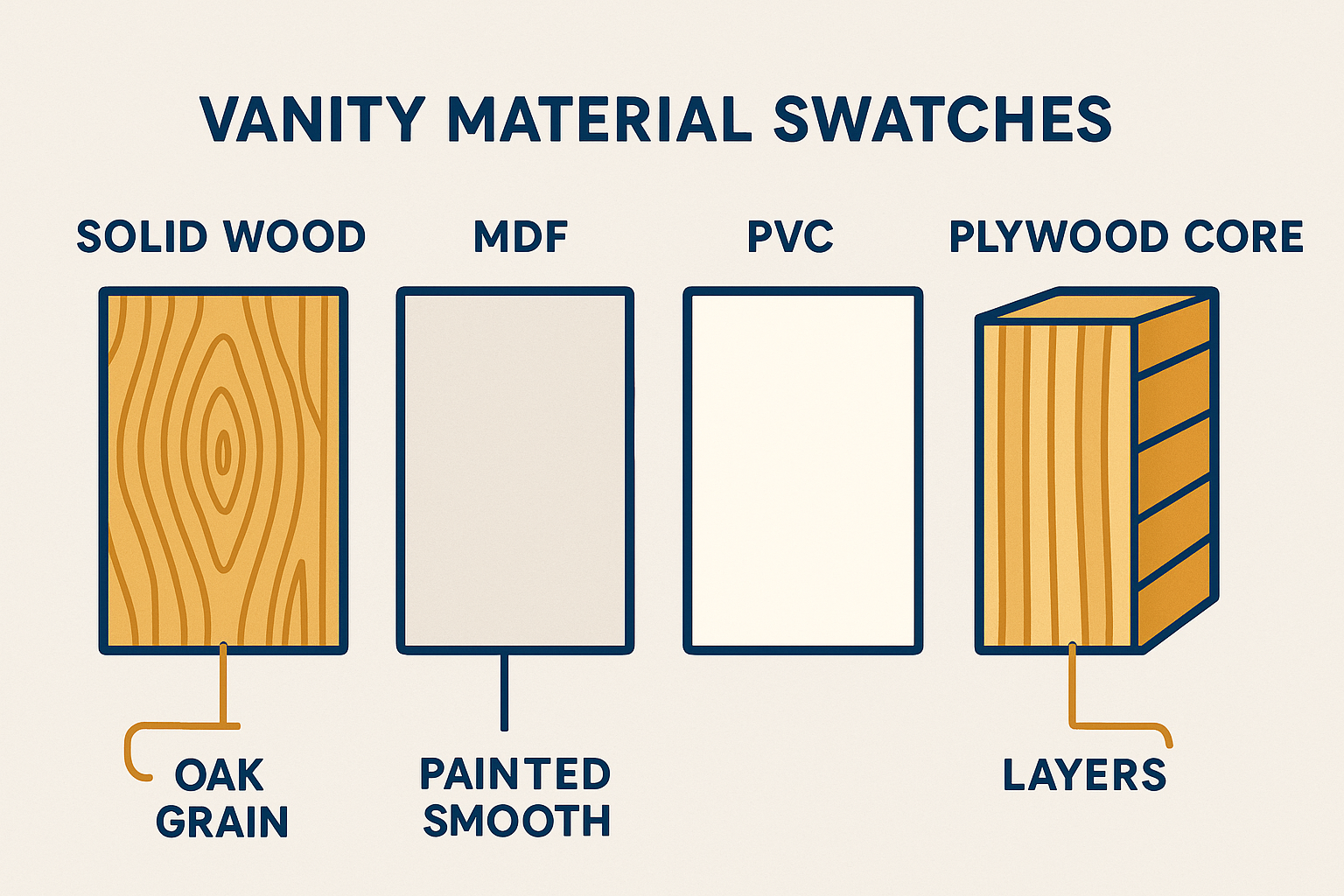
This guide covers the main materials used in bathroom vanity construction, how they perform over time, and how to identify quality in a product before you buy.
The Five Main Vanity Cabinet Materials
Solid Wood
Solid wood vanity cabinets are made from wood boards cut from lumber — maple, oak, birch, cherry, or poplar are common species for bathroom cabinets. The cabinet box and doors are constructed from solid wood panels.
Advantages:
– The most durable material for door and frame construction when properly finished
– Responds well to refinishing — can be repainted or restained
– Has real weight and feel quality
– Joints and mortise-and-tenon construction hold over time
Disadvantages:
– Solid wood moves with humidity and temperature changes — it expands and contracts seasonally. In a high-humidity bathroom, solid wood cabinet doors can swell and bind if the wood is not properly sealed on all sides.
– Higher cost than engineered alternatives
– Not ideal for the cabinet box (large panels of solid wood are prone to movement)
Best use: Door and drawer front construction, face frames. Solid wood is best used for the visible elements, with plywood used for the cabinet box structure.
Plywood
Plywood is made from wood veneers glued in alternating grain directions. It is dimensionally stable, holds fasteners well, and handles moisture better than solid wood panels or MDF.
Advantages:
– Excellent structural stability — does not sag under load
– Holds screws and hinges securely
– Better moisture resistance than MDF (though not waterproof)
– Can be veneered with virtually any wood species for appearance
Disadvantages:
– Not as smooth a surface as MDF (visible grain and occasional voids in edge sections)
– More expensive than MDF for equivalent dimensions
– Quality varies significantly based on core species and veneer quality
Best use: Cabinet box (carcass) construction. A plywood box with solid wood or MDF doors is a durable combination used by quality Canadian cabinet manufacturers.
MDF (Medium-Density Fibreboard)
MDF is made from wood fibres bound with resin under heat and pressure. It has a perfectly smooth surface that takes paint extremely well, making it the dominant material for painted cabinet doors.
Advantages:
– Very smooth surface — the best substrate for painted finishes
– Consistent and uniform — no grain, no knots, no variation
– Less expensive than solid wood or plywood for equivalent applications
– Easy to mill precisely
Disadvantages:
– Heavy — heavier than plywood at equivalent thickness
– Does not hold fasteners as well as plywood or solid wood, particularly near edges
– Swells significantly when exposed to water — moisture damage to MDF is typically not repairable
– Vulnerable to edge damage (chips and dents more easily than solid wood)
MDF in bathrooms: MDF performs well in low-humidity bathroom applications when properly sealed on all surfaces. In high-humidity bathrooms, near shower splashback, or in environments where liquid spills at the cabinet base are likely (children’s bathrooms), MDF is more vulnerable than plywood.
PVC and Thermofoil
PVC (polyvinyl chloride) cabinet components and thermofoil (vinyl foil laminated to an MDF core) are used for budget-tier and some mid-range bathroom vanities. Thermofoil wraps MDF in a vinyl film that provides a smooth, easy-clean surface.
Advantages:
– Highly moisture-resistant compared to bare MDF
– Easy to clean
– Available in a wide range of colours and simulated wood grain patterns
– Lower cost
Disadvantages:
– Thermofoil can peel from the MDF core over time, particularly at edges, in high heat (near heat sources) or in very humid environments
– Cannot be refinished once the film peels
– Does not look or feel as premium as painted solid wood or wood veneer
Best use: Budget and mid-range bathroom vanity applications where moisture resistance is prioritized over premium appearance. A PVC or thermofoil bathroom vanity in a secondary bathroom with regular moisture exposure often outperforms a cheap MDF cabinet.
Bamboo and Composite Materials
Some vanity manufacturers offer bamboo or composite wood-polymer construction. These materials provide excellent moisture resistance. They are available at specific price points and perform well where moisture is a significant concern, but are less common in the standard Ottawa renovation market.
What the Label Actually Tells You
“Solid wood” in marketing: A vanity described as “solid wood” sometimes means solid wood for the door and face frame only, with plywood or MDF for the cabinet box. Read specifications carefully — a legitimate solid wood cabinet is typically more expensive than one that uses solid wood only for visible elements.
“Wood” cabinet boxes: Some budget vanities use particleboard (lower density than MDF, even worse moisture resistance) for the box. A particleboard base that gets regular moisture contact from plumbing leaks or cleaning will deteriorate faster than plywood or MDF.
Finish quality: The finish on the door matters as much as the substrate. A proper multi-coat factory finish — primer, colour coats, and topcoat — provides sealing on all surfaces including the back of the door. Bare or inadequately finished backs allow moisture absorption from bathroom air that causes swelling and paint failure at the door edges.
Countertop Material Is Separate
Vanity countertop material is separate from the cabinet box material and should be evaluated independently. See the Bathroom Countertop Materials article for a full comparison.
For vanity selection as part of a full bathroom renovation in Ottawa, our team at Miracle Dream Homes helps homeowners choose the right cabinet specification for their bathroom conditions and budget. See our bathroom renovation page and our powder room renovation page for more on how we approach material selection.
For Canadian cabinet quality standards, the Kitchen Cabinet Manufacturers Association (KCMA) ANSI/KCMA A161.1 standard is the industry benchmark for residential cabinet construction quality. KCMA certification testing includes humidity exposure tests that simulate bathroom conditions.
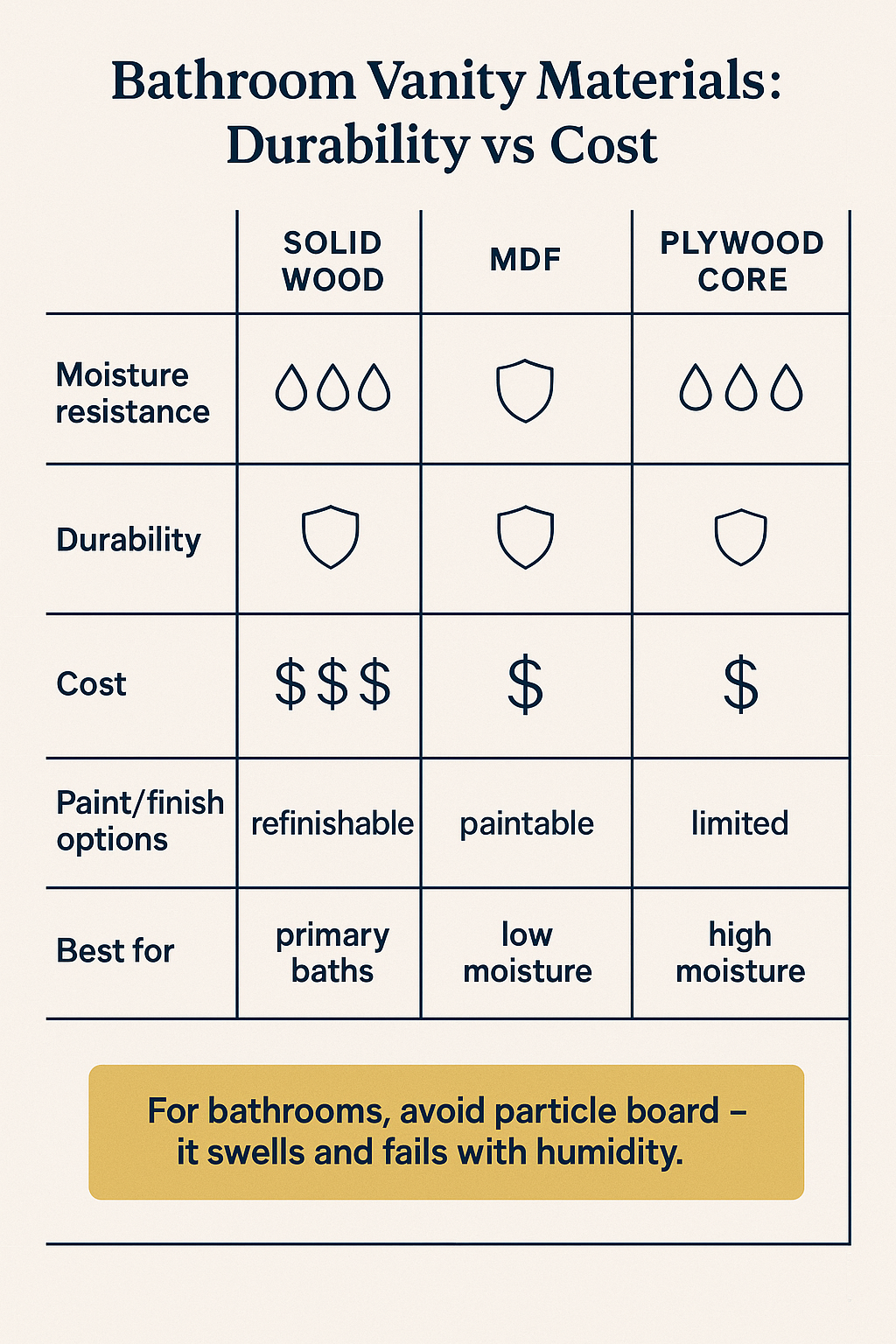
Frequently Asked Questions
What is the most durable bathroom vanity material?
A cabinet box constructed from quality plywood, with solid wood face frames and doors finished in a quality multi-coat factory finish, is the most durable combination for a bathroom vanity. Plywood holds fasteners well and resists moisture better than MDF. Solid wood or high-quality MDF doors with a complete factory finish perform well in normal humidity bathroom conditions.
Is MDF suitable for a bathroom vanity?
MDF is appropriate for painted bathroom vanity doors when properly sealed on all surfaces with a quality factory finish. It is more vulnerable to moisture damage than plywood if the finish is damaged or incomplete. For the cabinet box — particularly in high-humidity bathrooms or near the floor where water contact is more likely — plywood is the more durable choice.
How do I tell what a bathroom vanity is made from?
Look for material specifications in product documentation rather than marketing descriptions. “Solid wood construction” should specify the species and whether it applies to the box, doors, or both. Check whether the box is described as plywood or particleboard. Ask the supplier directly if the specification is not clear.
Does the vanity material affect long-term maintenance?
Yes. Plywood and solid wood vanities can be refinished — sanded and repainted — when the finish deteriorates. MDF and thermofoil vanities cannot be easily refinished once the surface breaks down. This makes the choice of vanity material relevant not just at purchase but over the full renovation cycle.