
Master Ensuite Renovation: What to Consider Before You Start
The primary ensuite is the bathroom homeowners use every day, often twice a day. It is also the bathroom where renovation investment has the greatest personal payoff and — in the Ottawa real estate market — one of the highest-impact upgrades for a home’s perceived quality and listing value. A well-executed ensuite renovation transforms the daily experience of the master bedroom suite and signals quality to anyone who sees the space.
Before any design decisions are made, there are structural, spatial, and functional questions that shape what a primary ensuite renovation can and should accomplish.
What Makes an Ensuite Different from Other Bathrooms
An ensuite bathroom — accessible directly from the master bedroom rather than the hallway — is designed for two adults as a private space. This framing changes several design decisions:
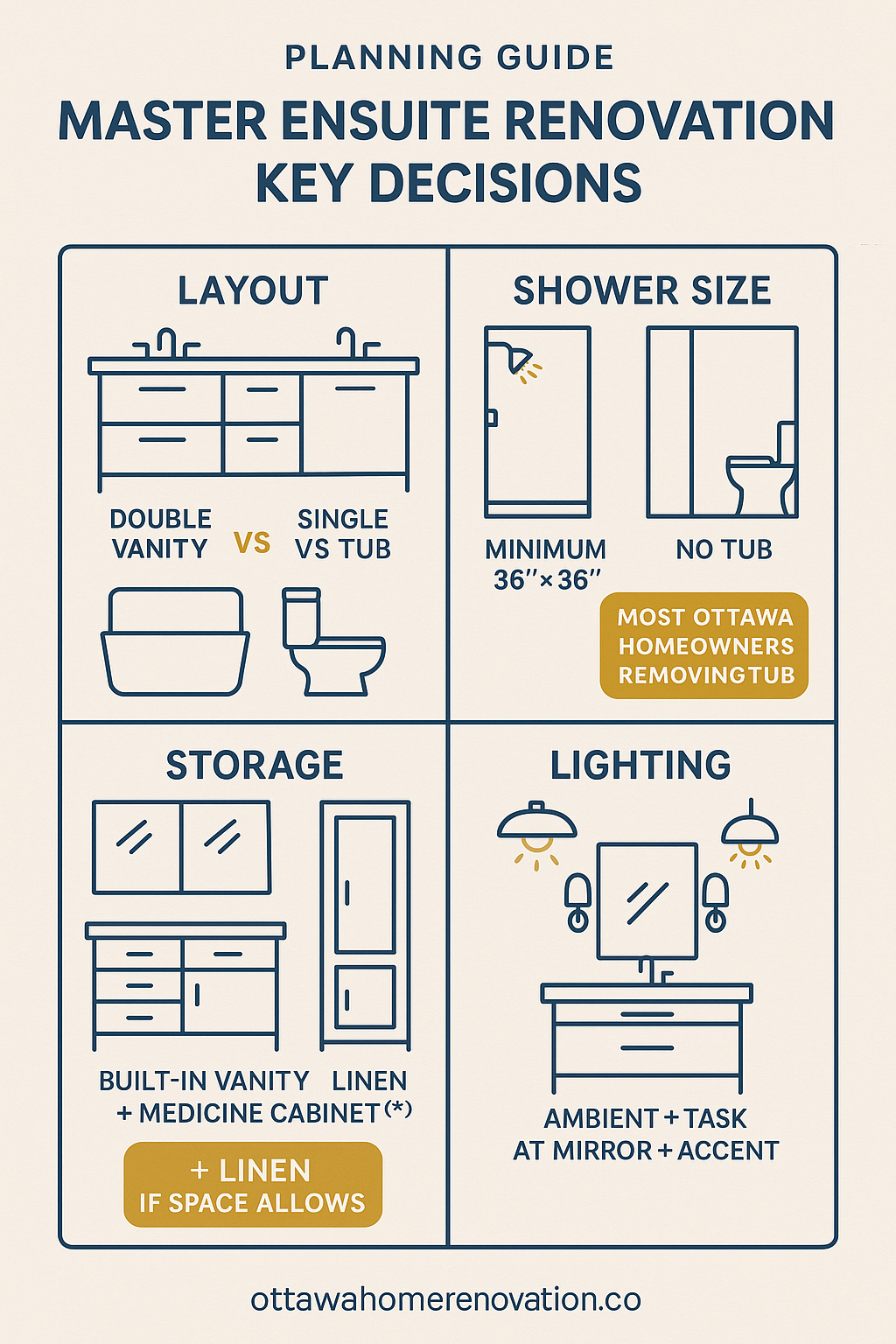
The shower replaces the tub as the primary fixture. In a dedicated ensuite, the tub is rarely used by both occupants regularly. The majority of Ottawa homeowners renovating an ensuite choose a shower-only or shower-plus-freestanding-tub configuration rather than a standard tub-shower combo.
Storage is for two. Double vanities, side cabinets, and mirror storage are appropriate for two-person daily use in a way they are not in a shared family bathroom.
Privacy matters more. Toilet placement, the option of a water closet (separate toilet room), and sound separation from the bedroom are considerations in an ensuite that rarely apply elsewhere.
Luxury finishes are justified. In the ensuite, premium tile, frameless glass, heated floors, and quality fixtures are well-placed investments. The space is used daily and is the most visible indicator of a home’s renovation quality.
The Four Core Questions
Before beginning design work on a primary ensuite renovation, work through these questions:
1. Is the existing footprint adequate, or does it need to expand?
Many older Ottawa homes — particularly those built in the 1970s–1990s — have small ensuites designed around a standard 5-foot alcove tub. These spaces typically run 4.5 m² to 6 m² — sufficient for a functional bathroom, but limiting for a walk-in shower, double vanity, and freestanding tub if all three are desired.
If the existing footprint is too small for the intended scope, the renovation requires borrowing space from an adjacent area — a closet, hallway, or bedroom corner. Expanding the ensuite footprint is a more complex renovation involving framing changes, permit requirements, and possibly HVAC and electrical relocation. It adds cost, but it may be necessary to achieve the desired result.
2. What are the plumbing constraints?
The existing drain stack location largely determines where the toilet, shower, and tub can be located without significant plumbing relocation cost. Moving drains — particularly in a slab-on-grade home — adds significant cost. In homes with accessible basement ceiling below the ensuite, drain relocation is more feasible.
Understanding the plumbing constraints before finalizing the layout prevents design decisions that require expensive plumbing work to execute.
3. What is the structural floor capacity?
If a freestanding cast iron tub or stone resin tub is part of the design, the floor structure needs to support the combined weight of the tub and water — which can reach 400–600 kg for a large filled cast iron tub. A structural assessment is part of the renovation planning when heavy fixtures are involved.
4. What are the ventilation requirements?
An ensuite with a large shower generates substantial moisture. Proper exhaust ventilation — sized to the bathroom volume, rated to move air to an exterior vent, and positioned to capture moisture at the shower zone — is a code requirement and a practical necessity. If the existing ventilation is inadequate (many older ensuites have undersized fans venting into the attic rather than exterior), the renovation is the right time to correct it.
Layout Priorities for a Primary Ensuite
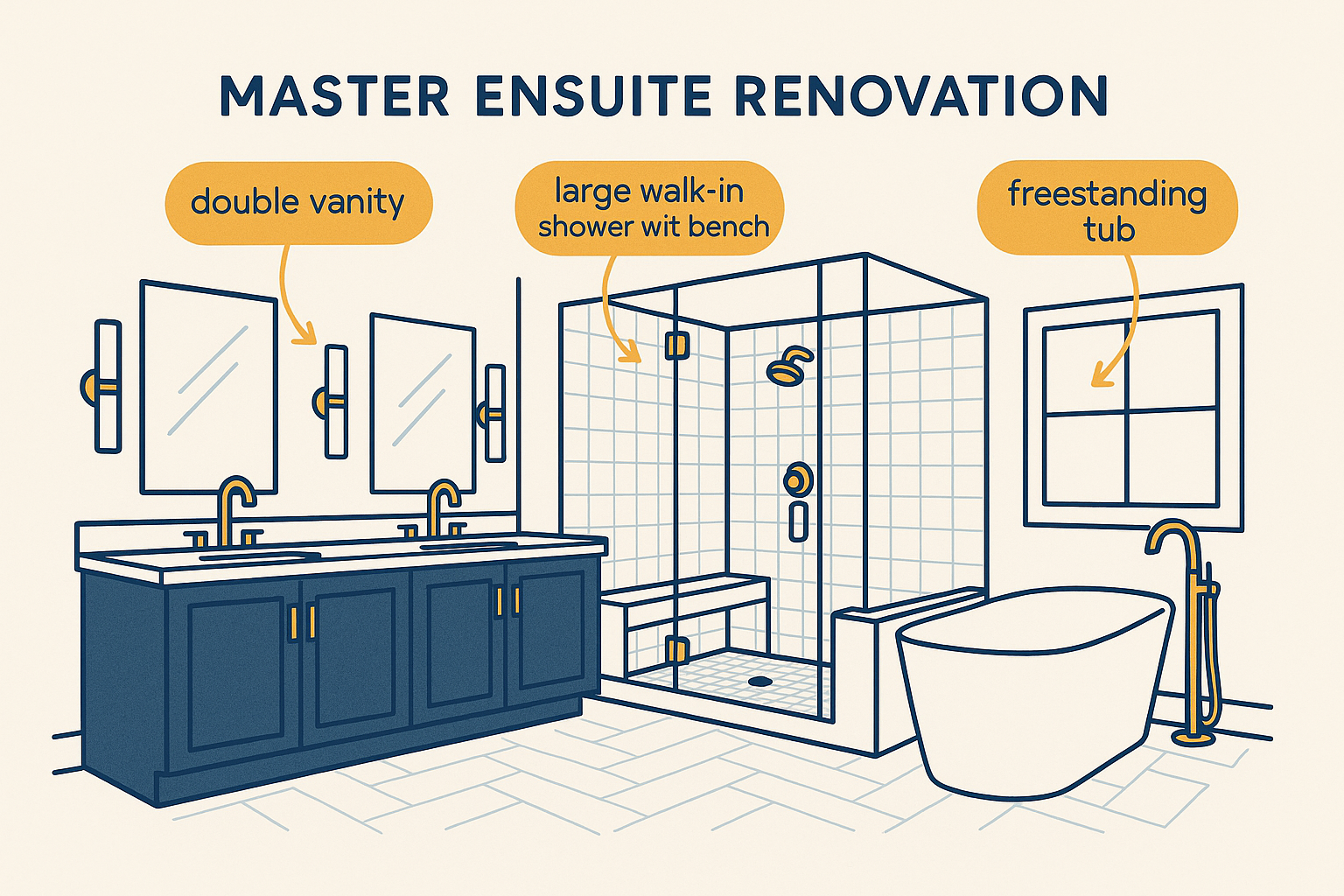
Double vanity: In a two-person ensuite, a double vanity — 1,200–1,500 mm or wider — with two sinks, two drawers banks, and separate mirror zones significantly improves morning functionality. This is the single most impactful functional upgrade for a two-person ensuite.
Walk-in shower: A shower at least 900 x 900 mm (ideally 1,000 x 1,200 mm or larger) with a frameless glass door is the standard for a primary ensuite renovation. Larger showers — 1,200 x 1,800 mm — accommodate a bench, body spray fixtures, and the spatial quality of a spa-style shower.
Freestanding tub: If a soaker tub is part of the scope, a freestanding tub (acrylic, cast iron, or stone resin) positioned as a visual focal point — typically under a window or centred on a wall — is the current standard. Built-in alcove tubs are appropriate in family bathrooms but feel less intentional in a primary ensuite renovation.
Water closet: In larger ensuite renovations (8 m²+), a separate compartment for the toilet — a water closet with its own door — provides privacy between the two bathroom users. This feature is common in custom home construction and premium renovations.
Heated floor: In-floor radiant heat under tile is highly valued in a primary ensuite. The tile surface is comfortable from the first step out of the shower or bath. Electric radiant heat is the standard installation for bathroom floor heating and does not require changes to the home’s hydronic heating system.
Cost Expectations
Primary ensuite renovations in Ottawa vary significantly based on footprint, scope, and finishes:
Standard scope (4.5–6 m², shower-only, double vanity, quality finishes): $20,000–$30,000
Mid-premium scope (6–9 m², freestanding tub + walk-in shower, double vanity, heated floor): $30,000–$45,000
Premium scope (9+ m², custom tile, statement fixtures, expanded footprint, full custom): $45,000–$70,000+
These ranges reflect Ottawa contractor rates, current material costs, and a renovation scope that includes full gut, waterproofing, tile, fixtures, and finishes. They do not include structural modifications, significant plumbing relocation, or footprint expansion — these add to the base scope cost.
What Not to Cut
In a primary ensuite renovation, the areas where quality investment is most visible and durable:
Tile installation and waterproofing. A properly waterproofed shower with quality tile installation lasts the life of the renovation. Poor waterproofing leads to water damage behind walls, which is expensive to remediate and often invisible until significant damage has occurred.
Frameless glass. In a primary ensuite, the visual quality difference between framed and frameless shower glass is significant. The frameless enclosure reads as genuinely premium; a framed sliding door reads as builder-grade regardless of the tile quality around it.
Plumbing fixtures. In a daily-use bathroom, fixture quality is experienced every day. Thermostatic shower valves, quality faucets, and a properly functioning toilet are worth the investment.
For primary ensuite renovation planning in Ottawa, our team at Miracle Dream Homes handles the full scope from design through construction. We also handle bathroom additions for homes where the ensuite footprint needs to expand.
For National Building Code compliance and permit requirements for bathroom renovations in Ottawa, Ottawa Building Code Services administers the permit process for renovation work exceeding a certain scope.
Frequently Asked Questions
How long does a primary ensuite renovation take?
A standard primary ensuite renovation — gut renovation with new tile, fixtures, glass, and finishes — typically takes 3–4 weeks from demolition to completion. Larger scopes with footprint expansion, structural work, or custom elements run 5–7 weeks. The longest lead-time items are typically custom glass (1–2 weeks from measure to installation) and specialty tiles or fixtures on order.
Should an ensuite renovation include a bathtub?
For most adults who use an ensuite daily, a walk-in shower delivers more daily-use value than a tub. If the home has a separate family bathroom with a tub for children or occasional soaking, retaining a tub in the ensuite is unnecessary. If the ensuite will be the only bathing space in the home, retaining or adding a tub provides bathing flexibility. The decision should reflect actual use patterns, not assumptions about what a bathroom needs.
Does a primary ensuite renovation require a permit in Ottawa?
A renovation that moves plumbing, moves walls, or alters electrical requires a permit from Ottawa Building Code Services. Cosmetic renovations that replace fixtures in-place without structural, plumbing, or electrical changes are typically permit-exempt. Your renovation contractor handles permit applications as part of the project scope for any regulated work.
What is the return on investment for an ensuite renovation in Ottawa?
A well-executed primary ensuite renovation in Ottawa typically returns 60–80% of its cost in increased home value, depending on the home’s price range and local comparables. The return is highest when the renovation brings the ensuite to the standard expected at the home’s price point — a dated ensuite in an otherwise updated home represents a discount to buyers. The personal return — daily quality of life in a well-designed space — is significant but not quantifiable in listing terms.