
Bathroom Storage Solutions: Built-In, Freestanding, and Recessed Options
Storage is one of the most common sources of dissatisfaction in bathroom renovations. Homeowners often focus on tile, fixtures, and finishes during the planning phase, and address storage as an afterthought. The result is a beautiful bathroom that lacks adequate space for towels, toiletries, and everyday products — which then accumulate on the vanity counter and undermine the finished appearance.
Planning storage as a deliberate element of the renovation produces far better results. The options range from structural built-ins to recessed niches to freestanding additions, and each has a specific place in a well-organized bathroom.
The Storage Planning Question
Before choosing storage solutions, clarify what the bathroom needs to store:
- Daily-use toiletries (used at the sink)
- Shower and bath products (used inside the shower or bath)
- Towels (in use and in reserve)
- Cleaning products
- Medication and first aid
- Extra toilet paper and paper products
- Appliances (hairdryer, electric shaver, etc.)
Each category has different storage requirements. Products used at the sink need accessible counter or vanity storage. Shower products need in-shower storage. Towels need accessible hanging and storage near the bath zone. Mapping these requirements before renovation planning ensures the finished bathroom accommodates actual use patterns.
Vanity Storage
The bathroom vanity provides the primary storage volume for most bathrooms. Vanity storage capacity varies significantly based on vanity configuration:
Single sink vanity (600–750 mm): One cabinet base with one or two doors and possibly a drawer. Appropriate for a single-person bathroom or secondary bathroom.
Double sink vanity (1,200–1,500 mm): Two cabinet bases, typically with full-width drawer banks. Provides substantially more storage for two-person bathrooms.
Drawer configuration: Deep drawers below the sink — where plumbing allows — provide more accessible storage than cabinet doors with shelves. Pull-out organizers inside drawers (dividers, bins, tiered trays) significantly increase usable capacity.
Tall side cabinets: Adding a tall linen cabinet (300–400 mm deep, 1,800–2,100 mm tall) beside the vanity provides substantial storage for towels, linens, and reserves without occupying counter space.
When selecting a vanity, evaluate storage configuration as carefully as appearance. A vanity with generous drawer storage typically functions better in daily use than one with the same footprint but fewer drawers.
Recessed Niches
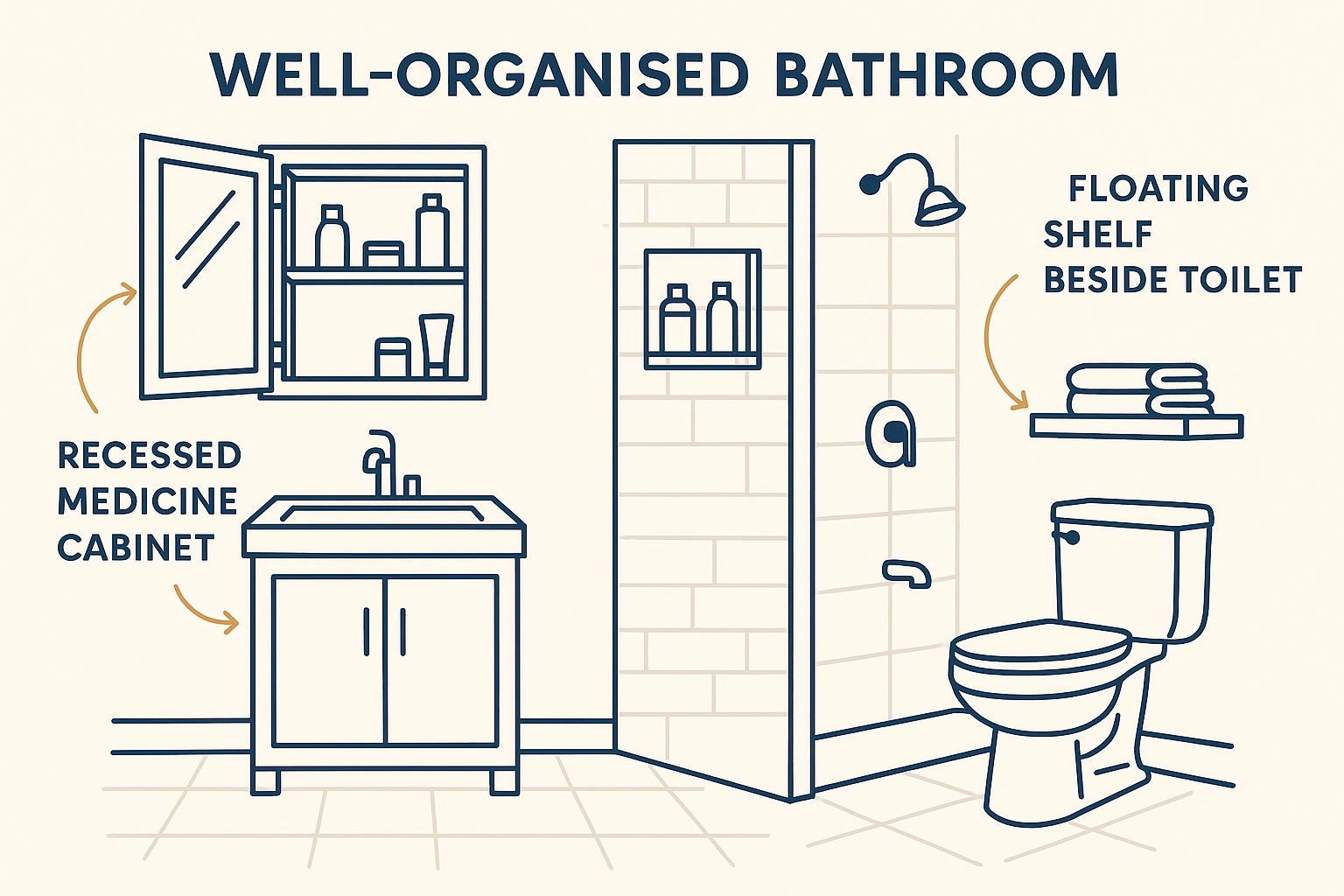
A recessed niche — a shelf unit set into the wall between studs — is one of the most efficient storage additions in a bathroom renovation. The niche occupies wall depth rather than floor or shower space, and when tiled to match the surrounding wall, integrates visually into the space.
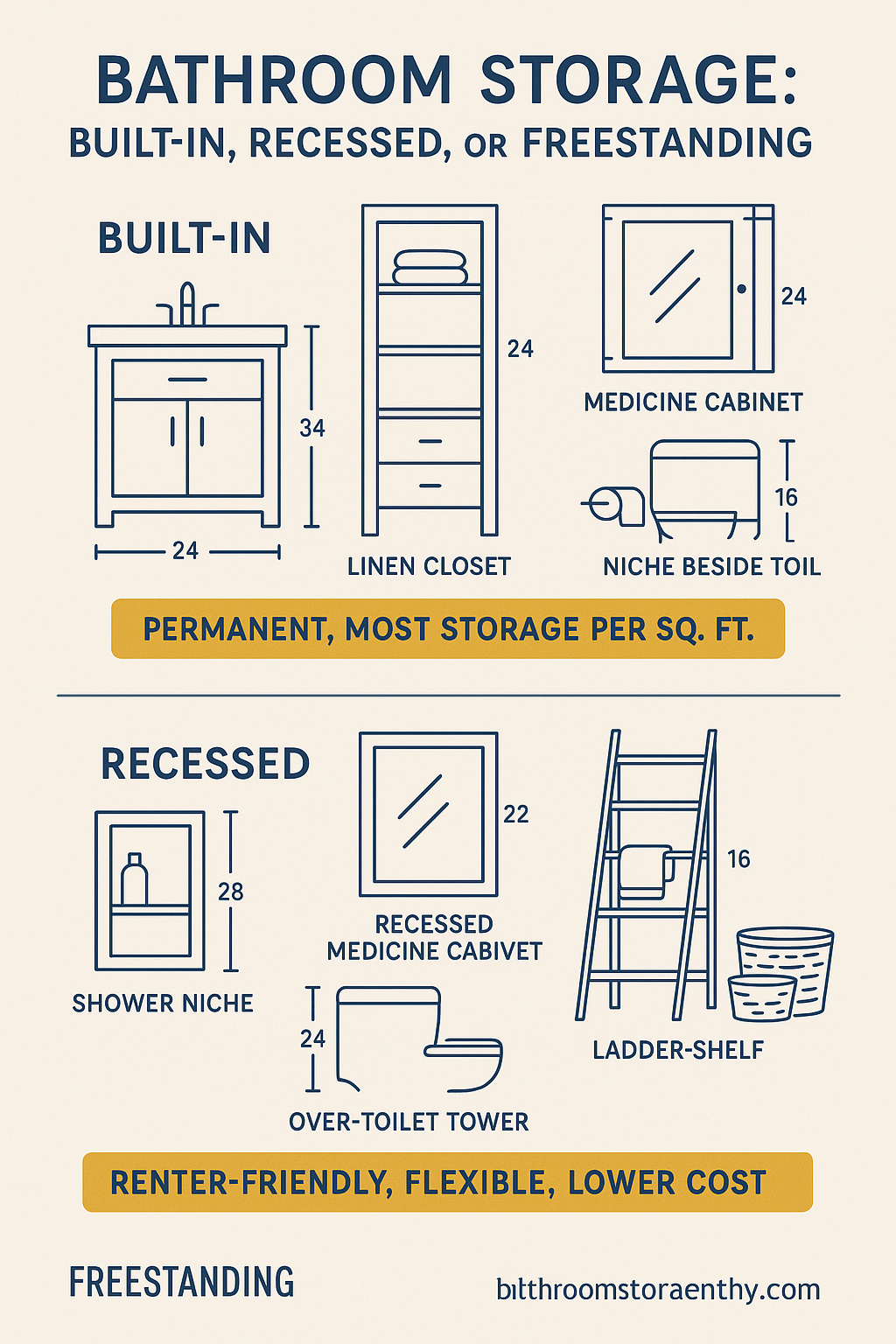
Shower niches: The most common application. A shower niche set 1,200–1,400 mm above the floor provides convenient, waterproof storage for shampoo, conditioner, soap, and razors. Single-niche installations hold 3–4 standard-size bottles. Double-niche or stacked-niche configurations provide more storage for households with many shower products.
Niche construction requirements: A shower niche is built into the wall framing before tile installation. It requires:
– Structural framing between studs (or a niche unit designed to span studs)
– Proper waterproofing on all interior niche surfaces
– Tile installation that integrates with the surrounding shower tile
The waterproofing of a shower niche is as critical as the rest of the shower — inadequately waterproofed niches are a common source of water infiltration into wall structure. When the niche is specified during renovation planning, the tile setter integrates it correctly.
Bathroom wall niches: Outside the shower, a recessed niche in a bathroom wall provides display or storage space for towels, candles, or toiletries. These do not require waterproofing beyond standard paint or tile finish, but do require the wall structure to permit recessing.
Recessed medicine cabinets: A recessed medicine cabinet above the vanity provides mirrored storage for medications, toiletries, and personal items. Recessed installation requires a wall cavity of at least 90 mm — achievable in most standard stud walls but requiring verification before specification.
Built-In Shelving
Built-in shelving in the bathroom takes several forms:
Built-in linen cabinet: A full-height cabinet built into a bathroom wall or alcove, with adjustable shelves, provides substantial towel and linen storage. In bathrooms with an alcove or dead corner beside the toilet or vanity, a built-in linen cabinet is the most space-efficient storage solution.
Floating shelves: Open floating shelves on a bathroom wall provide accessible storage and display space. In the bathroom context, floating shelves work best for items used regularly and stored in containers — not for loose products that accumulate dust. Glass or stone shelves suit contemporary bathroom aesthetics.
Under-stair and under-slope storage: In bathrooms beneath a staircase or under a roof slope, the irregular space provides an opportunity for custom built-in storage designed to fit the exact geometry.
Built-in bench with storage: In a walk-in shower or larger bathroom, a built-in bench provides seating (valuable for accessibility applications) and, with a hinged or lift-top seat, enclosed storage beneath.
Over-Toilet Storage
The space above the toilet tank is an underutilized storage zone in most bathrooms. Options include:
Floating shelf above tank: A shelf 200–300 mm above the tank lid provides accessible storage for reserve toilet paper, candles, or decorative items. Width matches the tank width — typically 350–400 mm.
Over-toilet cabinet: A purpose-built cabinet unit fits above the toilet, with a shelf at tank level and an enclosed cabinet above. These units provide meaningful storage volume in a small bathroom without requiring floor space.
Built-in above-toilet niche: In a renovation context, a recessed niche or built-in unit above the toilet integrates more cleanly than a freestanding over-toilet unit.
Freestanding Storage
Freestanding storage — furniture, towers, shelving units — works in bathrooms where renovation scope does not include structural storage, or where additional storage is needed after renovation.
Bathroom linen tower: A narrow freestanding cabinet (300–400 mm wide, 1,800 mm tall) provides towel and linen storage in a small floor footprint.
Rolling cart: A rolling storage cart provides flexible storage that moves as needed. Useful in larger bathrooms or where storage needs change frequently.
Towel ladder: A freestanding towel ladder provides towel hanging for 3–4 towels without requiring wall installation. Suits rental contexts and bathrooms without adjacent wall space for bars.
Limitations: Freestanding storage, while flexible, typically provides less capacity per floor footprint than built-in options, and reads as less finished in a completed renovation.
Towel Storage
Towel storage is a specific planning requirement distinct from general bathroom storage:
- Towel bars (600–900 mm) for full-size bath towels: require 150–200 mm clearance above
- Towel rings for hand towels: single position beside the sink
- Hooks for robe, towel, and bag hanging: flexible and space-efficient
- Towel racks with shelves: combine hanging and folded storage
- Heated towel bars: combine storage with towel warming functionality (discussed separately in the heated towel bar article)
A bathroom for two adults requires a minimum of two towel bars or one double-bar unit. Adding a hook behind the door provides secondary hanging for robes or in-use items.
For storage planning as part of a full bathroom renovation in Ottawa or a powder room renovation, our team integrates storage specification into the design process from the start — not as an afterthought.
For space-efficient storage systems for bathroom applications, Rev-A-Shelf and Hafele provide vanity organizers, pull-outs, and drawer systems that increase the functional capacity of standard vanity cabinets.
Frequently Asked Questions
What is the best way to add storage to a small bathroom?
In a small bathroom, recessed solutions add storage without consuming floor space. A shower niche handles in-shower products. A recessed medicine cabinet above the vanity handles toiletries and medications. An over-toilet floating shelf or cabinet uses otherwise empty wall space. Finally, choosing a vanity configured with deep drawers rather than open shelves maximizes the storage capacity of the vanity footprint.
How do you plan a shower niche?
A shower niche is planned before tile installation, during the framing and waterproofing stage of the renovation. The location is chosen based on the shower layout — typically on a non-plumbing wall, at a height convenient for the users. The niche framing is built between studs, the interior is waterproofed as part of the shower waterproofing membrane system, and tile is installed throughout. If a shower niche is not specified before tile installation begins, it is not possible to add one without removing and reinstalling the tile.
Are recessed medicine cabinets still a good choice?
Yes. A recessed medicine cabinet above the vanity is one of the most space-efficient storage solutions in a bathroom — it provides mirrored storage in the vanity zone without projecting into the room. Modern recessed medicine cabinets are available in frameless and framed styles, with adjustable shelving, soft-close doors, and integrated lighting. They suit any bathroom style from contemporary to traditional.
How much storage should a bathroom vanity have?
For a primary bathroom used by two people, aim for a 1,200 mm or wider double vanity with full-width drawer configuration, plus a side linen cabinet if space allows. For a single-person secondary bathroom, a 750 mm single vanity with a drawer bank provides adequate daily storage. A vanity with deep drawers organized with dividers holds significantly more usable items than a cabinet-door configuration of the same outer dimensions.