
LED vs. Incandescent vs. CFL: Choosing Bathroom Bulbs
Bathroom bulb selection is one of the smallest decisions in a renovation and one that homeowners get wrong more often than most. Choosing a bulb with poor colour rendering, incorrect colour temperature, or insufficient output for the space affects every task performed at the vanity mirror — and these effects are cumulative over years of daily use.
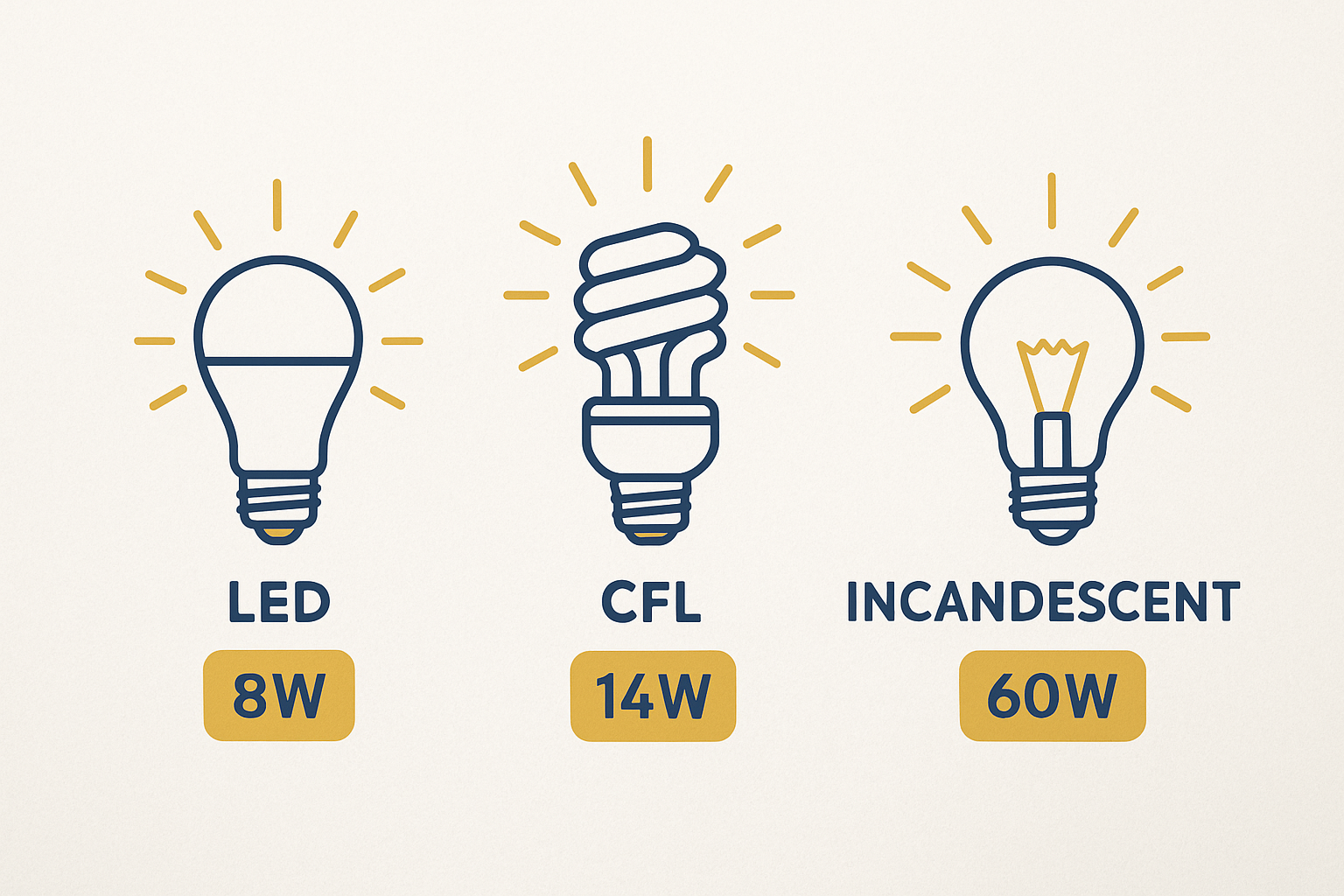
This guide covers the three main bulb types in residential use, how they compare for bathroom applications, and what specifications actually matter when making a selection.
Incandescent Bulbs
Incandescent bulbs produce light by passing electrical current through a tungsten filament until it glows white-hot. They have been in use since the 1880s and produce an extremely warm, continuous-spectrum light.
Performance characteristics:
– CRI of 100 (perfect colour rendering by definition — incandescent light is the standard against which CRI is measured)
– Colour temperature: 2,700K (warm white)
– Energy efficiency: approximately 10–17 lumens per watt — the least efficient light source in common use
– Lifespan: 750–2,000 hours (1–3 years at average use)
Status in Canada: Traditional incandescent bulbs (general purpose A-type, 40–100W) were phased out of Canadian production and import under Energy Efficiency Regulations amendments, with the phase-out completing in 2015. Standard incandescent bulbs are no longer available for purchase in Canada in general-service formats.
Specialty incandescent (appliance bulbs, rough service, reflector lamps) remain available in some applications.
CFL Bulbs (Compact Fluorescent)
CFL bulbs generate light by exciting mercury vapour in a phosphor-coated tube. They were introduced as the energy-efficient alternative to incandescent during the 2000s and have largely been superseded by LED.
Performance characteristics:
– CRI: 80–85 for most residential CFLs (some high-CRI products reach 90+)
– Colour temperature: Available in a range from 2,700K to 5,000K
– Energy efficiency: 40–70 lumens per watt (significantly better than incandescent)
– Lifespan: 8,000–15,000 hours
– Warm-up time: Most CFLs take 30–60 seconds to reach full brightness — not ideal for a bathroom where you want immediate full light
– Contains mercury (requires proper disposal, not general recycling)
– Not compatible with most dimmers (requires specifically-rated dimmable CFLs)
Status in bathroom use: CFL is largely being replaced by LED in new renovation projects. The warm-up delay and mercury content are practical disadvantages, and LED now matches or exceeds CFL on every performance metric while being fully dimmable and mercury-free.
LED Bulbs
LED (Light Emitting Diode) technology has become the dominant residential lighting technology. LEDs produce light through electroluminescence — far more efficiently than incandescent and without the warm-up issues of CFL.
Performance characteristics:
– CRI: 80–95+ depending on product quality (high-quality bathroom LEDs are available at CRI 90+)
– Colour temperature: Available from 2,700K through 6,500K
– Energy efficiency: 80–130+ lumens per watt (5–10x more efficient than incandescent)
– Lifespan: 15,000–50,000 hours (15–50 years at average household use)
– Instant-on: Full brightness immediately at switch activation
– Dimmable: Most quality LED bulbs are compatible with standard dimmers (confirm LED-compatible dimmer)
– Contains no mercury
– Runs cool — significantly less heat output than incandescent
The right LED for bathroom use: Not all LED bulbs perform equally in bathroom conditions. Key specifications to check:
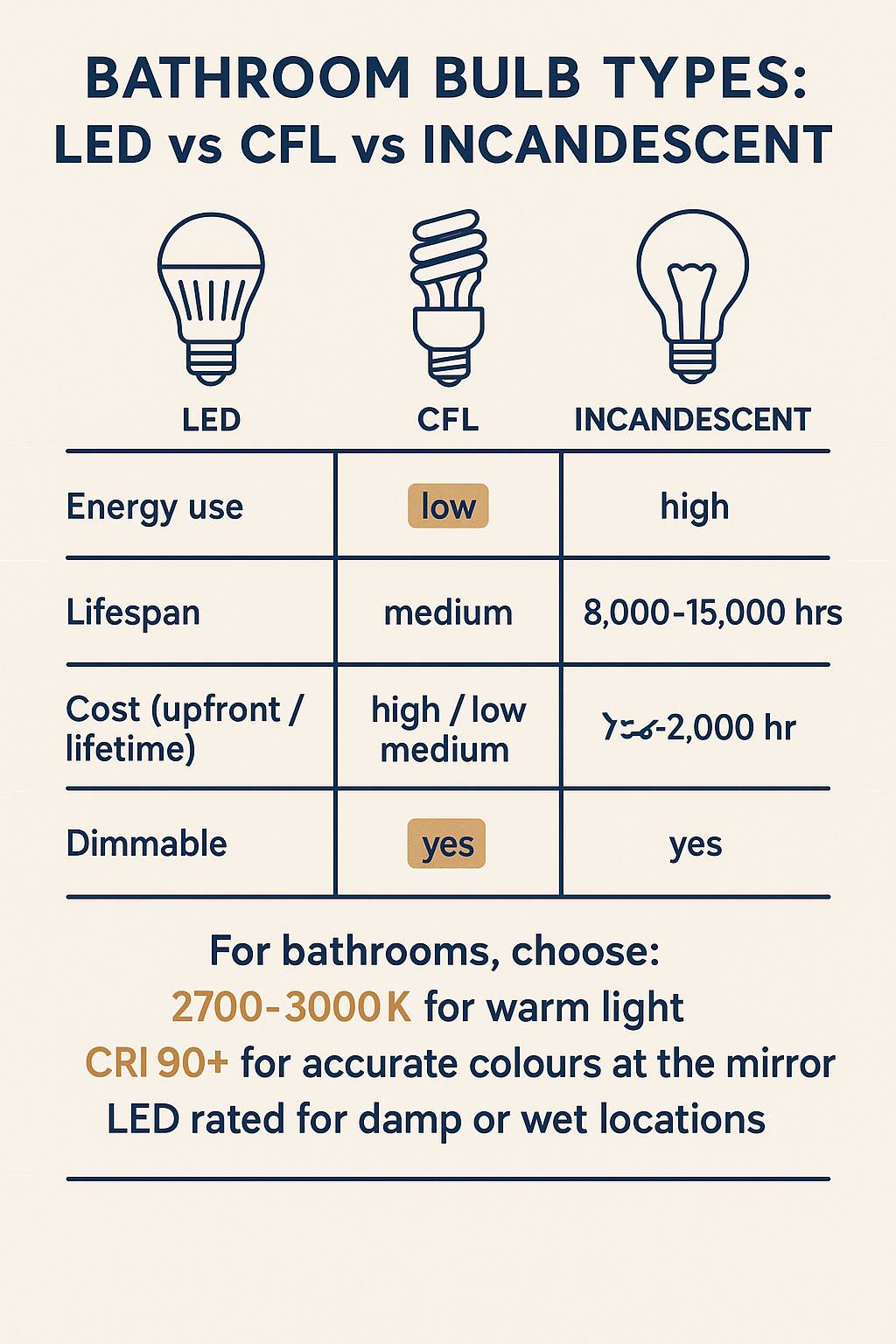
– CRI 90 or above for vanity applications
– Colour temperature appropriate to the application (2,700–3,000K for most bathrooms)
– Damp-rated for fixtures in humid environments; wet-rated for fixtures inside shower enclosures
– Compatible with the specific dimmer switch if dimming is required
Comparing Bulb Types for Bathroom Applications
| Factor | Incandescent | CFL | LED |
|---|---|---|---|
| Colour rendering (CRI) | 100 (best) | 80–85 typical | 80–95+ |
| Colour temperature | 2,700K only | 2,700K–5,000K | 2,700K–6,500K |
| Energy efficiency | Poor | Moderate | Excellent |
| Lifespan | 1,000–2,000 hrs | 8,000–15,000 hrs | 15,000–50,000 hrs |
| Warm-up time | Instant | 30–60 seconds | Instant |
| Dimmer compatibility | Full | Limited | Most (check) |
| Bathroom moisture | Fine | Fine | Check rating |
| Availability | Limited | Declining | Widely available |
Choosing by Bathroom Application
Vanity/Mirror Lighting
This is where bulb quality matters most. The CRI specification directly affects how faces, makeup, and skin tones appear at the mirror.
Recommended: LED, CRI 90+, colour temperature 3,000K. Look for products specifically marketed for vanity or makeup application — they are designed for the CRI and colour temperature requirements of face-level task lighting.
General Ambient Lighting (Pot Lights, Ceiling Fixtures)
Recommended: LED, CRI 80–90, colour temperature 2,700–3,000K. Standard residential LED bulbs are appropriate here. On a dimmer circuit, confirm the LED is rated as dimmable and that the dimmer switch is LED-compatible.
Shower Enclosure Lighting
Requirement: Fixtures inside the shower must be wet-rated (not just damp-rated). Most LED recessed fixtures rated for wet locations use integrated LED modules rather than replaceable bulbs — the entire fixture is replaced when the LED module ends its lifespan (typically 25,000+ hours).
Recommended: Wet-rated recessed LED downlight. Confirm the IP (Ingress Protection) rating — IP65 or higher for shower applications.
Night Light or Accent
Recommended: LED, warm white (2,700K). Very low wattage LED (2–4W) provides adequate night orientation light with minimal energy use.
Colour Temperature Revisited
The colour temperature debate in bathroom lighting is between 2,700K (warm) and 3,000–3,500K (neutral-warm).
2,700K: Matches the warm quality of traditional incandescent light. Flattering and comfortable for most uses. Not ideal for colour-accurate makeup application.
3,000K: The sweet spot for bathroom use. Warm enough to be comfortable, accurate enough for most grooming tasks. This is the standard recommendation for bathroom renovation projects.
3,500–4,000K: Better for makeup application accuracy, slightly clinical for relaxation use. Works well in a bathroom with a dimmer — bright and accurate when needed, dimmed and warm when not.
For lighting selection and fixture specification in Ottawa bathroom renovations, our team at Miracle Dream Homes handles the full scope — from layout planning to fixture selection. Learn more at our bathroom renovation page or our powder room renovation page.
For Canadian LED product certification and energy efficiency standards, Natural Resources Canada provides the Energy Star program requirements, and DesignLights Consortium (DLC) provides performance ratings for commercial-grade LED products.
Frequently Asked Questions
Are LED bulbs really better than incandescent for a bathroom?
Yes, for almost all applications. LED provides equivalent or better light output at 1/10th the energy, lasts 20–50x longer, and is available in colour temperatures and CRI ratings that match or exceed incandescent quality. The main advantage incandescent had — perfect CRI of 100 — is now matched by quality high-CRI LED products at CRI 95+.
Why does colour temperature matter for bathroom lighting?
Colour temperature affects how skin tones, makeup, and clothing appear at the mirror. A 2,700K bulb renders colours with a warm yellow cast that is flattering but slightly inaccurate. A 3,000–3,500K bulb renders colours more accurately, which matters when assessing makeup, checking for blemishes, or matching clothing colours.
Can I use any LED bulb in my bathroom?
Not in all locations. Standard LEDs (not specifically rated) are appropriate for general bathroom fixtures outside wet zones. Fixtures inside the shower enclosure require wet-rated LEDs or wet-rated fixtures with integrated LED modules rated for that environment. Check the fixture’s IP rating before installing in or adjacent to the shower.
Do LED bulbs work with dimmer switches?
Most LED bulbs are dimmable, but not all dimmers are LED-compatible. Older dimmer switches designed for incandescent loads may not work properly with LEDs — you may see flickering, buzzing, or a minimum brightness above true off. Replace the dimmer with an LED-compatible dimmer at the same time you switch to LED bulbs.