
How to Set a Realistic Bathroom Renovation Budget
The most common mistake in bathroom renovation planning is choosing a budget number before understanding what that number will and will not cover. A homeowner who budgets $10,000 expecting a full renovation — new tile, new fixtures, new vanity, moved plumbing — is going to be disappointed. A homeowner who understands that $10,000 covers a cosmetic refresh or a small bathroom refresh, and $20,000–$35,000 covers a full gut renovation, can make a decision that matches their expectations.
This guide walks through how to set a bathroom renovation budget in Ottawa, where costs typically land, and how to allocate your spending for the best result.
What Does a Bathroom Renovation Cost in Ottawa?
Ottawa bathroom renovation costs in 2025–2026 fall into broadly predictable ranges:
Cosmetic refresh (no structural, plumbing, or electrical changes)
– New vanity, toilet, mirror, lighting, paint
– Existing tile left in place or re-grouted
– Range: $4,000–$8,000
Mid-range renovation (full gut and replacement, no layout changes)
– Full tile replacement (floor and walls), new vanity, toilet, shower, fixtures
– Existing plumbing and electrical stays in place
– Range: $12,000–$22,000
Full renovation with layout or scope changes
– Moving plumbing (toilet, shower, sink)
– Expanding the bathroom footprint
– Premium materials (stone countertops, heated floors, custom vanity)
– Range: $25,000–$45,000+
The typical Miracle Dream Homes project falls in the $10,000–$25,000 range, reflecting mid-range renovations with quality materials and professional installation.
How Bathroom Renovation Costs Break Down
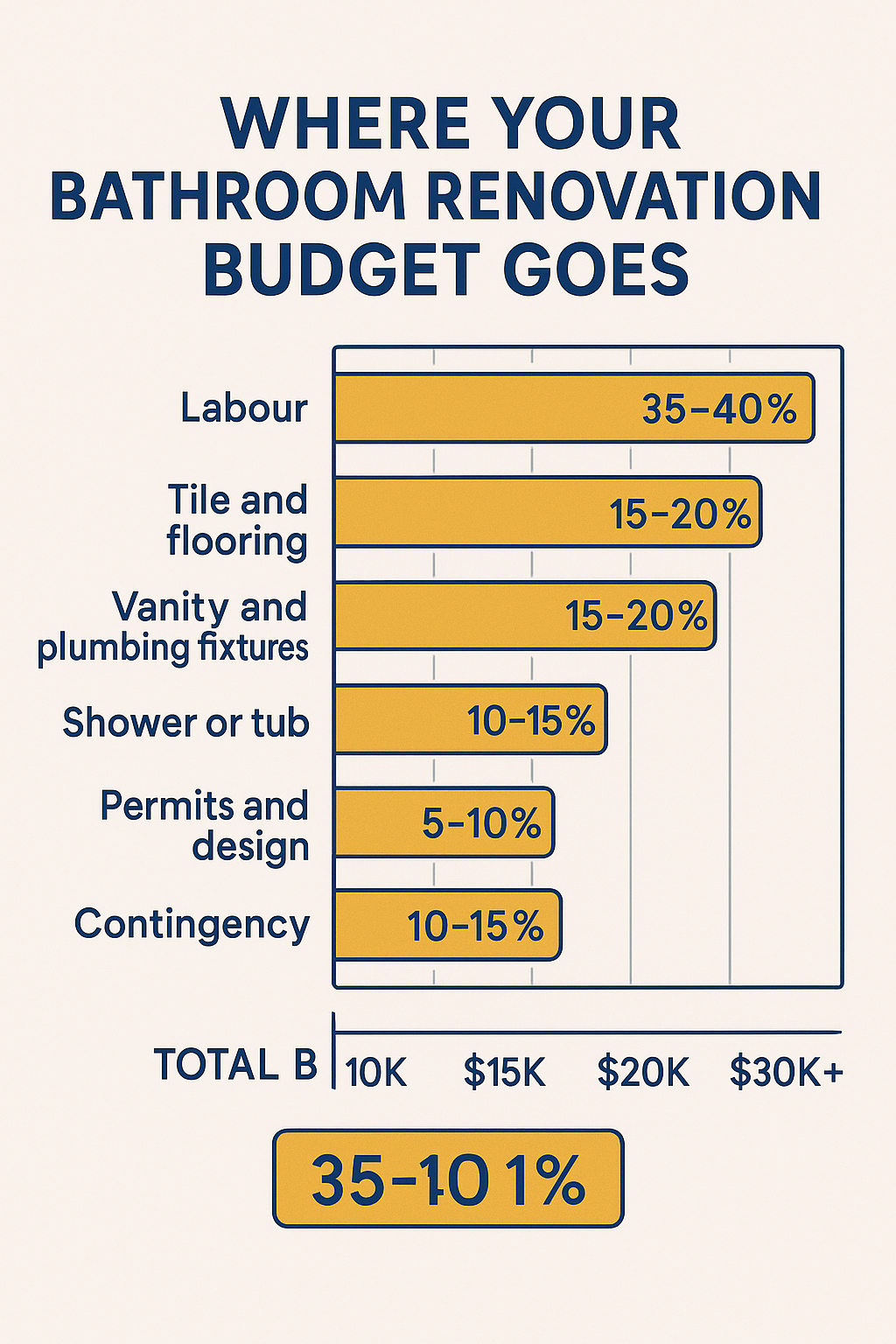
Understanding where the money goes is the foundation of a useful budget. Bathroom renovation costs split roughly as follows:
Labour: 40–50% of total budget
Labour is typically the largest single cost. It includes demolition, framing and waterproofing, plumbing, electrical, tile installation, painting, and fixture installation. Labour costs in Ottawa are set by the local market for licensed trades — they are not significantly negotiable.
Tile and materials: 15–25% of total budget
Floor tile, wall tile, backerboard, waterproofing membrane, grout, and adhesive. The range is wide because tile pricing varies enormously — from $3/sq ft builder-grade porcelain to $25+/sq ft natural stone.
Fixtures and fittings: 15–25% of total budget
Toilet, vanity, countertop, sink, faucet, shower fixtures, and tub (if applicable). Quality mid-range fixtures for a full bathroom renovation typically run $3,000–$6,000. Premium fixtures add significantly.
Electrical and plumbing (rough-in): 10–20% of total budget
Particularly relevant for renovations involving moving fixtures, adding heated floors, upgrading ventilation, or adding new lighting circuits.
Cabinetry and millwork: 5–15% of total budget
Custom or semi-custom vanity, linen cabinet, built-in shelving.
Setting Your Number
Work backward from what you want, not forward from a number you’ve heard.
Step 1: Define the scope. Is this a cosmetic refresh, a full gut renovation, or something in between? Scope is the primary cost driver.
Step 2: Identify any structural requirements. Is the plumbing moving? Is the electrical panel adequate? Does the subfloor need replacing? These are cost multipliers. If you do not know, get a professional assessment before setting a budget.
Step 3: Set a material quality level. Materials are where you have the most control over cost. Builder-grade tile and standard fixtures produce a clean, functional bathroom. Premium materials add cost without proportional functional improvement — that is a value judgment each homeowner makes differently.
Step 4: Apply a contingency. Every bathroom renovation encounters something unexpected once walls open. Typically a 10–15% contingency on the base project cost is appropriate. This is not pessimism — it reflects the reality of renovating existing homes where conditions are not fully known until demolition.
Step 5: Get quotes that reflect your scope. A quote based on a scope of work is meaningful. A budget number pulled from a home improvement website is not. Two quotes for the same scope in Ottawa with the same material specifications should be within 10–20% of each other. A quote that is dramatically lower than others deserves scrutiny.
Where to Spend and Where to Save
Spend on tile installation. Poorly installed tile fails. It cracks, grout lines open, and water gets behind it. Labour quality on tile work directly determines how long the renovation holds up.
Spend on waterproofing. Behind the tile in a shower is a waterproofing membrane. Cutting corners here means water infiltration in 5–8 years. The membrane cost is modest relative to the total project; the failure cost is significant.
Spend on fixtures you touch daily. The faucet, the shower valve, and the toilet flush mechanism are things you interact with every day. Quality fixtures at the $200–$600 range for faucets and $350–$700 for toilets outlast budget alternatives and feel better in daily use.
Save on decorative tile. Accent tile and decorative inserts add cost without structural function. A well-chosen field tile without decorative accents is often a better-looking result than a busy combination of multiple tile types.
Save on mirrors. A quality mirror at $150–$300 looks as good as one at $600 in most bathroom settings. Medicine cabinets add storage and function; plain mirrors save money.
For a consultation on what a specific scope costs in Ottawa, visit our bathroom renovation page or our powder room renovation page for smaller-scale projects.
Financing Your Renovation
Ottawa homeowners have several financing paths for bathroom renovations:
Home equity line of credit (HELOC). For homeowners with built equity, a HELOC provides flexible financing at mortgage-adjacent interest rates. It is the most cost-effective renovation financing tool available.
Renovation loan. Unsecured personal loans for home improvement. Higher interest rate than a HELOC but no equity requirement.
Government programs. The Canada Greener Homes Grant, Canada Mortgage and Housing Corporation (CMHC) programs, and Ontario provincial programs may provide rebates or financing assistance for specific renovation types — particularly those involving energy efficiency or accessibility improvements.
For general renovation cost guidance specific to Canadian markets, CMHC’s renovation resources and HomeStars’ annual contractor pricing guide are useful reference points.
Frequently Asked Questions
What is a realistic budget for a full bathroom renovation in Ottawa?
A full gut renovation of a standard 4-piece bathroom in Ottawa — new tile, fixtures, vanity, toilet, and shower — typically runs $12,000–$25,000 using quality mid-range materials and a professional contractor. Renovations involving moved plumbing, premium materials, or structural changes can reach $35,000 or more.
How much of a bathroom renovation budget should go to labour?
Labour typically accounts for 40–50% of a full bathroom renovation budget. This reflects the cost of licensed plumbers, electricians, tile setters, and carpenters in the Ottawa market. Labour is relatively fixed — it is not the primary area to economize.
What contingency should I add to a bathroom renovation budget?
A 10–15% contingency on the base cost is standard. Bathroom renovations frequently reveal subfloor damage, outdated plumbing that requires upgrading, or mould remediation needs once walls open. A contingency prevents these from derailing the project.
Can I save money by providing my own fixtures and tile?
Yes, homeowners often supply fixtures and tile purchased directly from suppliers. This works well when the material specifications are confirmed before ordering and when quantities are accurate. Contractors typically add a markup to supplied materials, so purchasing directly can save 10–20% on materials — but the homeowner assumes responsibility for correct specification and quantity.