
What Affects Bathroom Renovation Costs: Materials, Labour, and Scope
Bathroom renovation costs in Ottawa range from under $5,000 for a basic cosmetic refresh to over $50,000 for a full gut renovation of a large primary ensuite with premium materials. The gap between those numbers is explained by three factors: scope, materials, and labour. Understanding each one helps you make informed tradeoffs rather than guessing at a number.
Scope: The Primary Cost Driver
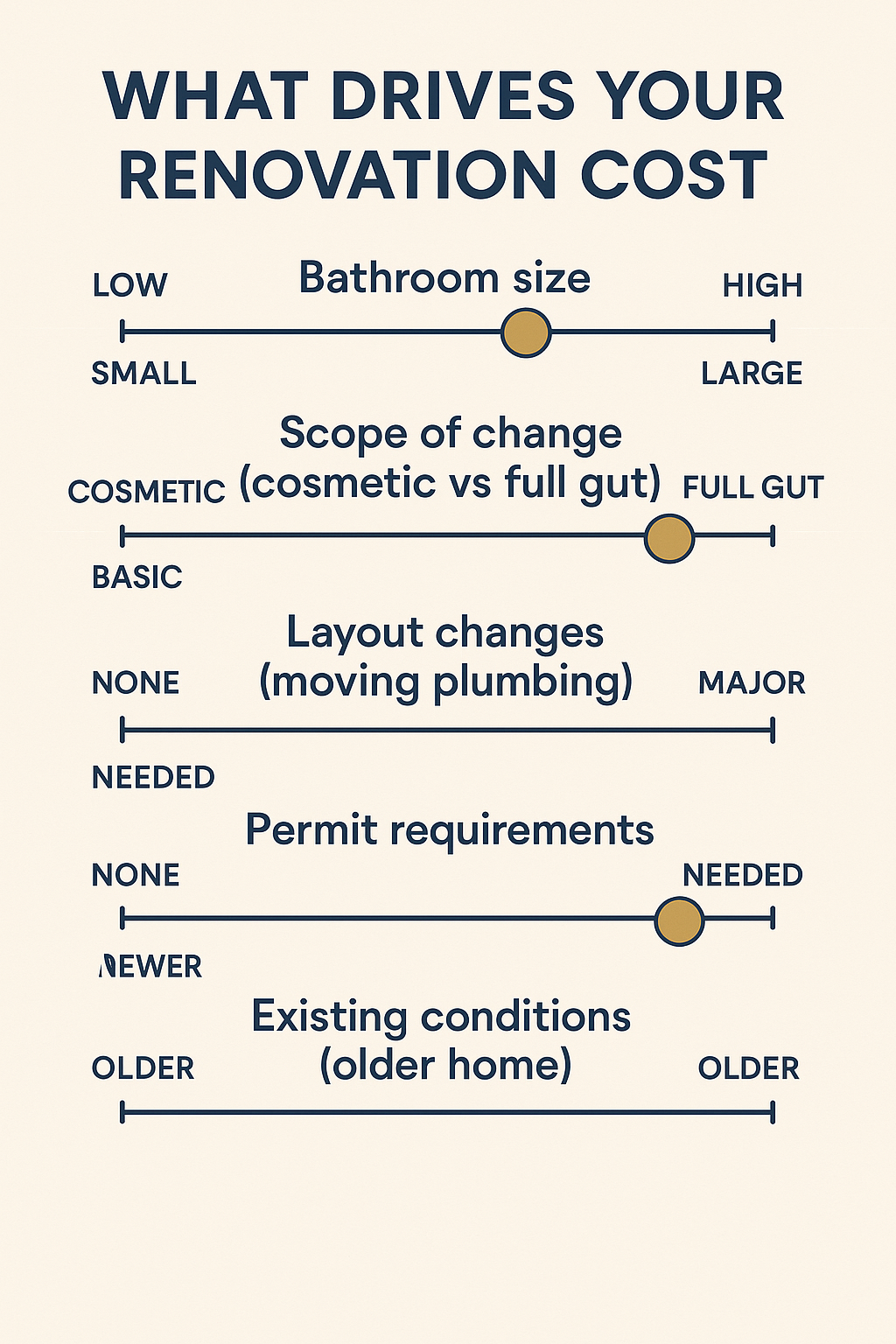
Scope refers to what is actually changing in the bathroom. It is the most important factor in determining overall cost, more influential than material selection or labour rates.
What scope includes:
– How many square metres of tile are being replaced
– Whether plumbing fixtures are moving (toilet, shower, sink) or staying in place
– Whether electrical is being upgraded, extended, or simply replaced in kind
– Whether the bathroom footprint is changing (addition, wall removal, expansion)
– Whether there are structural issues (subfloor, framing, joists) to address
A renovation that replaces tile, vanity, and fixtures without touching the plumbing or electrical is a fundamentally different project than one that moves the toilet, adds a new shower, and requires a new exhaust fan circuit.
Scope Categories and What They Cost
Replace only: Swap out the vanity, toilet, light fixtures, and accessories. Tile stays. Plumbing stays. Electrical stays. Cost range: $3,000–$7,000.
Surface renovation: Replace all tile, fixtures, and vanity without moving plumbing. Full demolition and reinstall of everything visible, but rough-in stays in place. Cost range: $10,000–$18,000.
Full renovation with minor plumbing: All new tile and fixtures, plus minor plumbing adjustments (repositioning a supply line, updating shut-off valves). Cost range: $15,000–$25,000.
Full renovation with layout changes: Moving the toilet, relocating the shower, changing the vanity wall. Requires significant plumbing rough-in work. Cost range: $20,000–$40,000.
Primary ensuite with premium scope: Full gut, structural work, premium tile, custom vanity, heated floors, frameless glass. Cost range: $30,000–$60,000+.
Materials: Where You Control the Budget
Within a given scope, material selection is where homeowners have the most influence over cost. The spread between builder-grade and premium materials is significant.
Tile
Tile is the dominant material cost in most bathroom renovations, and the price range is enormous.
- Builder-grade porcelain (e.g., 30 x 30 cm floor tile): $2–$5/sq ft
- Mid-range porcelain or ceramic: $5–$12/sq ft
- Large-format porcelain (60 x 120 cm or larger): $10–$20/sq ft
- Porcelain tile with a stone appearance (marble-look, slate-look): $12–$25/sq ft
- Natural stone (marble, travertine, slate): $15–$50+/sq ft
A standard 4-piece bathroom has approximately 25–35 sq metres of tile surface. At $5/sq ft, tile costs $1,350–$1,890. At $20/sq ft, the same surface runs $5,400–$7,560. The labour to install is the same regardless of tile price.
Vanities
A ready-to-install vanity ranges from $400 for a 60 cm builder-grade unit to $3,500+ for a solid-wood custom unit with stone top. Semi-custom vanities at $800–$1,800 account for the majority of mid-range renovations.
Countertops
Vanity countertop material adds cost beyond the vanity base:
– Engineered stone (quartz): $300–$800 for a standard vanity top
– Granite or marble: $400–$1,200 depending on slab
– Cultured marble or solid surface: $150–$400
– Ceramic integrated top: included in many stock vanity prices
Plumbing Fixtures (Faucets, Shower, Toilet)
Mid-range plumbing fixtures — a quality toilet ($350–$600), single-handle faucet ($200–$450), and a pressure-balance shower valve with trim ($250–$500) — total $800–$1,550. Premium brands and finishes (Kohler Signature, Grohe, TOTO Neorest) can triple or quadruple these costs.
Shower Enclosure
- Framed shower door: $400–$800 supply and install
- Semi-frameless: $700–$1,400
- Fully frameless glass panel or hinged door: $1,200–$3,000+
Labour: Fixed Costs in the Ottawa Market
Labour costs reflect the Ottawa market rates for licensed trades — plumbers, electricians, tile setters, and general carpenters. These are not significantly negotiable below prevailing rates without accepting quality or licensing risk.
Approximate Ottawa labour rates for bathroom work:
- Licensed plumber: $120–$175/hour
- Licensed electrician: $110–$160/hour
- Tile setter: $75–$120/hour
- Demolition and rough carpentry: $60–$90/hour
- Painting: $50–$80/hour
A full bathroom renovation typically involves 60–120 labour hours across all trades. Labour content varies significantly with scope complexity.
What drives labour costs up:
– Moving plumbing (the most expensive trade work in a bathroom)
– Complex tile patterns (herringbone, mosaic, large-format with precise layout)
– Custom millwork or built-in storage
– Heated floor installation (wiring and thermostat)
– Multiple inspections required for permit work
What keeps labour costs predictable:
– Keeping plumbing in place
– Standard tile formats in stack-bond or offset patterns
– Pre-manufactured vanity units rather than custom millwork
Permit Costs
Bathroom renovations in Ottawa that involve structural changes, moved plumbing, or new electrical circuits require a building permit. Permit fees in Ottawa are scaled to the value of the renovation. A $20,000 renovation permit typically runs $500–$900. Required inspections (framing, plumbing, electrical) add time but not significant additional cost.
Unpermitted work in a bathroom creates issues at resale and may not be covered by home insurance for water damage claims.
The Cost of Not Spending Enough
The cheapest bathroom renovation is often not the best value. Quality shortfalls that generate ongoing cost:
- Failed waterproofing → water damage behind walls within 5–8 years
- Poorly installed tile → cracked grout, loose tiles, required re-tile within 3–5 years
- Undersized exhaust fan → mould growth within 2–3 years
- Cheap toilet → repeated service calls and eventual replacement
Spending adequately on installation quality and waterproofing protects the investment in the materials you chose. The best renovation result combines mid-range materials with high-quality installation.
For a full bathroom renovation quote in Ottawa, our team provides detailed breakdowns across scope, materials, and labour so you can see exactly where your budget is going. We also serve homeowners in Kanata, Barrhaven, and across the Ottawa region.
For independent pricing benchmarks, HomeStars publishes annual contractor pricing data for Canadian markets, and Renoassistance provides vetted contractor matching and cost guidance for Ontario homeowners.
Frequently Asked Questions
What is the biggest factor affecting bathroom renovation cost?
Scope — specifically whether plumbing and electrical fixtures are moving. A renovation that keeps plumbing in place costs significantly less than one that relocates the toilet, shower, or sink, because plumbing rough-in work is one of the most expensive components of a bathroom renovation.
How much does tile selection affect the total renovation cost?
Tile price per square foot can range from $2 to $50+. On a standard bathroom with 30 square metres of tile surface, moving from a $5/sq ft tile to a $20/sq ft tile adds $4,500+ to material costs alone, with identical labour. Material selection is the primary lever homeowners control in a mid-range to high-end renovation.
Does a bathroom renovation require a permit in Ottawa?
It depends on scope. Cosmetic renovations (replacing like-for-like fixtures without structural, plumbing, or electrical changes) typically do not require a permit. Renovations involving moved plumbing, new electrical circuits, or structural changes do require a permit from the City of Ottawa.
Why do two bathroom renovation quotes differ so much?
Significant quote variation typically reflects: different scope assumptions (one contractor included items the other excluded), different labour rates (licensed vs unlicensed trades), different material allowances, and different levels of preparation work included. A line-item comparison of two quotes — rather than a total comparison — usually reveals the source of the difference.