
Glass Shower Doors vs. Curtains: Pros, Cons, and What Most Homeowners Choose
The choice between a glass shower door and a shower curtain is one the homeowners often underestimate. It affects daily use, cleaning effort, the visual quality of the finished bathroom, and the resale impression of the space. Neither is universally superior — the choice depends on the shower type, budget, household priorities, and how much cleaning effort you are willing to put in over the years.
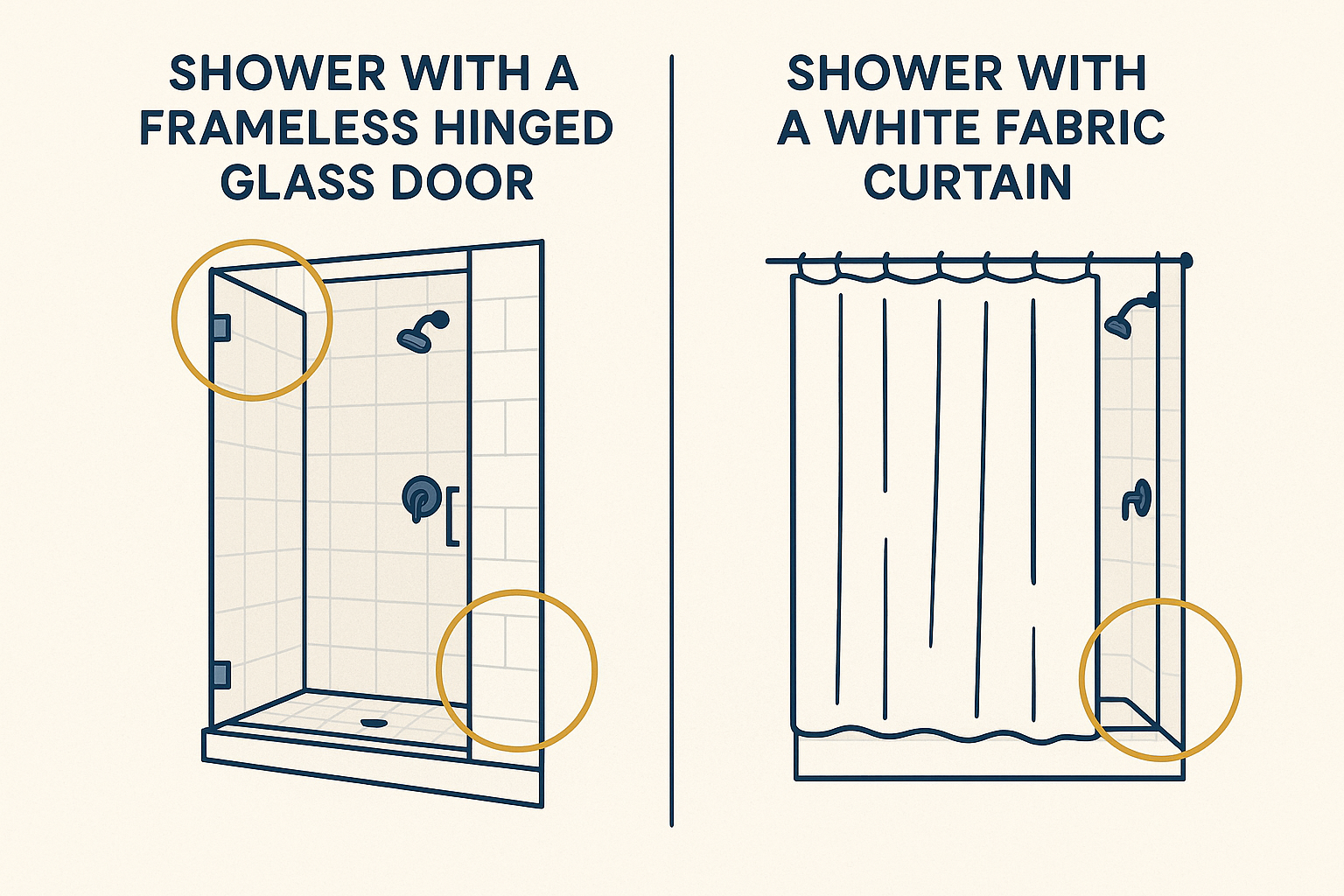
Shower Curtains: The Case For
Shower curtains are the simplest, most affordable, and most flexible enclosure solution. A quality curtain rod, liner, and curtain can be installed in 20 minutes and replaced in another 20 when worn or outdated.
Advantages of shower curtains:
Low cost. A curtain rod and quality curtain runs $50–$200. Even a premium option with a decorative curtain is under $300.
Easy replacement. When the liner develops mildew or the curtain style needs updating, replacement takes minutes and costs very little. This flexibility suits households that like to refresh the bathroom look without major investment.
No glass cleaning. Shower doors develop soap scum and hard water deposits on the glass. Curtains avoid this cleaning task entirely.
No maintenance. No hinges to maintain, no seals to replace, no track to clean. The curtain rod stays in place indefinitely.
Accessibility. For seniors and people with limited mobility, a curtain provides more flexible entry into the shower than a hinged or sliding door. The opening is not constrained by door swing clearance.
Disadvantages of shower curtains:
Water containment. A curtain liner relies on contact with the tub or shower walls to contain spray. When the curtain is displaced mid-shower — by pressure or movement — water escapes easily. This is less of an issue in an alcove shower than in a walk-in shower.
Appearance. A shower curtain signals a budget or secondary bathroom in the mind of most buyers and visitors. It does not project the finished quality of a glass enclosure.
Mould on the liner. Shower liners accumulate mildew at the base when not regularly cleaned or replaced. Most disposable liners need replacement every 3–6 months in an active shower.
Glass Shower Doors: The Case For
Glass shower doors — frameless, semi-frameless, or framed — are the standard choice for any bathroom renovation intended to project quality.
Advantages of glass shower doors:
Appearance. Glass doors make a bathroom look more finished, more spacious (particularly frameless glass), and more premium than a curtain. Frameless glass in particular reads as genuinely high-end.
Water containment. A hinged or sliding glass door contains shower spray more reliably than a curtain — particularly in a walk-in shower where a curtain would be impractical.
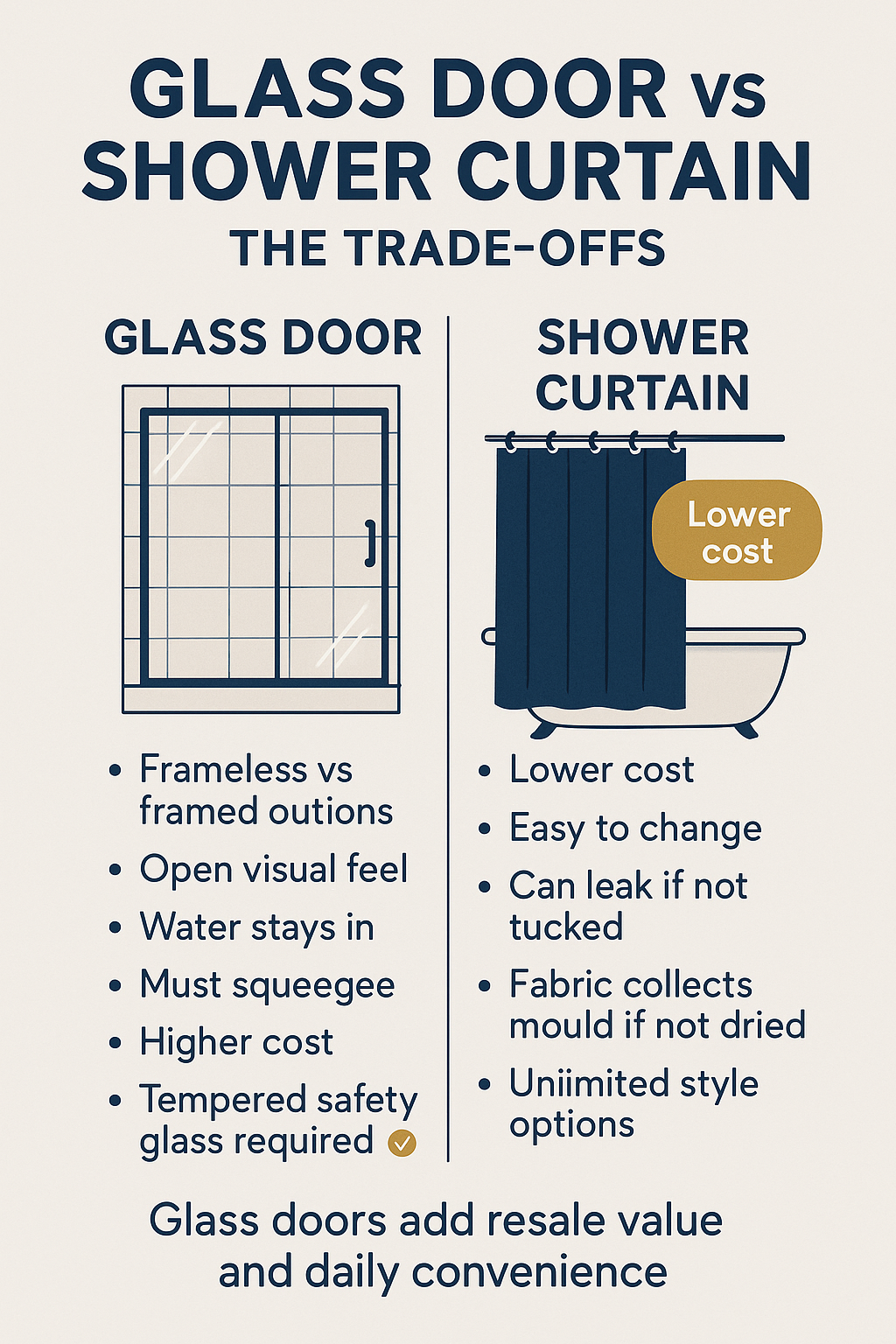
Perceived value. For resale, a glass shower enclosure is a clear upgrade signal over a curtain. In the mid-to-premium renovation market, glass is the expected standard.
Durability. A quality glass shower door and hardware is a one-time installation that, properly maintained, lasts the life of the bathroom renovation.
Disadvantages of glass shower doors:
Cleaning. Glass doors require regular cleaning to prevent soap scum and hard water buildup on the glass surface. This is the most common complaint from glass door owners in Ottawa homes, where moderate mineral content in the water produces visible deposits. A squeegee after each shower significantly reduces the cleaning effort, but it requires consistent discipline.
Cost. A framed sliding door runs $300–$700 installed. A semi-frameless hinged door runs $700–$1,400 installed. A fully frameless door or panel runs $1,200–$3,000+ installed.
Fixed configuration. Once installed, the door is in a fixed position. Removing or replacing it is possible but involves work.
Door Types and Their Characteristics
Framed Sliding Door
A framed sliding door uses a metal frame around all glass panels and slides on a top track and bottom track. It is the most common and least expensive glass enclosure for alcove showers.
Advantages: Lower cost, widely available, functional for alcove installations.
Disadvantages: Metal frame around glass panels is harder to clean, the bottom track accumulates grime, the sliding mechanism requires track cleaning, and the appearance is builder-grade.
Semi-Frameless Hinged Door
A semi-frameless door has framing only at the top, bottom, and hinge side. The glass edge on the door-swing side is unframed. This provides a cleaner appearance than a fully framed door with less cost than a fully frameless unit.
Frameless Hinged Door
A frameless door uses thick tempered glass (10–12 mm) with no metal frame. The door is supported entirely by the hinge hardware and door-side seals. The visual result is nearly invisible glass with minimal hardware — the standard for premium bathroom renovation.
Advantages: Visual quality is significantly superior to framed or semi-frameless. The minimalist hardware suits contemporary and transitional bathroom designs.
Disadvantages: Higher cost. Installation requires precise levelling of the frame opening. The hinge hardware must be properly maintained.
Open Entry (No Door)
In larger walk-in showers, the glass panel approach — a fixed glass panel that contains spray without a door — is increasingly popular. No pivot, no hinges, no door track. The shower is entered by walking around the glass panel.
This approach is the most minimal and the easiest to clean. It works best in showers 120 cm or wider, where water containment from the open entry is not an issue.
What Most Ottawa Homeowners Choose
In mid-to-full bathroom renovations, glass enclosures are the standard choice at essentially every price point above a basic cosmetic refresh. A frameless or semi-frameless hinged door is the most common selection in the $15,000–$30,000 renovation range. Fully frameless glass panels and pivot doors are common in premium primary ensuite renovations.
Shower curtains are retained primarily in:
– Secondary bathrooms with alcove tub-shower combos (where the curtain suits a family bathing context)
– Budget-constrained renovations
– Rental properties where simplicity and replaceability are priorities
For shower enclosure selection and installation as part of a tub-to-shower conversion or full bathroom renovation in Ottawa, our team handles enclosure specification and installation across all types.
For glass shower door standards and tempered glass specifications, ANSI Z97.1 and CSA B72 govern the safety glazing standards for shower enclosures in Canada.
Frequently Asked Questions
Are frameless shower doors worth the higher cost?
In a primary bathroom renovation, yes. Frameless glass provides the cleanest visual appearance, is easier to clean than framed options (no metal frame channels to scrub), and reads as a premium finish that adds to the perceived quality of the bathroom. The cost premium over semi-frameless is typically $300–$600, which is justified by the quality difference in appearance and maintenance.
How do I prevent soap scum buildup on glass shower doors?
The most effective method is squeegeeing the glass after every shower. This removes water and soap before they dry and leave deposits. A hydrophobic glass treatment (Rain-X or similar) applied every few months causes water to bead and run off more readily, significantly reducing buildup. Vinegar-based glass cleaners remove existing mineral deposits without scratching.
Can I install glass shower doors in a walk-in shower without walls?
A walk-in shower without a wall enclosure typically uses a fixed glass panel — not a door — to contain spray. The panel is anchored to the floor and ceiling (or wall) and provides water containment from the spray zone without requiring a door. This works best in showers 120 cm or wider where the open entry is far enough from the shower head.
How long do glass shower doors last?
The glass itself essentially lasts indefinitely — tempered safety glass does not deteriorate under normal conditions. The hardware (hinges, handles, seals) has a lifespan of 10–20 years depending on quality and maintenance. Door seals and sweeps at the bottom typically need replacement every 5–10 years.