
Grab Bars in the Bathroom: Placement, Types, and Installation
Grab bars are the highest-value safety feature available in a bathroom renovation. Per dollar spent, no other bathroom modification reduces fall risk more effectively for seniors, people with limited mobility, or anyone recovering from injury. A properly installed grab bar beside the toilet and in the shower costs $200–$600 each, installed — and it directly addresses the moments when bathroom falls most commonly occur.
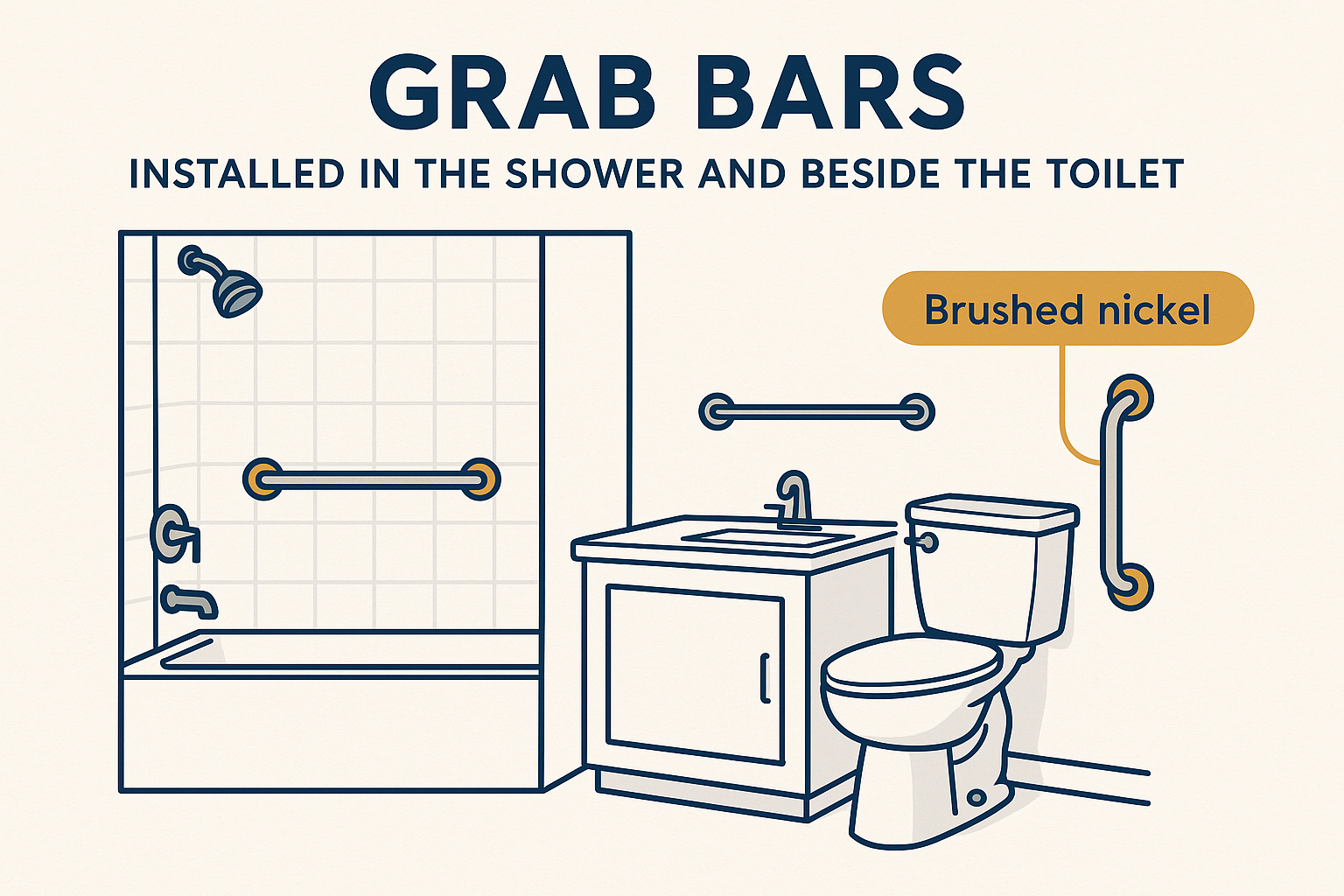
The barrier to grab bar installation is rarely cost. It is typically the assumption that grab bars look clinical, the lack of wall blocking to support them, or simply not thinking about them during the renovation. This guide addresses all three.
When Falls Happen in the Bathroom
Bathroom falls cluster at specific moments:
- Entering or exiting the tub or shower — one foot on a wet surface, one foot lifted, weight shift
- Rising from the toilet — transition from seated to standing, often without a support surface to push from
- Turning or bending while wet and on a slippery surface
- Recovering from a slip — when the foot slides, the first available grip determines whether the fall completes
A grab bar, correctly positioned at each of these moments, gives the hand something solid to hold during the highest-risk transition. The bar does not replace balance — it supplements it.
Grab Bar Placement: Where They Matter Most
At the Toilet
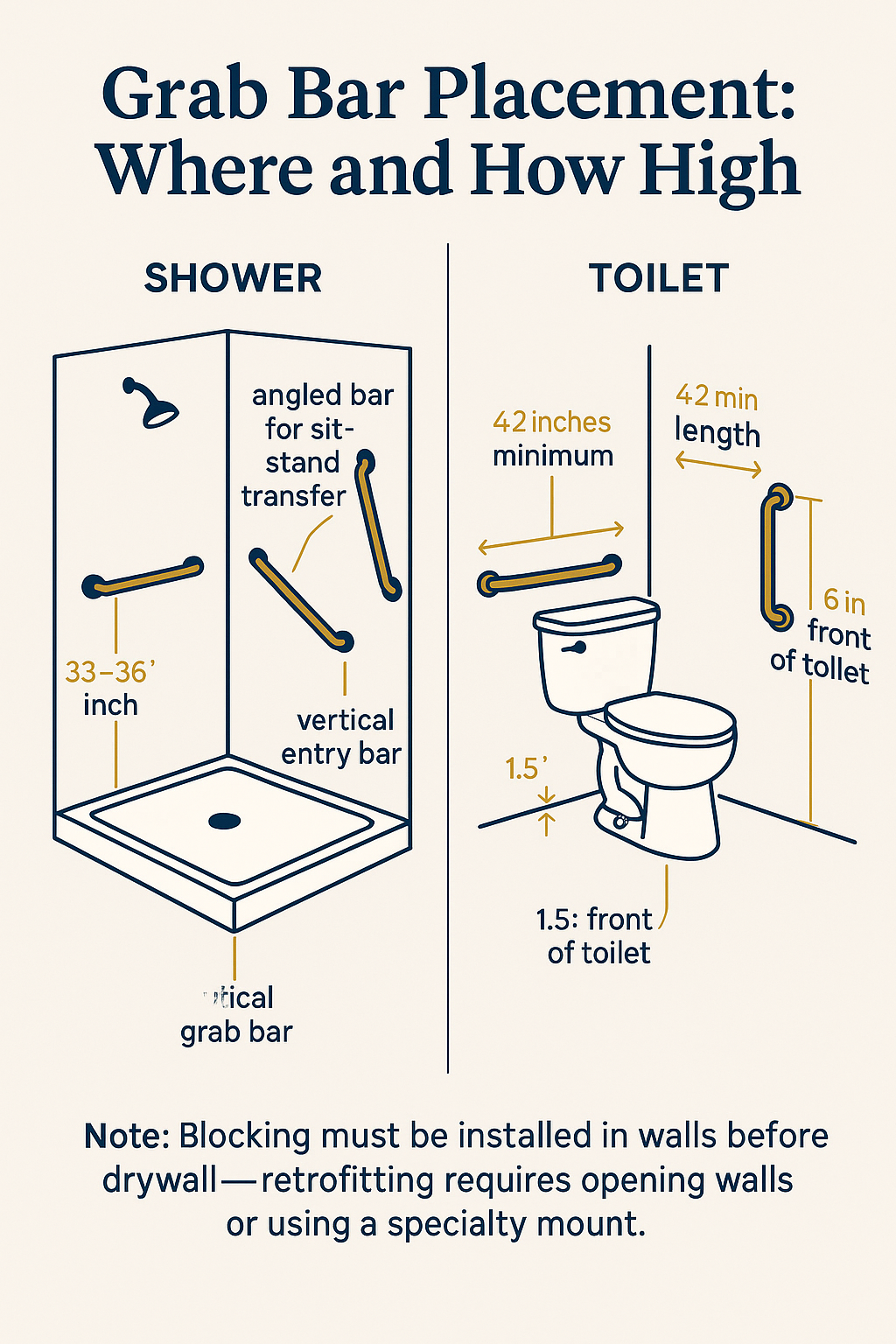
Side wall bar: A horizontal grab bar on the wall beside the toilet at 840–915 mm (33–36 inches) from the floor, beginning at or near the front of the toilet and extending 24 inches (610 mm) toward the back wall. This bar is gripped when rising from or lowering to the toilet seat.
Rear wall bar: A bar on the wall behind the toilet, at 840–915 mm height, spanning a minimum of 600 mm. This bar provides support for sitting positioning and a stabilizing grip when reaching for toilet paper.
If only one bar can be installed beside the toilet, the side wall bar is the higher-priority position — it directly supports the standing transition.
In the Shower
Entry bar — vertical: A vertical bar at the entry point of the shower, at 1,370–1,680 mm (54–66 inches) from the floor. The user grips this bar when stepping into or out of the shower. The vertical orientation allows it to be gripped at any height and in multiple hand positions.
Side wall bar — horizontal: A horizontal bar at 840–915 mm on the shower side wall (the wall to the side of the user’s standing position). This bar provides support during washing and is within reach for balance recovery.
Back wall bar — horizontal: A horizontal bar on the back wall of the shower at 840–915 mm. Provides support when turning and a secure grip for users who shower with their back to the entry.
Bench bar: If a shower bench is present, a bar adjacent to and above the bench (positioned at a height that supports the standing transition from the bench) significantly improves the safety of seated showering.
In the Bath
Tub side bar: For bathtubs in use, a horizontal bar on the wall at the long side of the tub at 840–915 mm provides support when rising from the tub.
Tub entry bar: A vertical bar at the foot of the tub entry (the end the user steps over) provides grip when the first foot steps in and when the last foot steps out — the highest-risk moments.
Types of Grab Bars
Standard Grab Bar
A cylindrical bar, 32–38 mm in diameter, in lengths from 30 cm to 120 cm. Available in every finish that matches common bathroom hardware: brushed nickel, polished chrome, matte black, brushed gold.
The 32–38 mm diameter is specified in Canadian accessibility standards (CSA B651) because it provides a secure grip for most hand sizes without requiring excessive hand-closing force.
Angled and L-Shaped Bars
Angled bars — typically at 135° — address shower entry corners where a single bar serves both the vertical and horizontal grip function. L-shaped bars combine a vertical entry grip with a horizontal support bar in one unit, minimizing the number of wall penetrations.
Fold-Down Grab Bar
A fold-down bar mounts to the wall and folds up when not in use. It is useful beside toilets in tight bathrooms where a fixed horizontal bar would be awkward when the space is used by a person who does not need it. The fold-down design provides the bar when needed and clears it when not.
Towel Bar Grab Bars
Decorative grab bars designed to function as towel bars as well as safety bars are available from major hardware manufacturers (Moen, Delta, Kohler). These bars are rated for grab bar loads while appearing identical to a standard towel bar. They are a practical choice in guest bathrooms or powder rooms where the grab bar function is desirable but the clinical appearance is not.
Note that a standard towel bar is NOT a grab bar. Standard towel bars are anchored with screws into drywall anchors designed for towel weight, not for the 250 kg+ force a falling adult can apply. A towel bar used as a grab bar typically fails when pulled, contributing to rather than preventing a fall.
Installation Requirements
Wall Blocking
A grab bar must be anchored into solid material: a wall stud, a plywood blocking panel, or a purpose-made grab bar backing panel. The minimum anchoring requirement is two screws into solid material — not drywall anchors.
In a tiled bathroom, the tile must be drilled through to reach the wall framing. A tile installer or handyperson with proper drill bits (diamond or carbide tile bits) and technique can drill through tile without cracking it.
During a bathroom renovation — before tiling — installing 19 mm plywood blocking panels in all anticipated grab bar locations is the most cost-effective approach. Blocking panels provide a solid anchoring surface anywhere within the blocked zone, eliminating the need to locate specific stud positions when bars are installed later.
Professional vs. DIY Installation
Grab bar installation is within the capability of a homeowner with basic carpentry skills, a drill, and the right drill bits — provided the wall blocking is present. The critical requirement is that the screws reach solid material.
For a tiled bathroom without existing blocking, professional installation by an experienced renovator or handyperson who can correctly locate studs through tile is the safer choice. An incorrectly installed grab bar that fails under load is more dangerous than no grab bar.
Load Rating
Canadian accessibility standards and manufacturer specifications for residential grab bars specify a minimum load rating of 1,112 N (250 lbs) for properly installed bars. Verify the load rating for any bar purchased; this information is on the product specification sheet.
For bathroom renovations that include aging-in-place accessibility features, our team at Miracle Dream Homes specifies grab bar blocking as a standard element of any accessibility-focused renovation. See also our full bathroom renovation page for complete renovation services.
For residential grab bar standards in Canada, CSA Group B651 (Accessible Design for the Built Environment) specifies placement heights, diameter requirements, load ratings, and installation standards used in residential accessibility renovation.
Frequently Asked Questions
Can a grab bar be installed on a tiled wall without blocking?
Yes, with proper technique. A grab bar can be anchored through tile into wall studs using appropriate drill bits and screws long enough to reach the stud framing. The challenge is locating studs accurately through existing tile — typically done with a stud finder and careful measurement. If the stud positions do not align with the ideal bar placement, blocking panels can be installed by cutting out a section of drywall (from the back, if accessible) without removing tile. A professional experienced in accessibility retrofits has the tools and technique for this work.
Do grab bars have to match the bathroom hardware finish?
No — but matching finishes produces a more cohesive appearance. If the bathroom hardware is all brushed nickel, brushed nickel grab bars maintain visual consistency. Matte black grab bars in a chrome bathroom are not incorrect, but the mismatch reads as mismatched hardware. Most major manufacturers (Moen, Delta, Kohler) offer grab bars in the same finish families as their faucet and hardware lines, making matching straightforward.
How much weight can a grab bar support?
A properly installed residential grab bar rated to CSA B651 standards supports a minimum of 1,112 N (approximately 250 lbs) of load. In practice, a bar anchored into plywood blocking with appropriate screws supports significantly more. The limiting factor is almost always the anchoring, not the bar itself — which is why blocking and correct fasteners matter more than bar brand or price.
Should I install grab bars in my bathroom even if I don’t need them yet?
Yes, during any bathroom renovation. The incremental cost of installing blocking — 19 mm plywood panels between studs before tiling — is $200–$500 during a renovation. Retrofitting blocking after tile is installed requires cutting into the wall. If you install blocking now but no bars, you retain the flexibility to install bars at any future point without renovation work. Grab bars can be added to a blocked wall in an afternoon.