
Basement Bathroom Design: Challenges, Solutions, and What to Expect
Adding or renovating a bathroom in a basement is one of the most common renovation projects in Ottawa homes. A basement bathroom adds a full or partial bathroom to the lowest level of the home — useful for finished basement living areas, basement bedroom suites, or rental units. It also involves a distinct set of technical challenges that do not apply to above-grade bathroom renovations.
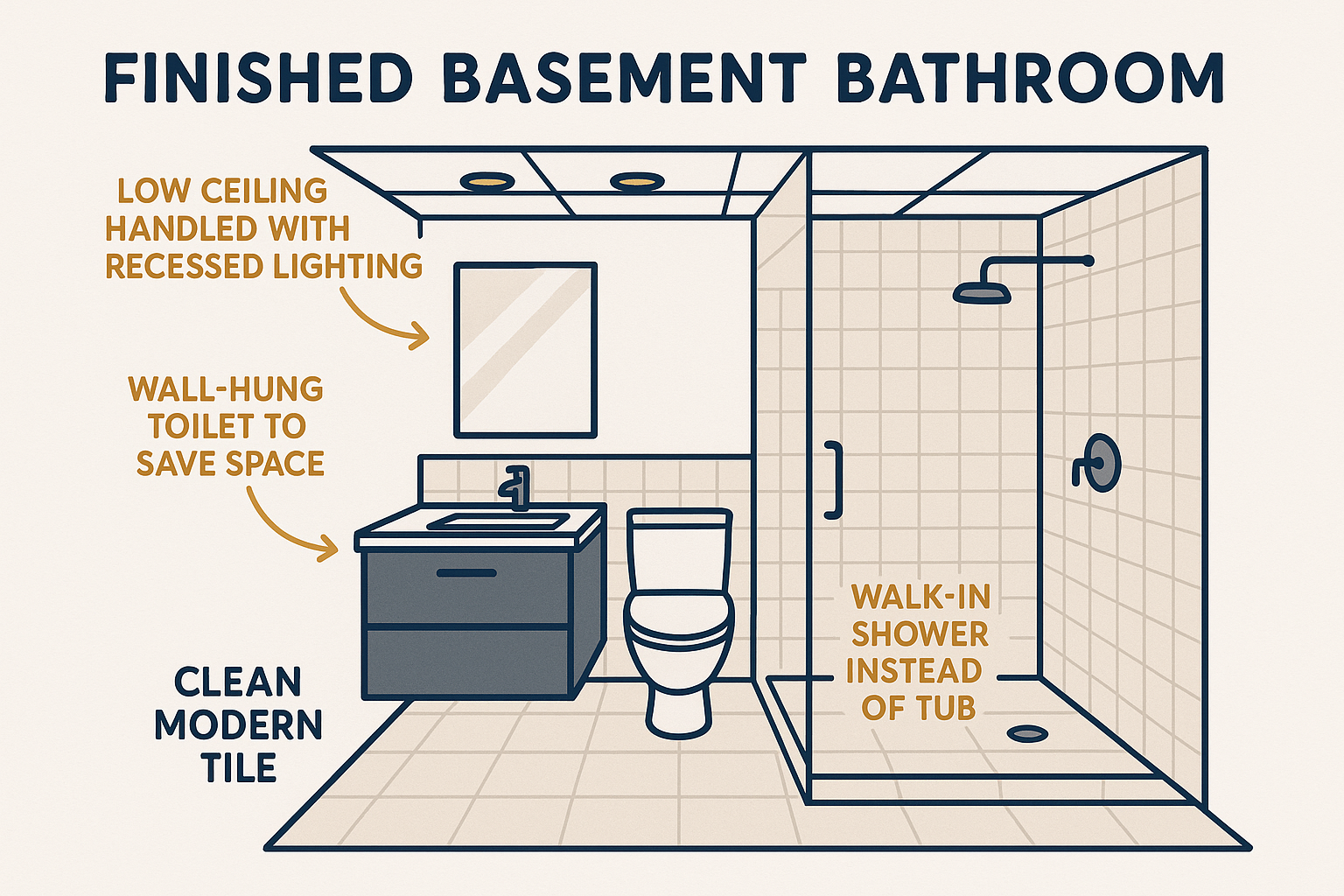
Understanding these challenges upfront determines the project’s scope, cost, and timeline far more accurately than treating a basement bathroom like an ordinary bathroom renovation.
The Core Challenge: Drain Elevation
Every bathroom drain must connect to the home’s main drain stack and ultimately exit the home below the frost line. In an above-grade bathroom, gravity handles this — wastewater flows downward from the fixtures to the stack and out.
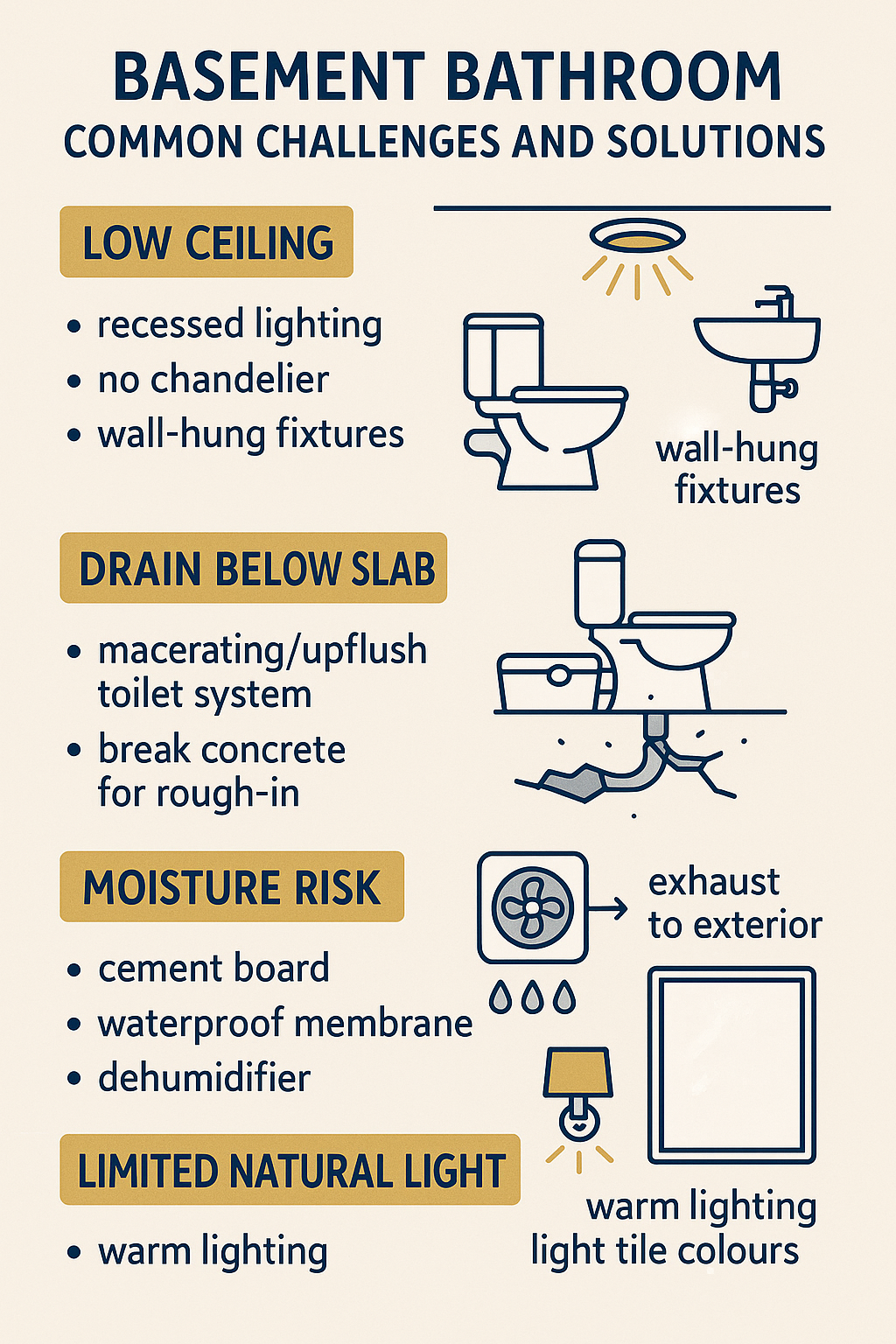
In a basement bathroom, the fixtures are at or below the level of the main sewer line. Wastewater cannot flow upward under gravity. Two solutions exist:
Option 1: Below-Slab Rough-In
If the basement already has a plumbing rough-in — drain pipes stubbed up through the concrete floor — the bathroom was planned for during the home’s original construction. In this case, the drains already connect to the main stack below the slab, and the rough-in location determines where the toilet, shower, and sink must be placed.
Many Ottawa homes built from the 1980s onward include a basement bathroom rough-in. If your home has one, a basement bathroom addition is significantly simpler — you are completing plumbing that was already designed into the structure.
If no rough-in exists, adding drains requires breaking the concrete floor (saw-cutting and excavating), installing new drain pipes below the slab, and re-pouring the concrete. This is the most significant cost item in a basement bathroom addition without an existing rough-in: $3,000–$7,000 for the concrete work alone.
Option 2: Above-Slab Sewage Ejection
A sewage ejection system — also called a sewage ejector pump or macerator pump — receives wastewater from the basement bathroom fixtures, grinds or macerates the waste, and pumps it upward and into the main drain stack above slab level.
Advantages: No concrete cutting required. The bathroom can be located anywhere in the basement, not just where rough-in drains exist.
Disadvantages: The pump requires electrical connection, maintenance, and eventual replacement. The system is more complex and has more failure points than a gravity drain. The grinding pump generates noise during operation. Certain waste types (flushable wipes, excessive solids) cause pump failures.
Sewage ejection systems are a practical solution where concrete cutting is not viable or cost-effective. Brands like Saniflo and Zoeller are established in the residential market. The system is reliable when properly installed and maintained.
Moisture and Waterproofing
Below-grade spaces are fundamentally different from above-grade in terms of moisture risk. Concrete foundation walls and slabs are porous — they transmit moisture from the soil outside, even when dry to the touch.
Adding a bathroom in this environment requires:
Vapour barrier on below-grade walls: Concrete foundation walls must have a vapour barrier installed before any framing, drywall, or tile work. This is not optional — tiling directly against a concrete wall without a vapour barrier is a common cause of early tile failure and mould growth.
Proper drain waterproofing: The shower floor waterproofing in a basement shower must address not only water from the shower but also potential moisture infiltration from below. A sheet membrane or liquid-applied waterproofing system that bridges the tile substrate and drain assembly provides this protection.
Bathroom exhaust ventilation: The exhaust fan in a basement bathroom must vent to the exterior — not into the basement ceiling plenum or the floor above. A basement with inadequate ventilation accumulates moisture rapidly and creates conditions for mould. Exterior venting from the basement requires running ductwork through the wall (in a walkout basement) or up through the home to an exterior vent point.
Water source identification: If there is any history of water seepage in the basement, this must be addressed before bathroom construction begins. A bathroom installed over an active water infiltration issue will fail and require remediation.
Ceiling Height
Ontario Building Code requires a minimum ceiling height of 1,950 mm (approximately 6 feet 5 inches) in a habitable space, though specific requirements for bathrooms are governed by the applicable edition of the code. Many older Ottawa basements fall short of this standard, particularly where ductwork, beams, and structural elements create low-clearance zones.
Before designing a basement bathroom, confirm the actual ceiling height in the proposed location after accounting for the finished floor (tile on concrete adds 10–20 mm) and any ceiling finish (drywall on strapping reduces ceiling height by 50–75 mm). A ceiling height that appears adequate may fall below the minimum after these deductions.
If the basement ceiling height is below the minimum, options include:
– Locating the bathroom in the highest-clearance area of the basement
– Relocating ductwork or reconfiguring mechanical systems to gain clearance
– Accepting a small non-habitable utility bathroom (where the code minimums may differ)
Design Considerations for Basement Bathrooms
Natural light: Basement bathrooms typically have no windows, or very small windows at the top of the wall. Light design in a basement bathroom must compensate for the absence of natural light — bright, layered artificial lighting is particularly important.
Tile selection: Lighter tile colours and finishes help compensate for the low ceiling and absence of windows. Reflective or gloss tile surfaces add perceived brightness.
Ceiling treatment: A bright white ceiling maximizes light reflection. A drop ceiling or painted grid ceiling that allows access to plumbing and mechanical systems above is practical in a basement bathroom.
Shower configuration: A walk-in shower without a door (using a fixed glass panel or an open entry) is easier to manage in a tight basement bathroom than a hinged door that requires swing clearance.
What a Basement Bathroom Addition Costs in Ottawa
A basement bathroom addition in Ottawa — adding a full or three-quarter bathroom where none existed — runs:
With existing rough-in: $12,000–$20,000 for a standard scope with quality finishes.
Without existing rough-in (with concrete cutting): $18,000–$30,000 depending on the complexity of the plumbing work and the bathroom scope.
With sewage ejection system: $15,000–$25,000 — slightly lower than concrete cutting if the ejector system avoids extensive excavation.
For basement bathroom additions and renovations in Ottawa, our team at Miracle Dream Homes handles all aspects of the technical scope, including plumbing assessment, waterproofing, and permit applications. See also our general bathroom renovation page for full renovation services.
For Ontario Building Code requirements for basement habitable space and bathroom requirements, the Ontario Building Code Act and Ottawa Building Code Services govern permit requirements for basement bathroom additions.
Frequently Asked Questions
Do I need a permit to add a basement bathroom in Ottawa?
Yes. Adding a basement bathroom involves plumbing work and potentially structural modifications — both of which require a building permit from Ottawa Building Code Services. The permit process ensures that the plumbing connections, drain work, and electrical connections meet code requirements. Your contractor applies for the permit as part of the project scope.
What is the cheapest way to add a basement bathroom?
The least expensive path to a basement bathroom is completing an existing rough-in — using drain connections already installed below the slab. If your home has a rough-in, completing it typically costs $12,000–$18,000 for a functional three-quarter bathroom. Without a rough-in, a macerating/sewage ejection system avoids concrete cutting and is typically less expensive than saw-cutting the slab — though the pump adds long-term maintenance considerations.
How do I find out if my basement has a rough-in?
Look for capped drain pipe stubs protruding through the concrete floor — typically near one corner or wall of the basement. These are usually capped with a plastic or rubber plug at floor level. A plumber can also confirm whether existing rough-in drains are connected to the main stack and at what depth. Many Ottawa homes built after 1980 include a three-piece rough-in (toilet, shower, and sink drain).
Can I put a bathroom anywhere in my basement?
With a sewage ejection system, a basement bathroom drain can be installed anywhere — the pump pushes wastewater up to the main stack regardless of fixture location. With a gravity drain, the bathroom must be positioned where the drain lines can connect to the main stack at the correct depth and slope. This usually means the bathroom needs to be close to where the main stack exits the basement floor.