
Choosing a Bathroom Faucet: Types, Finishes, and What to Look For
A bathroom faucet is one of the most frequently used fixtures in any home. The average household uses a bathroom faucet 20–30 times per day, which means a faucet installed in 2025 will be operated tens of thousands of times before the next renovation. Quality and reliability matter here more than in many fixture choices.
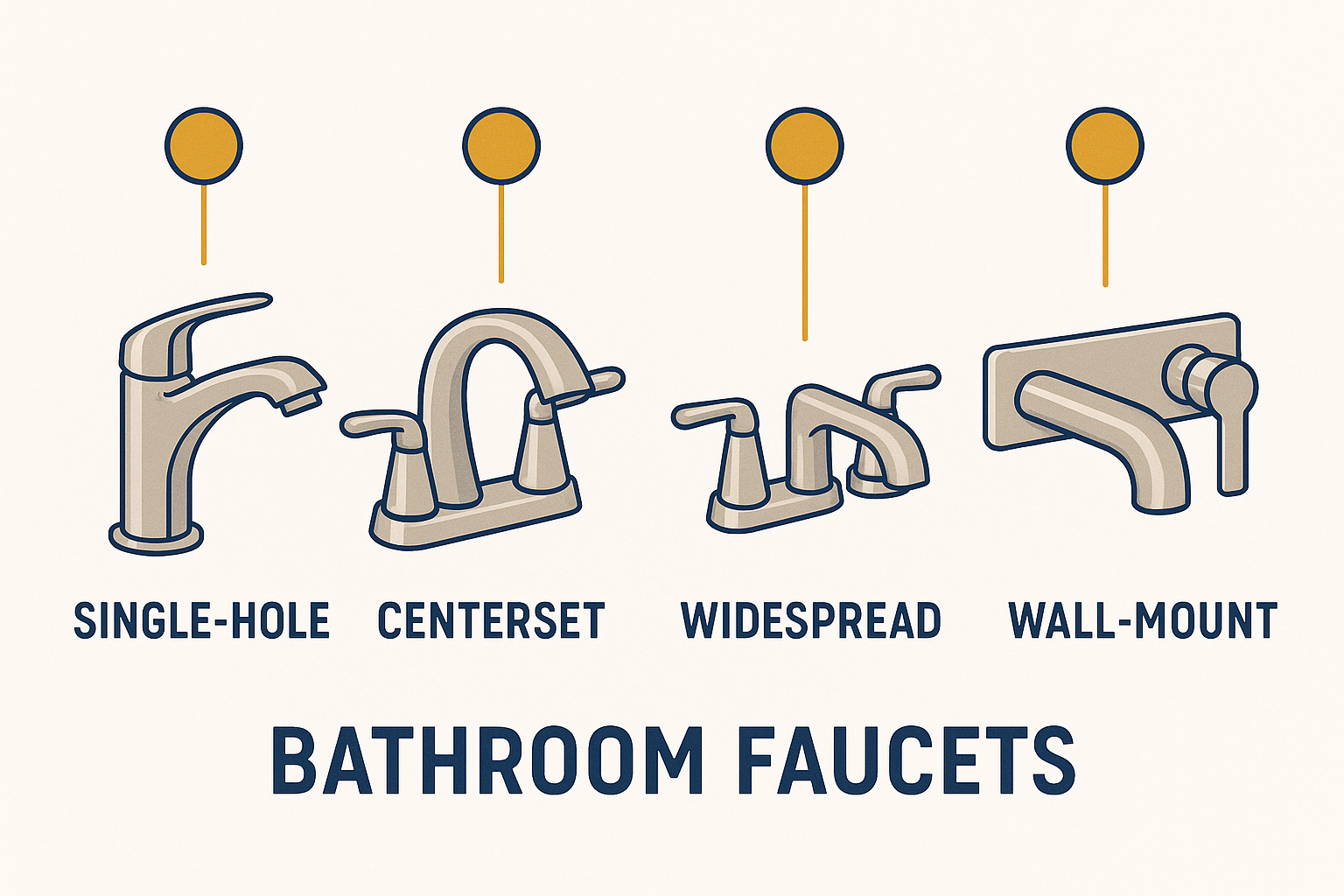
This guide covers the main faucet types for bathroom vanities, the finishing options and what they actually mean for durability, and the quality markers that separate faucets worth the money from ones that look similar but are not.
Bathroom Faucet Types by Configuration
Single-Hole (Single-Handle) Faucet
A single-hole faucet mounts through one hole in the countertop or vanity deck. It typically uses a single lever handle that controls both temperature and flow by pivoting left-right (temperature) and up-down (flow). Some versions are taller pillar-style designs with a separate lever or knob.
Advantages:
– Clean, minimal appearance
– Easy to operate — one motion for temperature and flow
– Requires only one countertop hole (simpler to retrofit)
Best for: Contemporary and transitional bathrooms, single-sink vanities, countertops without pre-drilled holes.
Widespread Faucet (Three-Hole)
A widespread faucet has three separate components: a spout and two handles. Each is mounted independently through its own countertop hole. The spacing between handles (typically 20 cm / 8 inches centred) gives the vanity deck a more traditional and substantial appearance.
Advantages:
– Traditional look with visual presence
– Independent hot and cold controls
– Available in a wide range of styles from traditional to contemporary
Best for: Traditional and transitional bathrooms, double vanities, countertops with pre-drilled three-hole configurations.
Wall-Mounted Faucet
Wall-mounted faucets install through the bathroom wall above the sink rather than through the countertop. Supply connections are in the wall. This creates a completely clear countertop and a dramatic visual result.
Requirements: The wall must be prepared with the supply rough-in at the correct height relative to the sink before the wall is closed. This is a decision that must be made at the renovation planning stage — retrofitting a wall-mounted faucet into an existing countertop sink installation is a major undertaking.
Best for: Primary ensuites with a premium aesthetic direction, vessel sinks (where countertop faucets would be impractical), design-forward powder rooms.
Vessel Sink Faucet
A vessel sink sits on top of the countertop rather than being drop-in or undermount. It requires a taller faucet so the spout clears the vessel rim. Vessel faucets are typically single-hole, tall-body designs specifically proportioned for above-counter installation.
Faucet Valve Types
The valve mechanism inside the faucet body determines long-term performance more than any external factor.
Ceramic disc valve: The current standard for quality bathroom faucets. Two ceramic discs that rotate against each other to control water flow. Ceramic is essentially non-wearing — ceramic disc valves typically carry lifetime warranties and require no regular maintenance. If you see “ceramic disc cartridge” in a faucet specification, it is the right indicator of a quality mechanism.
Compression valve: The oldest valve type — a rubber washer compressed against a seat. Found in older faucets and budget new ones. The rubber washer wears out and requires periodic replacement. A dripping faucet with a compression valve almost always has a worn washer.
Ball valve: A rotating ball with ports controls flow. Common in kitchen faucets. Less common in contemporary bathroom faucets. Ball valves are reliable but require occasional replacement of O-rings and seats.
Finish Options
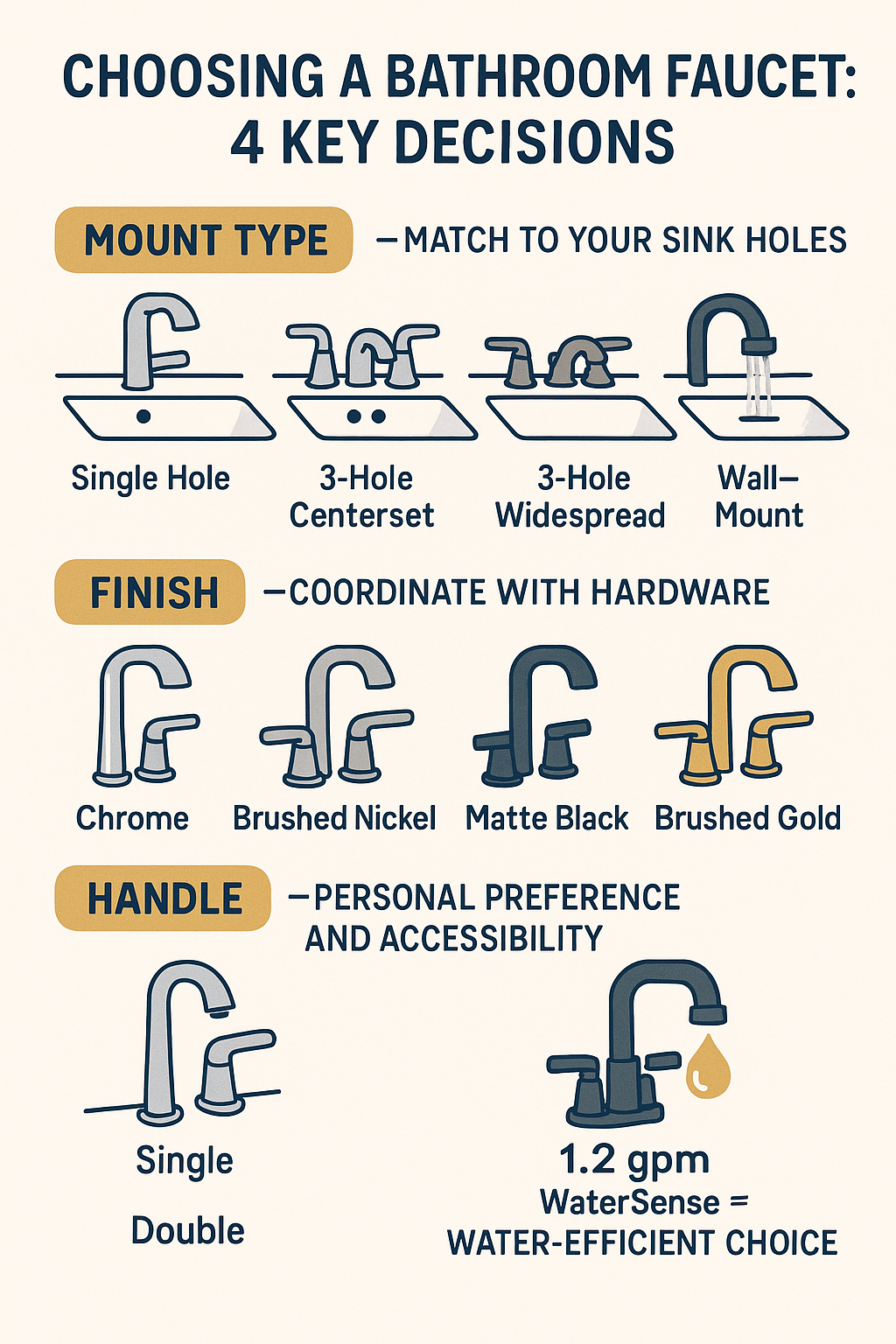
Faucet finish is a design decision, but different finishes have meaningfully different maintenance requirements and longevity.
Chrome: The original standard. Hard, highly reflective, and durable. Shows water spots and fingerprints prominently — requires frequent wiping in active bathrooms. A quality chrome finish lasts the lifetime of the faucet without peeling or tarnishing if the base is solid brass.
Brushed nickel: The most popular finish in the mid-range renovation market. Satin texture hides fingerprints and water spots far better than polished chrome. Warm and compatible with a wide range of bathroom palettes. A reliable choice for family bathrooms.
Matte black: Current design trend leader. Visually striking against light tile and white fixtures. Shows hard water deposits and mineral staining prominently — Ottawa’s municipal water has moderate mineral content, and matte black faucets require regular cleaning to maintain their appearance. Not the most practical choice for busy family bathrooms.
Brushed gold / brushed brass: Warm-toned finishes that suit terracotta, marble, and warm-wood bathroom palettes. Quality brushed brass uses a PVD (Physical Vapour Deposition) coating that resists tarnishing. Lacquered brass finishes without PVD will tarnish over 3–5 years.
Oil-rubbed bronze: A darker, vintage-influenced finish. Suits traditional and craftsman-style bathrooms. The “living finish” variation intentionally shows wear over time (deliberate patina); standard oil-rubbed bronze has a more stable appearance.
PVD (Physical Vapour Deposition) finishes: A coating process used for high-end faucet finishes that produces a harder, more durable surface than conventional electroplating. PVD finishes carry lifetime finish warranties from manufacturers like Kohler, Moen, and Delta. When comparing faucets, checking whether a finish is PVD-coated is a meaningful quality indicator.
What to Look For in a Quality Faucet
Solid brass body: Quality faucets are made from solid brass (an alloy of copper and zinc). Brass is corrosion-resistant, suitable for potable water contact, and dimensionally stable. Zinc alloy (zamak) faucets are less expensive but corrode internally over time, producing leaks and rough operation. “Brass” in marketing materials means little unless the specification confirms it.
Ceramic disc cartridge: As described above — the quality valve mechanism. Look for it explicitly in the product specification.
Lifetime warranty: Major quality faucet manufacturers (Moen, Delta, Kohler, American Standard) back their products with lifetime limited warranties covering defects in material and workmanship. A faucet in the $150–$400 range from these manufacturers is backed by a warranty that covers cartridge replacement and finish defects. Budget faucets at $40–$80 typically carry 1-year warranties.
Lead-free compliance: All faucets sold in Canada for potable water applications must meet NSF/ANSI Standard 61 for lead content. Any faucet purchased from a reputable Canadian retailer meets this standard, but it is worth confirming for imported fixtures without established North American distribution.
For faucet selection as part of a full bathroom renovation in Ottawa, our team at Miracle Dream Homes assists with product selection and specification. See our bathroom renovation page for information on our design-to-installation process, or our powder room renovation page where faucet selection is a high-impact choice in a compact space.
For NSF/ANSI certification and product specifications, NSF International and manufacturer specification sheets from Moen Canada and Kohler Canada are reliable resources.
Frequently Asked Questions
What is the best faucet finish for a busy family bathroom?
Brushed nickel hides fingerprints and water spots better than polished chrome or matte black. It suits a wide range of bathroom palettes and the satin texture is the most forgiving in terms of daily cleaning effort. Matte black is visually striking but requires more maintenance to stay looking clean.
How much should I spend on a bathroom faucet?
For a primary bathroom used daily, a faucet in the $150–$350 range from a quality manufacturer (Moen, Delta, Kohler) is the right investment. These products use solid brass bodies, ceramic disc cartridges, and carry lifetime warranties. Budget faucets under $80 use lower-quality materials and valves that require more frequent service.
What does a single-hole faucet require of the vanity?
A single-hole faucet requires a single pre-drilled hole in the countertop or vanity deck. If the vanity has three pre-drilled holes (standard on many stock vanities), a single-hole faucet can be installed using an escutcheon plate that covers the unused holes.
How long does a quality bathroom faucet last?
A quality faucet with a solid brass body and ceramic disc cartridge should last 20–30 years with normal maintenance. The finish may require attention (cleaning, occasional touch-up) before the mechanism fails. Most issues in quality faucets involve O-ring wear or cartridge replacement, both of which are straightforward repairs covered by manufacturer warranties.