
How to Remove Bathroom Mould Safely
Mould in a bathroom is common. The environment — warm, humid, with minimal air circulation — is exactly what mould needs to grow. Surface mould on grout, caulk, and tile is a cosmetic and hygiene problem that most homeowners can address themselves. Mould inside walls, behind tile, and in structural materials is a more serious situation that requires professional assessment.
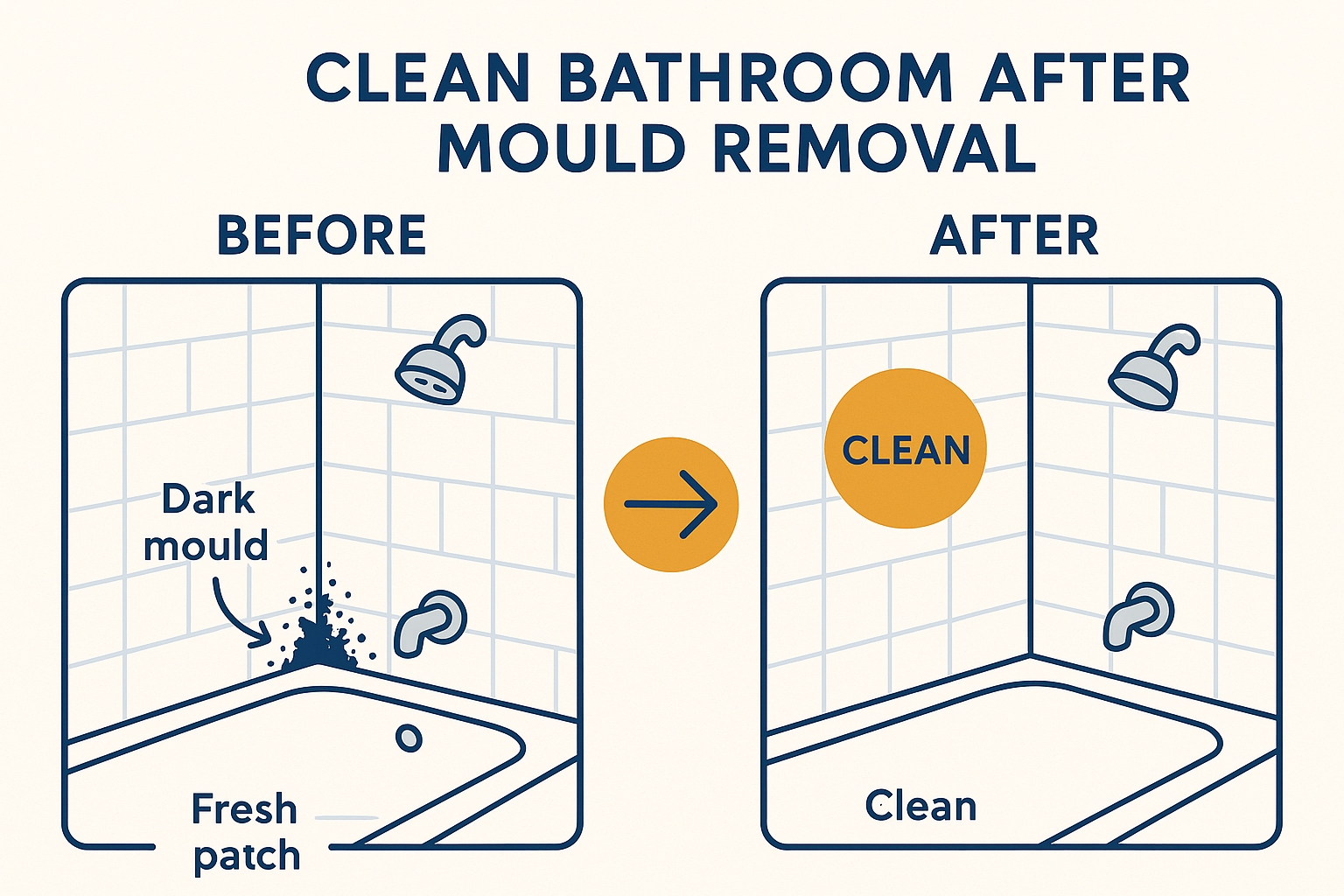
Understanding the difference, and knowing how to handle each case safely, prevents both under-reaction (ignoring a growing problem) and over-reaction (expensive remediation for a surface-level issue).
Types of Bathroom Mould
Surface mould: Black, grey, or green growth on grout joints, caulk lines, tile surfaces, shower doors, and grout in high-humidity areas. This is the most common type. It develops on the surface of materials and does not necessarily indicate structural damage or water infiltration.
Mould in caulk: Mould that has grown into the body of the caulk. Surface mould on caulk can be cleaned; mould throughout the caulk core cannot be cleaned out and the caulk must be replaced.
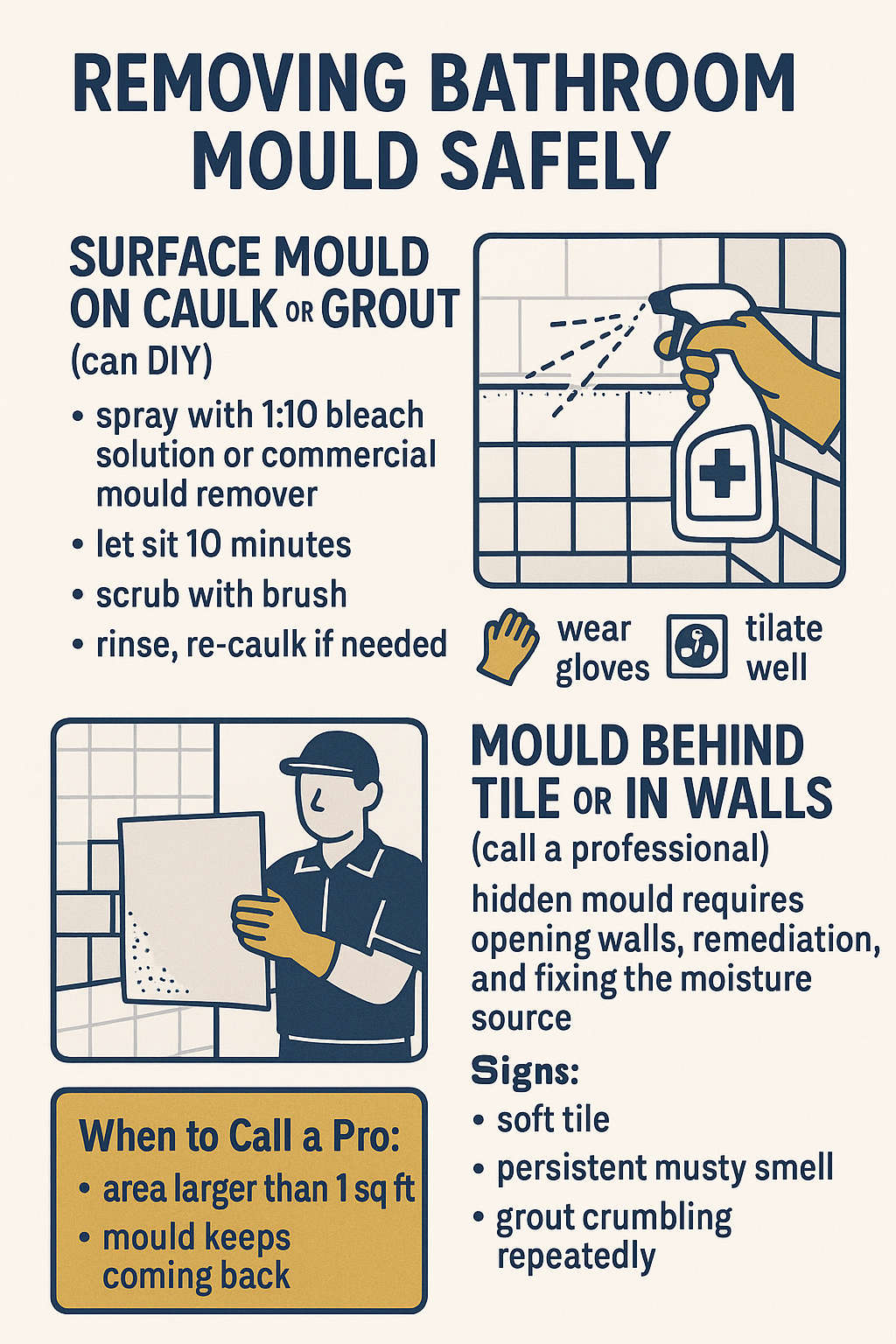
Mould behind tile: When waterproofing has failed — typically at cracked grout, failed caulk joints, or inadequate original waterproofing — moisture reaches the substrate behind the tile. Mould grows in the substrate (drywall, cement board, framing) and may not be visible until tile begins to loosen or a musty odour develops. This requires opening the wall to address.
Mould on walls and ceiling: Black spots on painted walls or ceiling, particularly near the shower or exhaust fan location. Often caused by condensation rather than water infiltration. Surface mould on painted surfaces can be treated and the surface repainted.
Safety Before You Start
Bathroom mould removal involves bleach or other biocides that require precautions:
- Ventilation: Open windows and run the exhaust fan at maximum. Bleach fumes in an enclosed bathroom cause respiratory irritation.
- Gloves: Nitrile or rubber gloves to prevent skin contact with bleach solutions and mould.
- Eye protection: Safety glasses or goggles when scrubbing overhead or using spray applications.
- Respiratory protection: For significant mould growth (more than 1 m²) or for individuals with respiratory sensitivities, an N95 respirator is appropriate.
Do not mix bleach with ammonia (produces toxic chloramine gas) or with acidic cleaners (produces chlorine gas). Use one product at a time.
Removing Mould from Grout and Tile
What you need:
– Undiluted white vinegar or a 1:4 bleach-to-water solution
– Stiff grout brush or old toothbrush
– Spray bottle
– Gloves, eye protection
Process:
- Apply the cleaning solution directly to the mouldy grout or tile surface
- Allow to sit for 10–15 minutes (do not rinse immediately — contact time matters)
- Scrub with the grout brush, working the solution into the grout joints
- Rinse thoroughly with water
- Allow the surface to dry completely
Bleach vs. vinegar: Bleach (sodium hypochlorite) kills mould effectively and whitens grout. Undiluted white vinegar (5% acetic acid) kills approximately 80–90% of mould species and is a reasonable alternative for those avoiding bleach in the household. For heavy mould growth in grout, bleach is more effective. For mild growth and as a maintenance spray, vinegar works.
Commercial mould removers: Products like Concrobium Mould Control or HG Mould Spray are formulated to kill mould and leave a residue that inhibits regrowth. These are more effective for ongoing mould management than a single bleach treatment in a bathroom with persistent moisture issues.
Removing Mould from Caulk
If mould is only on the surface of caulk (a superficial film), the cleaning process above may remove it temporarily. However, mould re-establishes quickly on porous caulk surfaces.
If mould is throughout the caulk body (the caulk appears grey or black throughout its section when prodded), replacement is the only solution:
- Remove the old caulk completely (score, pull, scrape — as described in the caulking article)
- Clean and dry the joint thoroughly, including treating the joint surfaces with a dilute bleach solution to kill mould spores in the substrate
- Allow the joint to dry for a minimum of 24 hours
- Apply new mould-resistant silicone bathroom caulk
Mould-resistant caulk contains a fungicide that inhibits mould growth within the caulk body. In a bathroom with ventilation issues, mould-resistant caulk extends the time before mould returns — but it does not prevent mould indefinitely if the underlying moisture problem is not addressed.
Removing Mould from Painted Walls and Ceiling
Process:
1. Mix 1 part bleach to 3 parts water
2. Apply to the mouldy area with a sponge or spray bottle
3. Allow to sit 10 minutes, then scrub and rinse
4. Allow to dry completely (24–48 hours)
5. Apply a mould-resistant primer before repainting
6. Repaint with a bathroom paint formulated with mildewcide
If mould recurs in the same location after cleaning and repainting, the source of moisture (ventilation failure, condensation, water infiltration) must be addressed — cleaning the surface repeatedly without correcting the cause is not a durable solution.
When to Call a Professional
Professional mould remediation is appropriate when:
- The mould covers more than 1 m² — the Health Canada guideline for residential mould remediation
- Tile or grout is loose, suggesting water has been infiltrating behind the tile (the mould is inside the wall)
- A musty odour persists after surface cleaning — this indicates mould in structural materials that are not visible
- The mould returns rapidly after proper surface cleaning — this indicates an ongoing moisture source that needs investigation
- The mould is near HVAC ducts — mould in ductwork requires professional assessment
A professional remediator contains the work area, removes affected materials (drywall, insulation, framing if necessary), treats the structural surfaces, and allows independent testing to confirm remediation before closing the walls. This is not a DIY scope for large or structural mould.
For bathroom renovation after mould damage — when the decision is to gut and rebuild rather than remediate — our team at Miracle Dream Homes handles the full scope including demolition of damaged substrate and proper waterproofing in the rebuilt shower. See also our tub-to-shower conversion page.
For mould assessment and remediation guidelines in Canada, Health Canada’s residential indoor mould guideline provides the reference standard for residential mould situations.
Frequently Asked Questions
Is bathroom mould dangerous?
Surface bathroom mould — common black or grey mould on grout and caulk — is a hygiene concern and a source of musty odour, but it is not typically a significant health hazard for healthy adults in brief bathroom exposures. Some individuals with respiratory sensitivities, asthma, or compromised immune systems may experience symptoms from bathroom mould exposure. Black mould (Stachybotrys chartarum) is a more serious species associated with water-damaged materials and prolonged high moisture — it requires professional assessment if suspected.
Why does mould keep coming back in my bathroom?
Recurring mould after cleaning indicates that the moisture conditions are not being corrected. The most common causes are: inadequate ventilation (exhaust fan is undersized, vents to attic rather than exterior, or is not used long enough after showering), failed caulk allowing water behind tile, or chronic condensation on cold surfaces. Fix the ventilation first — a bathroom that dries out within 30–60 minutes of shower use is far less hospitable to mould than one that stays damp for hours.
How do I know if there is mould behind my bathroom tile?
Signs of mould behind tile include: tile that is loose or hollow-sounding when tapped (delamination from moisture damage), grout that crumbles or falls out along one joint, a persistent musty odour despite surface cleaning, or tile that has shifted or lifted. If any of these signs are present, a renovation contractor or mould remediation professional should assess the wall before deciding whether to clean, repair, or gut the shower zone.
Can I paint over bathroom mould?
Painting over mould without killing it first allows mould to grow through the new paint within weeks or months. The correct process is: clean and kill surface mould with a bleach solution, allow to dry completely, apply a mould-resistant primer (Zinsser BIN or equivalent), then apply bathroom paint with mildewcide. If mould is in the wall substrate behind the drywall, painting is not a solution — the affected drywall must be removed.