
Bathroom Countertop Materials: Quartz, Granite, Marble, and More
The bathroom vanity countertop is a high-visibility surface that sits at the intersection of wet conditions, cleaning products, makeup, and daily use. Choosing the right material means balancing appearance, durability, and maintenance commitment — and understanding how each option actually behaves in a bathroom environment rather than just how it looks in a showroom sample.
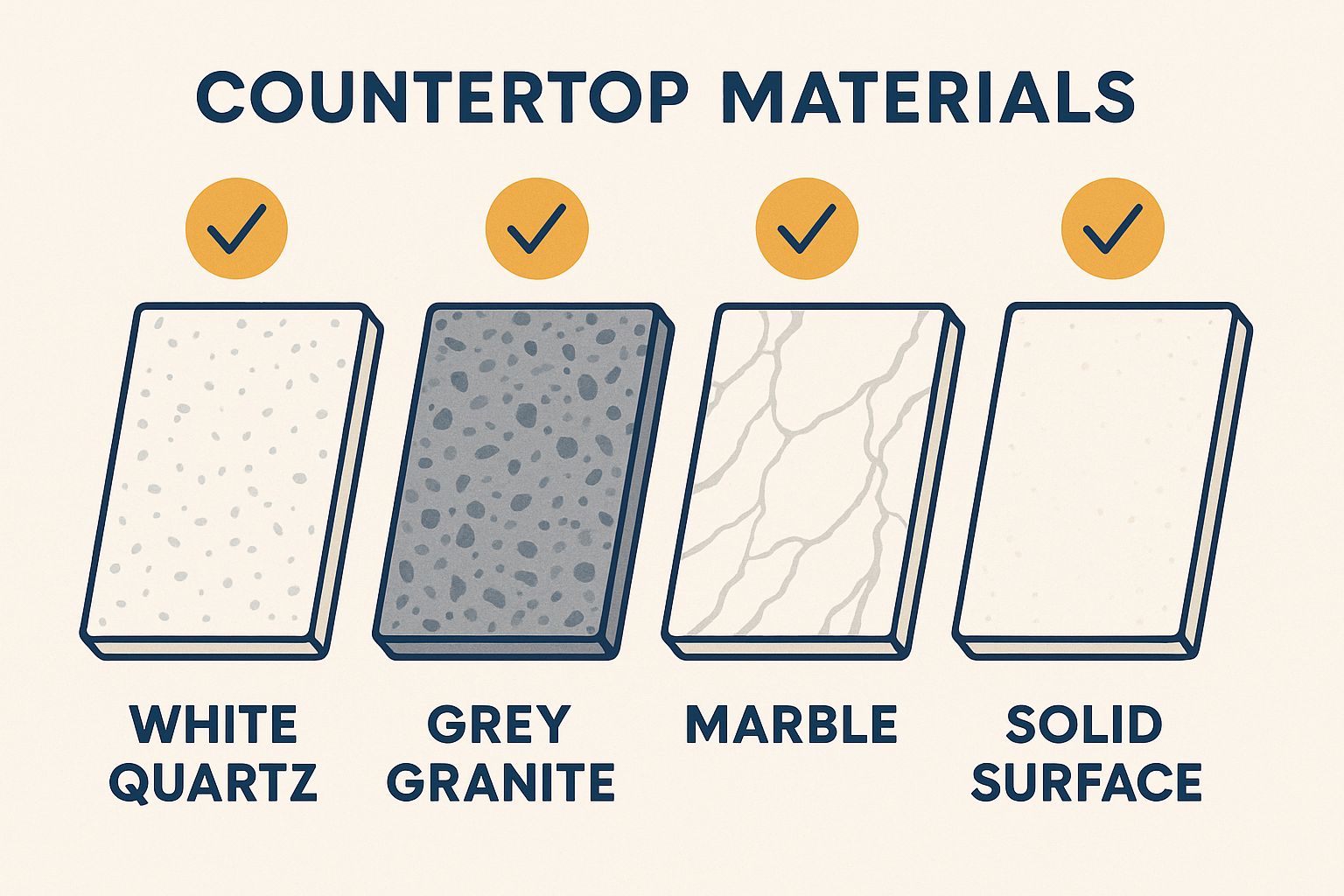
Engineered Quartz
Engineered quartz (brands include Caesarstone, Cambria, Silestone, and others) is made from approximately 90–95% crushed quartz aggregate bound with polymer resin. It is not natural stone — it is manufactured to a consistent composition and appearance.
Performance in a bathroom:
– Non-porous — does not absorb water, staining agents, or bacteria
– Does not require sealing
– Highly resistant to scratches, chips, and stains
– Not heat-resistant to the same degree as natural stone (avoid placing very hot tools directly on the surface)
– Consistent colour and pattern throughout — no natural variation to cause visual inconsistency across large vanity surfaces
Appearance: Engineered quartz is available in patterns that reference marble, concrete, and stone, as well as solid colours. The patterns are visually convincing but do not have the depth and natural variation of genuine stone.
Cost: $60–$120 per square foot installed for standard residential quartz. Premium brands and complex edge profiles add cost.
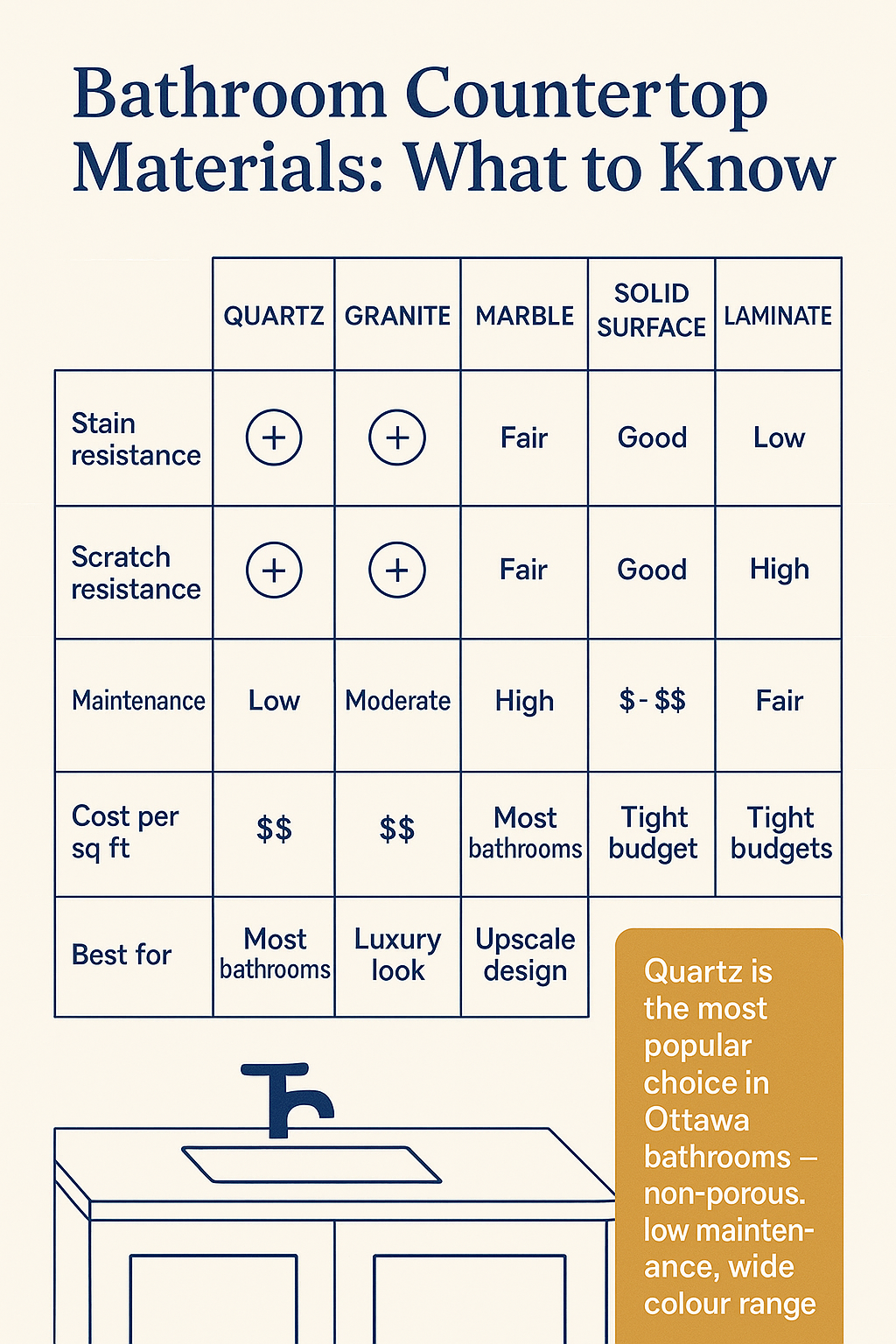
Best for: Bathrooms where low maintenance is the priority and the homeowner prefers a consistent, predictable surface. Quartz is the most practical choice for most bathroom vanity applications in terms of the performance-to-maintenance ratio.
Granite
Granite is a natural igneous stone quarried in slabs. Each slab is unique in pattern and colour. For bathroom vanity applications, a granite slab is cut to the vanity dimensions, edge-profiled, and holes cut for the sink and faucet.
Performance in a bathroom:
– Porous — must be sealed before installation and re-sealed annually
– Highly durable and scratch-resistant (harder than marble)
– Heat-resistant
– Chip-resistant at edges compared to marble or quartz
Appearance: Natural granite has genuine depth and variation — no two countertops are exactly alike. The movement, mineral inclusions, and colour variations in granite read as genuinely luxurious in a way that engineered stone does not fully replicate.
Cost: $55–$110 per square foot installed for standard residential granite slabs. Exotic granite cuts (bookmatched, unusual patterns) run higher.
Best for: Homeowners who value natural stone appearance and are prepared for the sealing maintenance commitment. Granite performs well in bathrooms and is somewhat more forgiving of sealing lapses than marble.
Marble
Marble is a metamorphic limestone, recognizable by its veining patterns. Carrara, Calacatta, and Statuario are the most familiar marble types in residential renovation. Marble has been used in premium bathrooms for centuries and continues to set the standard for luxury bathroom aesthetics.
Performance in a bathroom:
– Highly porous — absorbs water, acids, oils, and staining agents readily
– Acid-sensitive — etches (loses surface polish) from contact with acids including soap, shampoo, toothpaste, cleaning products, and coffee
– Requires sealing before installation and regular re-sealing
– Softer than granite or quartz — more susceptible to chipping and scratching
The etching issue: Etching is not staining — it is a chemical reaction between the calcium carbonate in marble and acid in common bathroom products. It removes the surface polish, leaving dull spots that are visible in raking light. Etches can be polished out by a stone restoration professional, but they occur with normal bathroom use if the marble is not protected and cleaned immediately.
Appearance: Marble is visually unmatched by any engineered alternative. The depth, the vein movement, and the translucent quality of genuine marble read as genuinely premium in a way that no manufactured material replicates.
Cost: $70–$200+ per square foot installed depending on marble type. Carrara starts at the lower end; Calacatta Gold and premium cuts are significantly higher.
Best for: Primary ensuites where the homeowner values the aesthetic, understands the maintenance requirements, and is committed to proper care. Marble in a children’s bathroom or a high-traffic secondary bathroom is a poor match for the maintenance demands.
Porcelain Slab
Porcelain slab countertops (Neolith, Dekton, Lapitec) use large-format porcelain panels — up to 120 x 300 cm — as countertop surfaces. The porcelain is fabricated to countertop dimensions just like stone.
Performance in a bathroom:
– Non-porous — no sealing required
– UV-stable (does not yellow or fade)
– Highly scratch and chip-resistant
– Heat-resistant (more so than engineered quartz)
– Available in patterns that closely reference marble, concrete, and stone
Cost: $80–$150 per square foot installed, comparable to or slightly above premium quartz.
Best for: Bathrooms where the marble look is desired without the maintenance commitment of genuine marble. Porcelain slab patterns have become increasingly convincing and represent a practical alternative to natural stone for low-maintenance households.
Solid Surface (Corian and Equivalents)
Solid surface countertops (DuPont Corian, Avonite, LG HI-MACS) are acrylic-based polymer materials that are seamlessly fabricated — the countertop, integrated sink, and any splashback can be one continuous piece with no joints.
Performance in a bathroom:
– Non-porous — no sealing required
– Can be repaired and resurfaced if scratched or damaged
– Seamless integration with undermount sinks eliminates joints where moisture can collect
– Not as scratch-resistant as stone — shows knife marks and abrasion
Cost: $40–$80 per square foot installed for standard solid surface. Integrated sink configurations add cost but eliminate the need for a separate sink.
Best for: Accessible bathrooms or households where easy cleaning and no-grout seamless surfaces are priorities. The integrated sink option is particularly relevant for accessible bathroom design where surface continuity improves usability.
Laminate
Laminate countertops (Formica, Wilsonart) use a high-pressure laminate bonded to a particleboard or MDF core. They are the least expensive option and the most common in builder-grade bathroom installations.
Performance in a bathroom:
– Not appropriate for consistent water exposure — the seam at the sink cutout and at the back edge is vulnerable to water infiltration that causes swelling and delamination
– Limited lifespan in a bathroom compared to stone, quartz, or solid surface
– Not repairable when damaged
Cost: $15–$35 per square foot installed.
Best for: Budget applications where the countertop will be replaced within 5–7 years, or as a temporary measure. Not recommended for a permanent renovation intended to last 15+ years.
For countertop selection as part of a full bathroom renovation in Ottawa, our team at Miracle Dream Homes assists with material selection and fabrication coordination. See our bathroom renovation page and our powder room renovation page.
For stone material specifications and natural stone care, the Marble Institute of America (MIA) and the Natural Stone Institute are the authoritative sources for stone selection and maintenance guidance in residential applications.
Frequently Asked Questions
What is the most low-maintenance bathroom countertop material?
Engineered quartz and porcelain slab are the most low-maintenance countertop options. Both are non-porous, require no sealing, and are resistant to the staining agents common in bathroom environments. Quartz is more widely available and familiar; porcelain slab is a newer option that more convincingly replicates natural stone patterns.
Is marble a good choice for a bathroom countertop?
Marble can be an excellent choice in a primary ensuite for homeowners who value its appearance and are prepared for the maintenance requirements: regular sealing, immediate cleanup of acids (soap, shampoo, cleaning products), and periodic professional polishing to address surface etching. In a secondary bathroom or a family bathroom with children, the maintenance demands make marble a difficult choice.
How much does a bathroom countertop cost to replace?
Countertop replacement depends on material and vanity dimensions. Standard quartz on a 60 cm single vanity: $300–$600. A 120 cm double vanity in quartz: $500–$900. Marble and premium granite at similar dimensions run $600–$1,500+. These estimates include basic edge profiling and sink cutout.
Can I use a kitchen countertop material in my bathroom?
Yes. Materials used for kitchen countertops — quartz, granite, marble, solid surface — are equally appropriate for bathroom vanity applications. The selection criteria are the same. Kitchen-specific considerations (cutting board use, pot heat) do not apply in a bathroom.