
Bathroom Renovation Warranty: What to Ask Your Contractor About
A bathroom renovation is a significant investment. The quality of the installation — waterproofing, tile, plumbing, and electrical work — determines whether the renovation holds up for 15–20 years or develops problems within 3–5 years. A proper warranty from the renovation contractor is a signal of confidence in the installation quality and provides recourse if problems emerge.

Understanding what a bathroom renovation warranty covers, how it works, and what questions to ask before signing a contract helps homeowners distinguish a contractor who stands behind their work from one who does not.
Types of Warranties in a Bathroom Renovation
A bathroom renovation involves work covered by multiple overlapping warranty types:
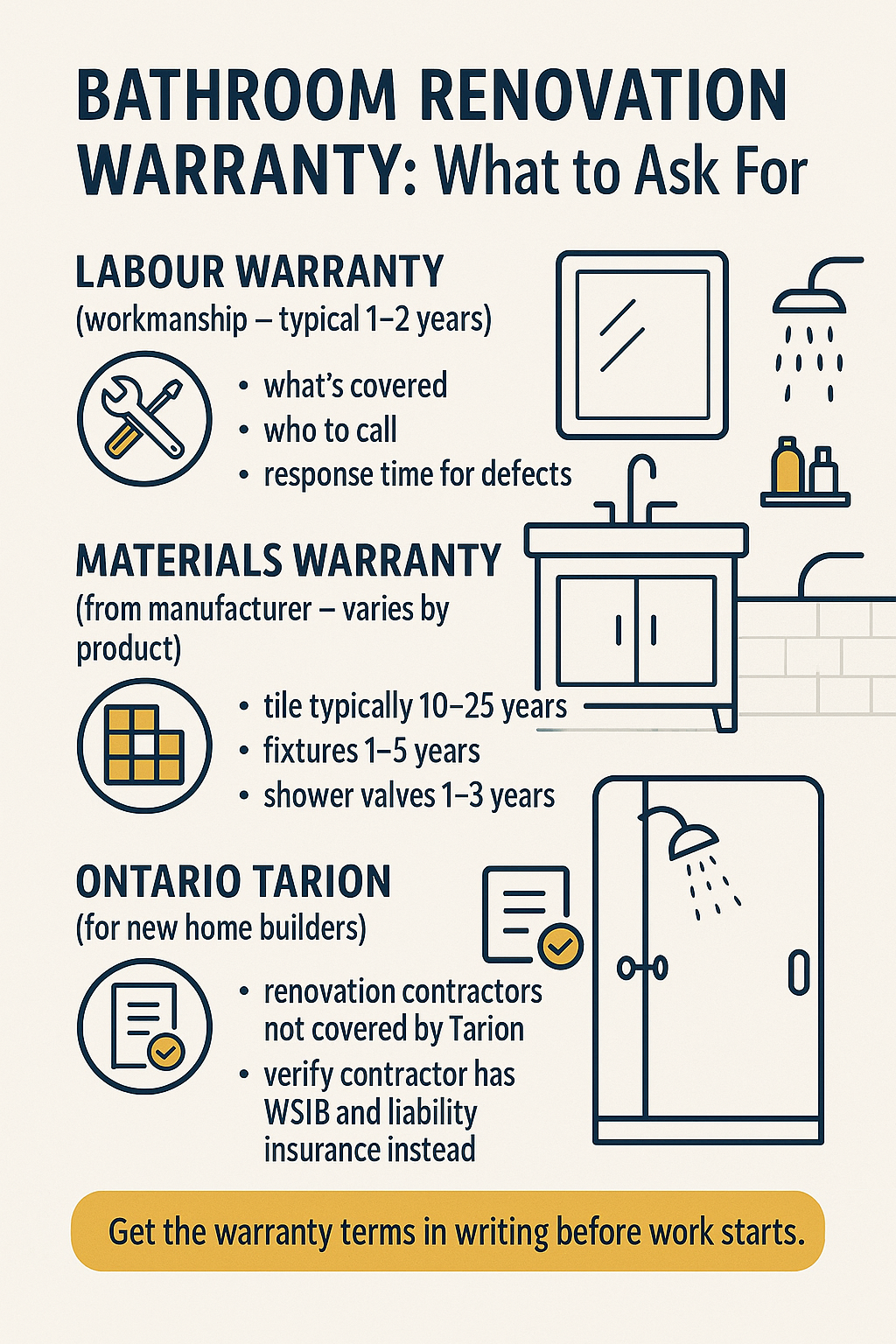
Contractor Workmanship Warranty
The contractor’s own warranty on the quality of the installation. This is the most variable warranty type — it is set entirely by the contractor, and its terms differ widely between companies.
A contractor workmanship warranty covers defects in how the work was performed — waterproofing failures, tile delamination from improper installation, grout failures, plumbing leaks from installation errors, or electrical faults from wiring errors.
What to look for:
– Duration: A minimum of 1 year for workmanship is the industry norm. Reputable renovators offer 2–5 years on workmanship. Some offer longer for specific elements.
– Scope: The warranty should specify what work is covered. “All labour and installation” is broader and more valuable than “tile installation only.”
– Exclusions: Reasonable exclusions include normal wear and tear, damage caused by the homeowner (impact, improper cleaning products), and consequential damages from events outside the contractor’s control.
Product and Material Warranties
Products installed during a bathroom renovation carry manufacturer warranties:
- Tile: Most porcelain and ceramic tile carries no explicit material warranty (tile is a commodity product), but structural defects are covered at the point of sale. Installation warranty covers the labour.
- Plumbing fixtures: Faucets, showerheads, and toilet valves from major manufacturers (Moen, Delta, Kohler) carry lifetime limited warranties on finish and function. These warranties are with the manufacturer, not the contractor.
- Vanity: Cabinet manufacturers (Kraftmaid, Bertch, custom local shops) carry 1–5 year limited warranties on cabinet construction and finish defects.
- Glass shower enclosures: Manufacturers carry 1–5 year warranties on hardware and tempered glass defects. The installation (levelling, sealing) is covered by the contractor’s workmanship warranty.
- Countertops: Quartz and stone countertop manufacturers carry 1–10 year limited warranties on defects in the stone material.
- Waterproofing products: Waterproofing membrane manufacturers (Schluter, Laticrete, Wedi) carry product warranties, but the correct installation procedure must be followed — installation warranty is the contractor’s responsibility.
Ontario New Home Warranty (Tarion) — Not Applicable to Renovations
The Tarion Warranty Program covers new home construction by registered builders in Ontario. It does not apply to renovation work on existing homes. A contractor who implies their work is “Tarion warranted” for a bathroom renovation on an existing home is either misinformed or misleading — Tarion applies to new home builders, not renovators.
Ontario Consumer Protection Act
Under the Ontario Consumer Protection Act (CPA), contractors are required to provide goods and services that meet a reasonable standard of fitness and durability. A renovation contractor who delivers work that fails prematurely due to installation defects has obligations under consumer protection law regardless of what the contract says. However, enforcing these protections requires the homeowner to pursue a claim — a defined contractor warranty is far more practical protection.
What to Ask Your Contractor About Warranty
Before signing a renovation contract, ask:
1. What is the warranty period for workmanship?
Get a specific duration. “We stand behind our work” is not a warranty. “We provide a 2-year warranty on all labour and installation” is.
2. What does the warranty cover?
Ask for the warranty to be written into the contract. The written warranty should specify: what is covered (waterproofing, tile installation, plumbing connections, electrical), the duration, the claim process (how to report a problem, what response time to expect), and any exclusions.
3. What is excluded?
Reasonable exclusions include: homeowner-caused damage, normal wear and tear, problems caused by events outside the contractor’s control (flooding, structural movement). Unreasonable exclusions include: excluding the waterproofing installation, excluding grout installation, or requiring the homeowner to pay for service calls to diagnose warranty claims.
4. Who performs warranty work?
Warranty work should be performed by the original contractor or a contractor they designate. A warranty that requires the homeowner to engage a third party for warranty repairs is not a functional warranty.
5. What happens if the company closes?
This is an uncomfortable but practical question. A contractor who has been in business for many years has a track record that reduces this risk. New or smaller contractors represent higher risk for warranty claims. Ask about business continuity — does the owner operate independently, or is there a larger organization backing the warranty?
What a Good Contractor Warranty Looks Like
A well-structured bathroom renovation warranty in a contract includes:
- Explicit duration: “2 years from the date of project completion” or similar
- Defined scope: “All labour and installation work performed by Miracle Dream Homes, including waterproofing, tile installation, plumbing connections, and fixture installation”
- Claim process: How the homeowner reports a problem, what response time to expect, how warranty work is scheduled
- Repair scope: What the contractor will do to resolve a warranted defect (repair, replace, or compensate)
- Clear exclusions: Limited to reasonable items — homeowner damage, normal wear, force majeure events
Red Flags in Warranty Language
Watch for:
- No written warranty: A verbal warranty is essentially unenforceable. All warranty terms must be in writing.
- “Limited lifetime warranty on workmanship” without defining “limited” — this phrase can mean almost anything. Ask for the specific limitations.
- Warranty voided by homeowner cleaning or maintenance: Reasonable cleaning of a bathroom should not void a workmanship warranty. If a contractor’s warranty is voided by the homeowner using standard bathroom cleaners, the warranty is not genuine protection.
- Warranty that requires separate service fees for claims: Warranty service should not require the homeowner to pay for a service call to assess a warranted problem.
- Warranty excluded from the contract and provided as a separate verbal commitment: If it is not in the contract, it does not exist in any practical sense.
For bathroom renovation services in Ottawa with a written workmanship warranty as part of every contract, our team at Miracle Dream Homes has served Ottawa homeowners since 2004. See also our powder room renovation page for smaller-scope renovation services.
For consumer protection guidance and contractor dispute resolution in Ontario, Consumer Protection Ontario and the Ontario Consumer Protection Act provide the legal framework for renovation contracts and contractor obligations.
Frequently Asked Questions
How long should a bathroom renovation warranty be?
A workmanship warranty of 1–2 years is the industry minimum. Reputable contractors offer 2–5 years on all installation work. For waterproofing specifically — which is the most critical installation element in a bathroom — a 5-year warranty on the waterproofing installation is reasonable and should be expected from a quality contractor. Manufacturer product warranties on fixtures, glass, and hardware are separate and often longer.
What does a bathroom renovation warranty typically not cover?
Reasonable exclusions include: normal wear and tear on grout, caulk, and fixtures (these require periodic maintenance); damage caused by the homeowner through improper use, abrasive cleaners, or physical impact; problems caused by plumbing or structural events outside the bathroom renovation scope; and consequential damages (lost property value, alternative accommodation costs). What should not be excluded: installation defects, waterproofing failures, plumbing connection leaks, and tile delamination from installation error.
What should I do if my contractor does not honour a warranty claim?
Document the defect: photograph the problem, date the photos, and describe the issue in writing to the contractor. Send the warranty claim in writing (email with read receipt is effective documentation). If the contractor does not respond within the timeline specified in the warranty, send a written demand for response. If the claim is not resolved, Ontario homeowners have recourse through: the Small Claims Court (for claims up to $35,000), Consumer Protection Ontario, or the Better Business Bureau. For larger claims, a lawyer specializing in construction and renovation disputes provides advice on options.
Does a renovation warranty cover water damage if the shower leaks?
A workmanship warranty on the shower waterproofing covers water damage that results from installation defects in the waterproofing — a membrane that was not properly lapped, a drain connection that was not properly sealed, or a substrate that was not properly waterproofed. The contractor’s liability is typically for repairing or replacing the defective installation and the damage caused directly by the waterproofing failure. For consequential damages (damage to the floor below, to stored items), the contractor’s liability depends on the contract language and the nature of the defect. This is where a clearly written warranty that specifies the scope of remediation matters significantly.