
Powder Room Design: Making the Most of a Small, High-Impact Space
A powder room — a bathroom with a toilet and sink, no bathing fixture — is the one bathroom in the home that visitors use. It is also the smallest bathroom in most homes, typically 3–5 m². These two facts together make the powder room a high-leverage design opportunity: a space where a deliberate design investment produces visible, lasting impact out of proportion to its size.
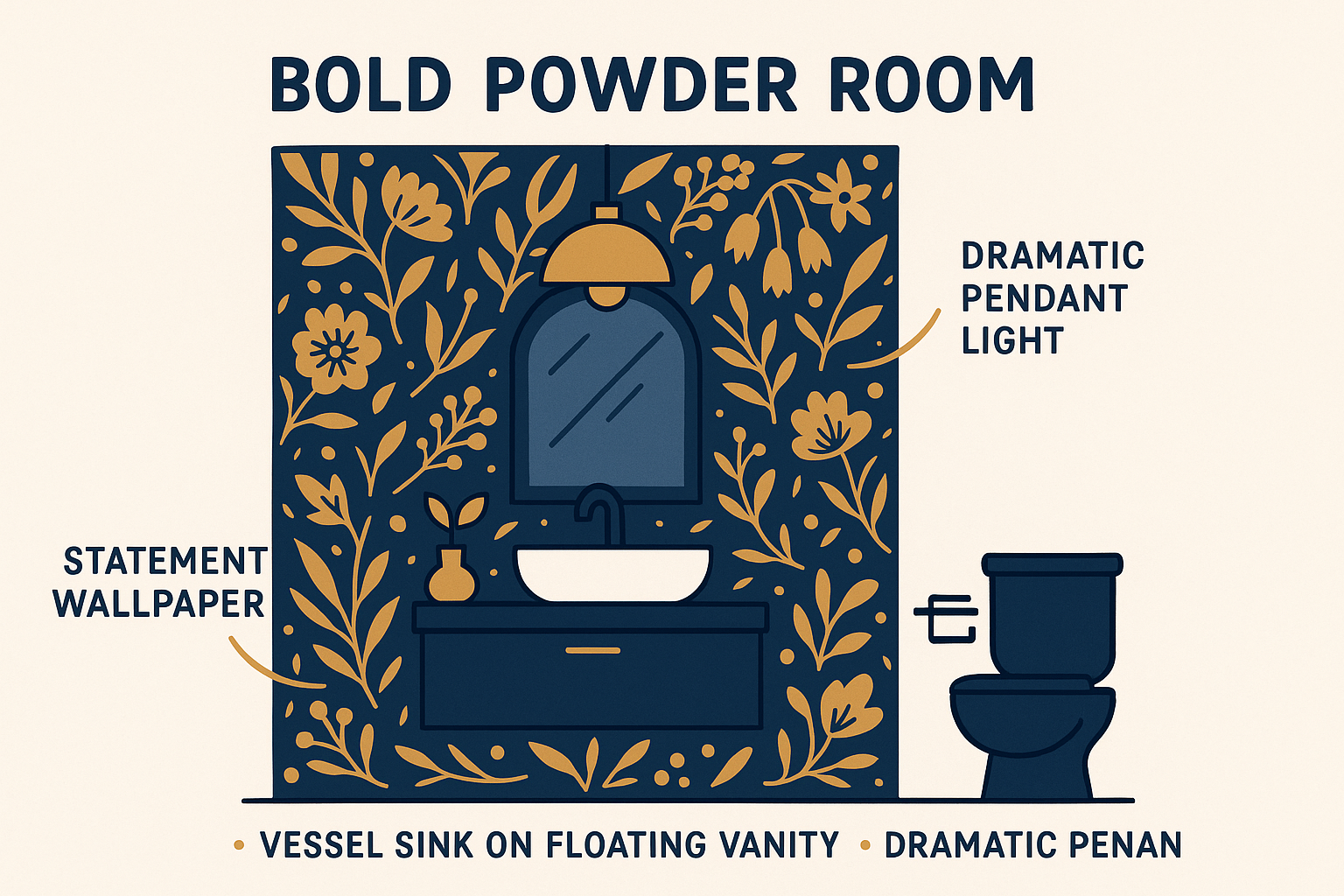
The most effective powder room renovations treat the space as a complete design statement rather than a scaled-down version of a larger bathroom.
What a Powder Room Includes
A standard powder room contains:
- Toilet (one-piece or wall-hung)
- Vanity or pedestal sink
- Mirror
- Lighting (vanity lighting and general)
- Towel ring or bar
- Toilet paper holder
- Optional: storage
The absence of a shower or tub simplifies the waterproofing requirements and the number of fixtures to coordinate. The design challenge is creating a space that feels finished and intentional within a very small footprint.
Layout and Space Planning
Powder rooms in Ottawa homes occupy the spaces that did not have another use: the space under the stairs, a corner of the main floor hallway, or a converted closet. The typical dimensions are 1.5 m × 2 m to 1.8 m × 2.5 m — tight enough that every design decision affects how spacious the room feels.
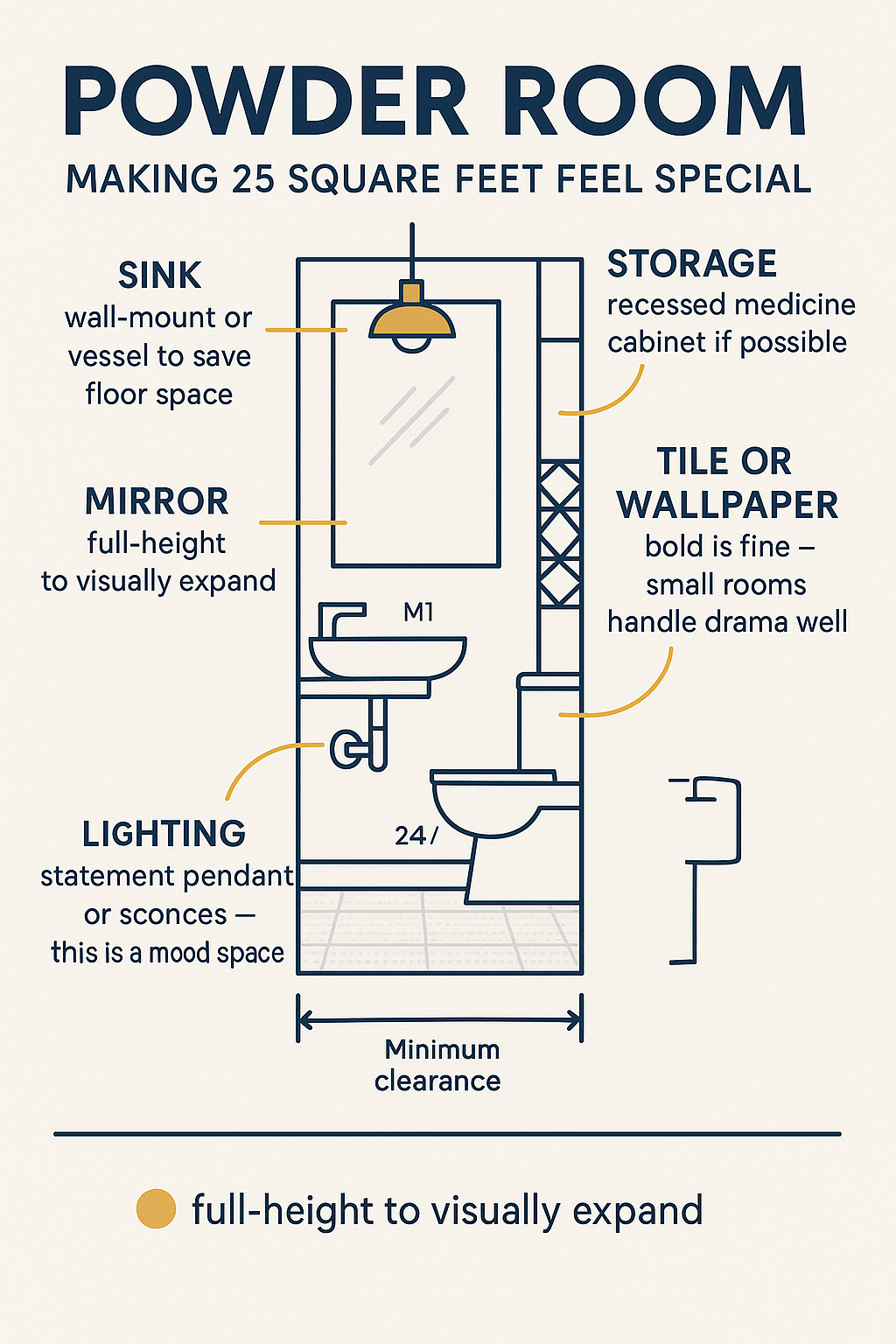
Toilet placement: The toilet typically anchors one end of the room. Minimum clear space in front of the toilet is 600 mm; 700 mm is more comfortable. Clearance beside the toilet (to the vanity or wall) should be at least 400 mm.
Vanity sizing: In a small powder room, the vanity is the most significant spatial element after the toilet. A compact console or pedestal sink (400–500 mm wide) preserves floor visibility and makes the room feel larger. A full vanity cabinet with storage (600–750 mm wide) provides storage at the cost of visual mass.
Wall-hung fixtures: A wall-hung toilet (cistern concealed in the wall) and a wall-hung sink eliminate the visual mass of floor-mounted fixtures and make cleaning the floor easier. In a powder room renovation, wall-hung fixtures are a worthwhile upgrade — the visual result is noticeably cleaner and more contemporary.
Door swing: In a very small powder room, consider whether the door can swing out into the hallway rather than into the room. An inward-swinging door that opens toward the toilet creates a cramped experience; an outward swing or pocket door resolves this.
Design Approaches
Because the powder room is small and used briefly rather than for extended personal routines, it tolerates design choices that would be overwhelming in a larger bathroom:
Bold tile: A full-height tile installation in a graphic or textured pattern — zellige tile, encaustic cement tile, large-format book-matched stone, vertical fluted tile — reads as intentional and striking in a small space. The same tile would be too much in a 10 m² bathroom; in a 4 m² powder room, it works.
Deep wall colour: A powder room is one place where a very dark or saturated paint or wall treatment — deep navy, forest green, charcoal, terracotta — creates atmosphere rather than feeling oppressive. The small space, combined with good lighting, makes deep colour feel rich rather than heavy.
Statement mirror: In a powder room where the vanity mirror is the primary reflective surface, a mirror with a distinctive frame or shape — arched, round, ornate, oversized — adds visual interest. A frameless backlit mirror provides a different effect: clean, contemporary, and functional for the lighting it provides.
Distinctive sink: A vessel sink or console sink in an unexpected material — stone, concrete, copper, handmade ceramic — reads as a design choice rather than a default fixture selection. In a powder room, the sink is visible immediately on entry; it is worth treating as a focal point.
Wallpaper: In a powder room, wallpaper is practical in a way it is not in wet-zone bathrooms. A powder room has no shower moisture, so wallpaper in the dry zone performs well and allows pattern and texture not achievable with paint or tile.
Lighting
Powder room lighting needs to address two functions: ambient light for the room and task light for the mirror.
Vanity lighting: Side-mounted wall sconces flanking the mirror at face height (1,500–1,600 mm centre height) are the best option for shadow-free task lighting at the mirror. An overhead fixture alone creates unflattering downward shadows. If a single overhead fixture is the only option, a flush LED panel with good colour rendering (CRI 90+) provides reasonable task light.
Ambient lighting: A powder room with a single vanity light often looks flat. Adding a ceiling fixture — a pendant, a flush mount, or a small chandelier — provides ambient fill and a design element. In a powder room with a dramatic tile or colour treatment, the ambient light level affects how the design reads.
Dimmer: A dimmer on the ambient light allows the powder room to function as a utility bathroom in bright mode and as a more atmospheric space when entertaining.
Storage Considerations
A powder room does not need the storage of a full bathroom, but some storage is useful:
- Toilet paper reserve (2–4 rolls minimum)
- Hand soap and hand cream
- Small first aid items
- Guest towels
A small recessed medicine cabinet above the vanity, a narrow floating shelf, or a compact under-sink vanity handles these requirements without dominating the space.
Cost Expectations
A powder room renovation in Ottawa runs $6,000–$12,000 for a standard scope — full gut renovation with quality tile, new fixtures, vanity, mirror, and lighting. Higher-end powder rooms with premium tile, wall-hung fixtures, and custom elements run $12,000–$18,000.
The powder room is one of the best-value renovation investments in a home. The small square footage limits material quantities and labour hours while the visible quality of the finished space is disproportionate to the cost.
For powder room renovation in Ottawa, our team at Miracle Dream Homes specializes in making the most of these high-impact spaces. See also our bathroom renovation page for information on bathroom renovation more broadly.
For design ideas and product specifications, the National Kitchen and Bath Association (NKBA) publishes residential bathroom design guidelines including clearance requirements and fixture placement standards for small bathrooms.
Frequently Asked Questions
What is the minimum size for a powder room?
The Ontario Building Code minimum for a powder room (toilet and sink only) is approximately 1.2 m × 1.5 m — though this is extremely tight. A functional powder room is more comfortable at 1.5 m × 1.8 m or larger. If a powder room is being added to a main floor, target at least 2.5–3 m² of usable floor area for comfortable use.
Is a wall-hung toilet worth it in a powder room?
Yes, in most powder room renovations. A wall-hung toilet eliminates the visual mass of the floor-mounted base, makes floor cleaning easier, and contributes to a cleaner contemporary appearance. The installation requires a carrier frame set into the wall (which adds framing depth to that wall) — this is best handled during a gut renovation rather than as a retrofit. The cost premium over a floor-mounted toilet is $800–$1,500 for the carrier frame, in-wall cistern, and installation.
Can I use wallpaper in a powder room?
Yes. A powder room — toilet and sink only, no shower or bath — does not generate the steam and moisture that limits wallpaper in wet-zone bathrooms. Wallpaper on the dry walls of a powder room performs well and allows design options not available with paint. Avoid wallpaper directly behind the toilet where occasional splashing occurs; tile or a moisture-tolerant paint in this zone is more practical.
How do I make a small powder room feel bigger?
Several approaches help: use a pedestal or wall-hung sink to keep the floor visible; extend floor tile into a continuous plane with minimal grout lines; use a large mirror to reflect light and depth; use consistent materials on floor and walls to avoid visual breaks; and ensure the lighting is bright enough to eliminate dark corners. Light paint colour helps, but is not mandatory — a small dark powder room with good lighting and a statement design can feel deliberate and atmospheric rather than cramped.