
Heated Bathroom Floors: How They Work and Whether They’re Worth It
Heated bathroom floors are one of the few renovation upgrades that consistently exceed expectations in daily use. In an Ottawa home where winter temperatures regularly drop below -20°C, stepping onto a warm tile floor instead of a cold one is not a trivial luxury — it is a genuine improvement in daily experience. The question is whether the installation and operating cost is justified.
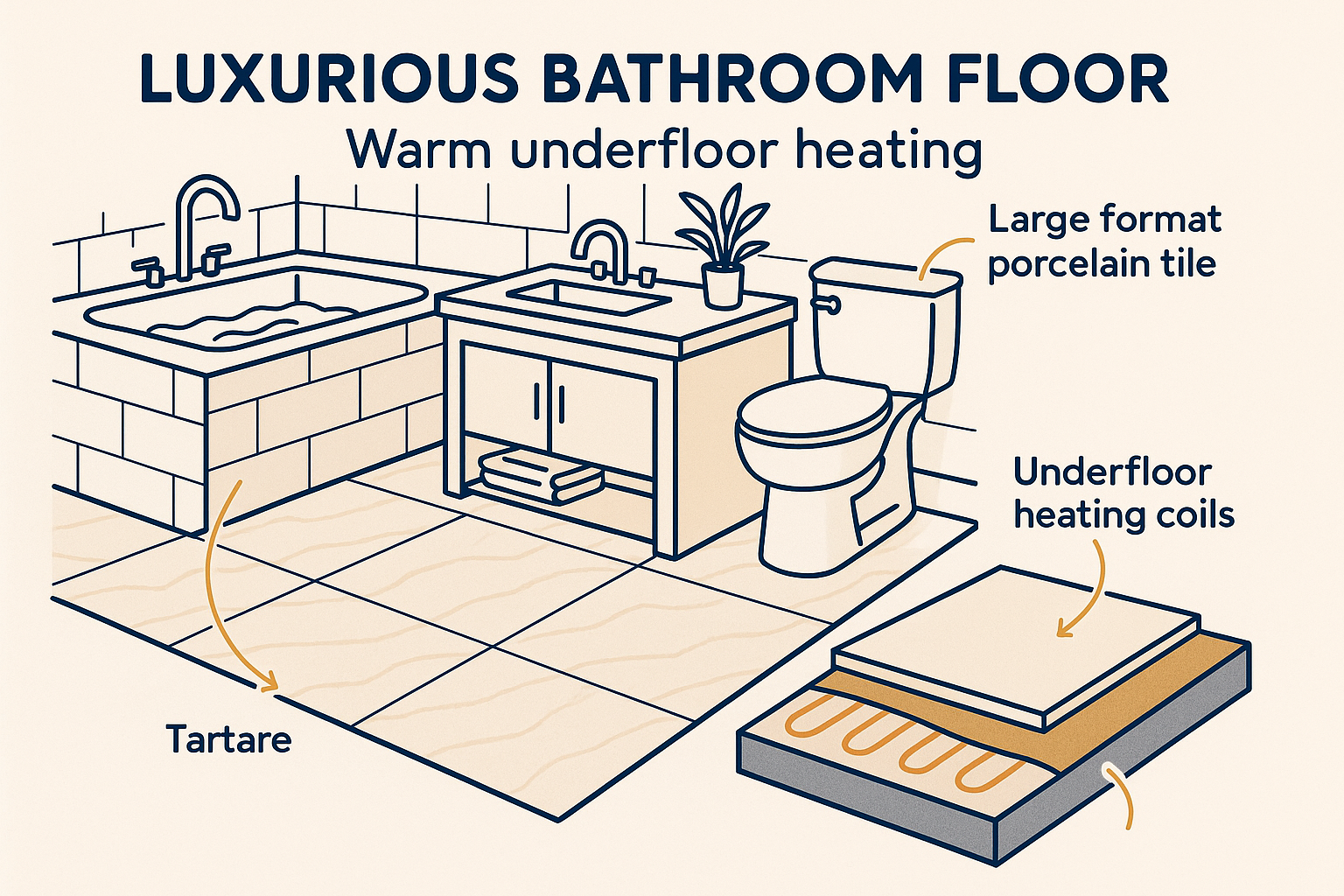
This guide covers how electric in-floor radiant heating systems work, what they cost to install and operate, and what the installation process involves.
How Electric In-Floor Radiant Heating Works
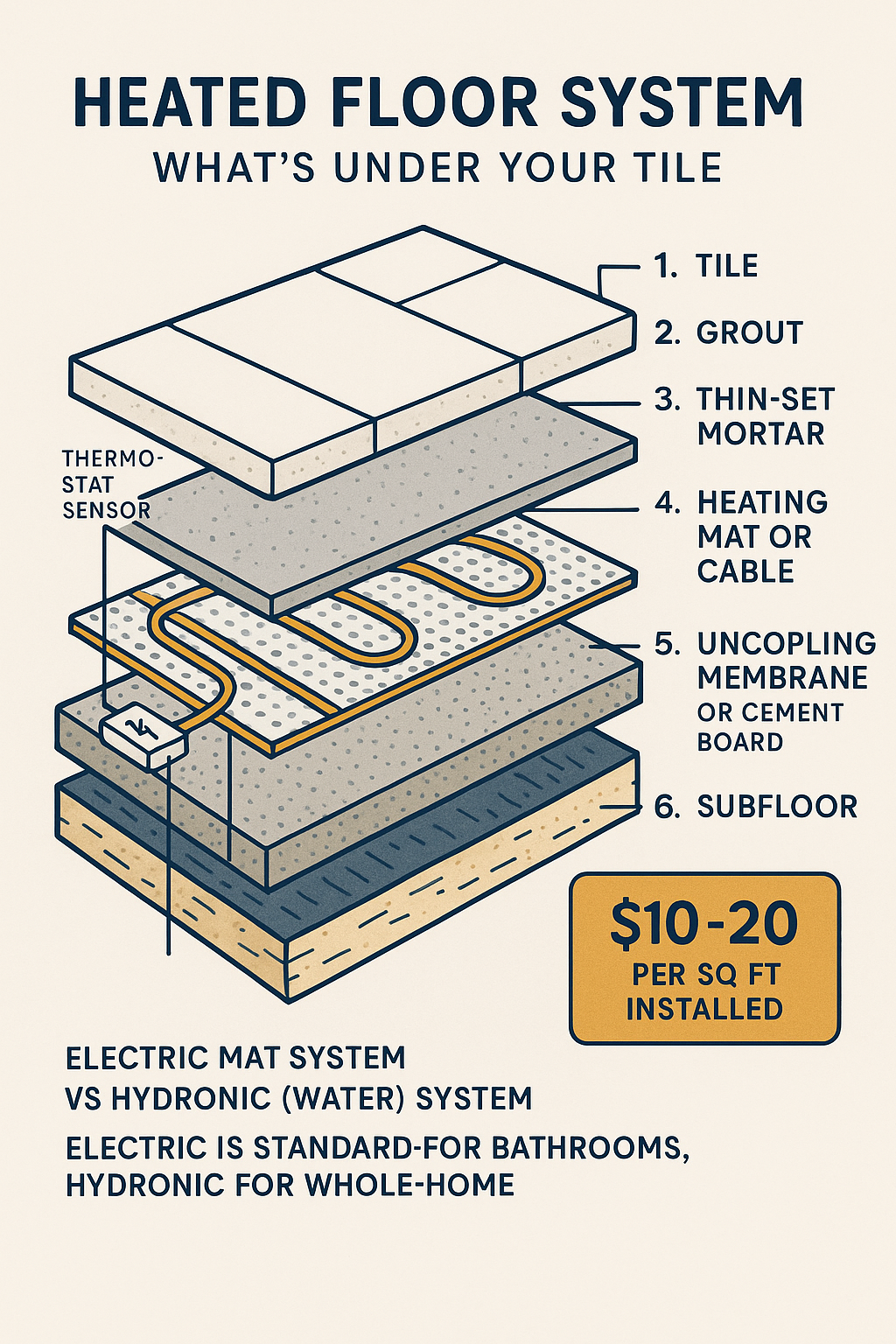
The most common type of heated bathroom floor in residential renovation uses electric resistance heating — a thin heating mat or cable installed in the mortar bed beneath the tile.
The components:
– Heating element: A mat or loose cable containing a resistance heating wire. Electric current passes through the wire and produces heat. The heat transfers through the mortar bed and tile to the surface.
– Thermostat: Controls when the system runs and at what temperature. Modern thermostats have programmable schedules (heat the floor before your typical morning shower time), WiFi connectivity, and floor temperature sensors plus ambient air sensors.
– Electrical circuit: Dedicated 15A or 20A circuit from the panel to the thermostat location.
Mat vs. cable:
– Heating mats come pre-spaced on a fibreglass mesh in standard widths (typically 30–60 cm wide). Easier to install in rectangular rooms because the mat rolls out without spacing calculations.
– Loose cable provides more flexibility in irregular room shapes. The cable is spaced and fastened manually. Requires more installation time but accommodates non-rectangular floor plans.
Hydronic vs. Electric Radiant
Hydronic radiant systems — circulating hot water through tubing in the floor — are used in whole-home radiant heating systems or large-area radiant installations. They are more energy-efficient per BTU at large scale and require a boiler system.
In a bathroom renovation context, electric radiant is almost always the appropriate choice. It:
– Does not require a boiler or expansion tank
– Can be installed during a tile renovation with minimal mechanical system modification
– Can be zoned independently for the bathroom without affecting the rest of the home
– Is practical in retrofit situations where hydronic tubing cannot be added to existing construction
Hydronic in-floor is appropriate only when a home is already heated by a hydronic system and the boiler has capacity to add a bathroom zone.
Installation Requirements
Electrical Rough-In
A heated bathroom floor requires a dedicated electrical circuit from the panel to the thermostat location. This must be installed before the floor is tiled and is typically done as part of the electrical rough-in phase of the bathroom renovation.
Typical circuit size:
– Floor mats up to approximately 7–8 square metres: 15A circuit
– Larger floor areas: 20A circuit
The circuit and thermostat rough-in must be planned and roughed in before flooring begins. It cannot be added after tile is installed without opening the floor.
Thermostat
The thermostat must be accessible — mounted on a wall at switch height. It contains the floor temperature sensor wire that runs in a conduit embedded in the tile mortar bed. The sensor wire must be installed at the same time as the heating mat.
Programmable thermostat: Required to realize the operating cost benefit of heated floors. A floor set to heat only during the 2-hour morning window uses a fraction of the energy of a floor heated all day.
Tile Compatibility
Electric radiant heating mats work best under tile (ceramic, porcelain, natural stone) and stone flooring. Tile is an ideal conductor of radiant heat and retains warmth effectively.
Heated floors are not compatible with standard hardwood flooring (wood expands and contracts with heat cycles). Engineered hardwood has limited compatibility — check manufacturer specifications. Luxury vinyl tile has limited compatibility — maximum temperature thresholds must be confirmed.
Floor Height Implications
A heating mat adds approximately 3–6 mm to the floor assembly height. When a bathroom is being fully renovated (removing existing tile and installing new), this is absorbed in the new mortar bed with no impact on door clearances. When heating is being added to an existing floor by tiling over the current floor, the added height may affect door clearances and transition strips at doorways.
Operating Costs
Electric radiant floor heating is often misrepresented as expensive to operate. Properly used — on a programmed thermostat, heating a small bathroom area for 2–4 hours per day during the morning period — the operating cost is modest.
Approximate operating cost:
A 5-square-metre bathroom floor with a 120W/m² heating mat (total system: 600W):
– Running 2 hours/day at Ontario’s average residential electricity rate (~$0.15/kWh):
– Daily: ~$0.18 | Monthly: ~$5.40 | Annual: ~$65
A 10-square-metre floor running 3 hours/day:
– Daily: ~$0.54 | Monthly: ~$16 | Annual: ~$196
These figures confirm that proper use of a programmed heated bathroom floor costs less than many homeowners assume — often less per month than a Netflix subscription.
Installation Cost
Heating mat material: $8–$15 per square foot, or $80–$160 per square metre, depending on mat quality and brand. A 5-square-metre bathroom floor: $400–$800 in mat material.
Thermostat: $80–$350 for a quality programmable thermostat (Nuheat, OJ Electronics, Schluter Ditra Heat).
Electrical circuit: $300–$600 for a licensed electrician to install a dedicated circuit to the bathroom.
Installation labour (mat installation and sensor wire setup): $150–$400.
Total installed cost for a standard bathroom: $900–$2,100.
For the daily comfort benefit in an Ottawa winter, this is a renovation upgrade with consistent demand among homeowners who have experienced it. Very few heated floor installations are removed in subsequent renovations.
For heated floor installation as part of a complete bathroom renovation in Ottawa, our team at Miracle Dream Homes includes the heating mat and thermostat as part of the tile installation scope. See our bathroom renovation page for more, or our tub-to-shower conversion page if you are planning a shower renovation alongside the floor upgrade.
For product specifications and installation guidance, Nuheat, Schluter Ditra Heat, and OJ Electronics are the major in-floor heating system suppliers used in Canadian residential renovation.
Frequently Asked Questions
Are heated bathroom floors expensive to run?
Not when used with a programmable thermostat. A 5-square-metre bathroom floor running 2 hours per day typically costs $4–$7 per month in Ontario at current electricity rates. The key is programming the thermostat to heat only during the hours the floor is actually being used — typically the morning routine window.
Does a heated bathroom floor require a dedicated electrical circuit?
Yes. The heating mat must be on a dedicated circuit — not shared with other bathroom loads. The circuit is typically 15A for a standard bathroom-sized installation. This circuit must be roughed in by a licensed electrician before the floor tile is installed, as the thermostat sensor wire is embedded in the tile mortar bed.
Can heated floors be installed under any type of tile?
Heated floor systems are compatible with ceramic, porcelain, and natural stone tile — the most common bathroom floor materials. They are not compatible with standard hardwood. Engineered hardwood and luxury vinyl tile have limited compatibility depending on the product and the maximum floor temperature specified by the manufacturer.
How long does a heated bathroom floor last?
The heating mat itself is highly durable — quality electric radiant systems carry 25-year warranties and typically outlast the bathroom renovation cycle. The thermostat is the more likely maintenance item over time. Thermostats have a typical lifespan of 10–15 years and are replaceable without disturbing the floor.