
How to Design a Small Bathroom That Feels Larger
Most Ottawa homes have at least one small bathroom — a main floor powder room, a second floor four-piece with tight clearances, or a basement bathroom tucked into whatever space was left. The challenge is not the size itself. A small bathroom designed well functions comfortably and feels intentional. A small bathroom designed poorly feels cramped and frustrating regardless of what you paid to renovate it.
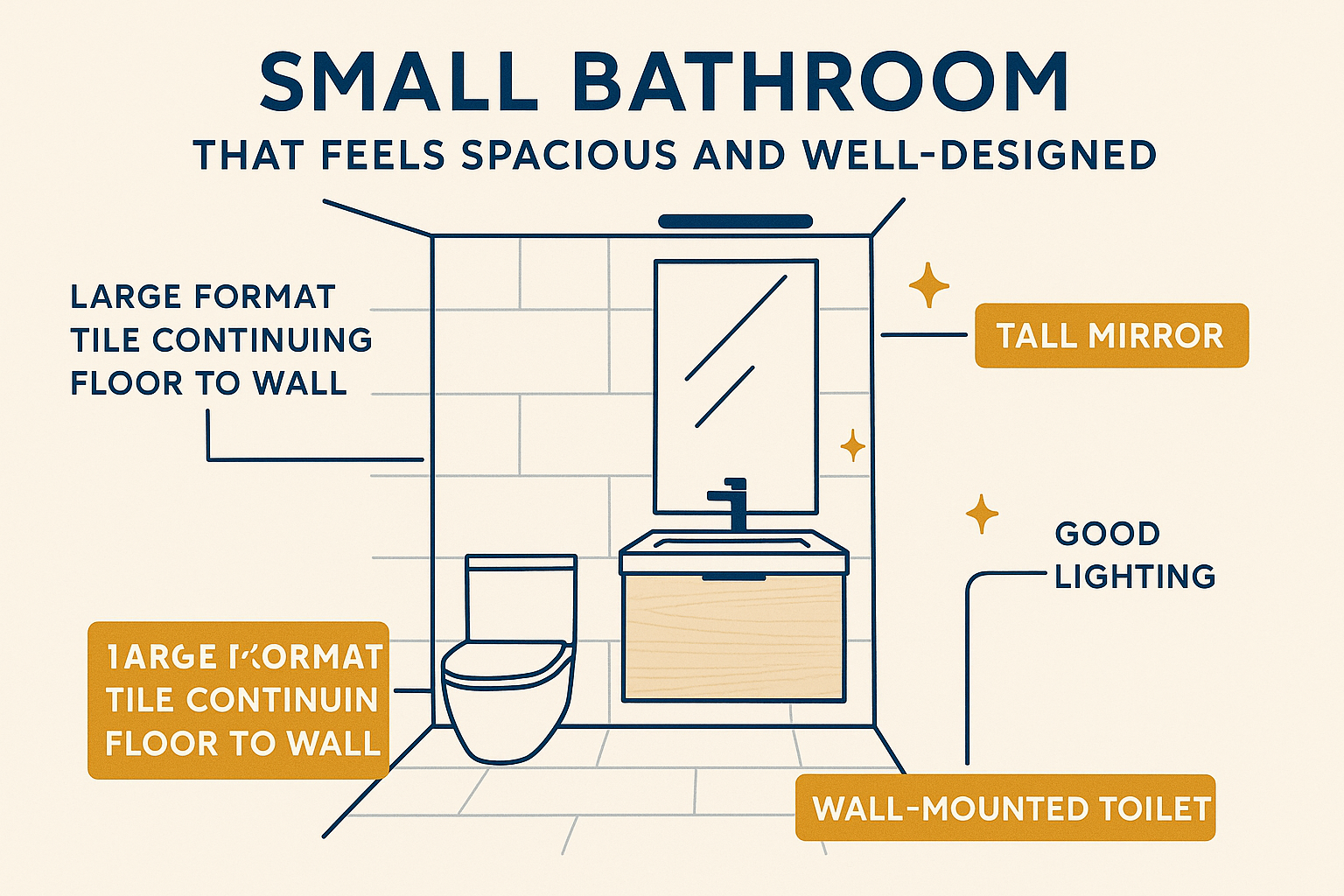
This guide covers the layout, material, fixture, and storage decisions that have the most impact on how a small bathroom reads and lives.
Start With Layout, Not Finishes
The single most important factor in a small bathroom is where the fixtures sit relative to each other and to the door. No amount of white tile will fix a layout where the toilet is immediately visible from the hallway, or where the vanity door swings into the shower door.
Before selecting any materials, consider:
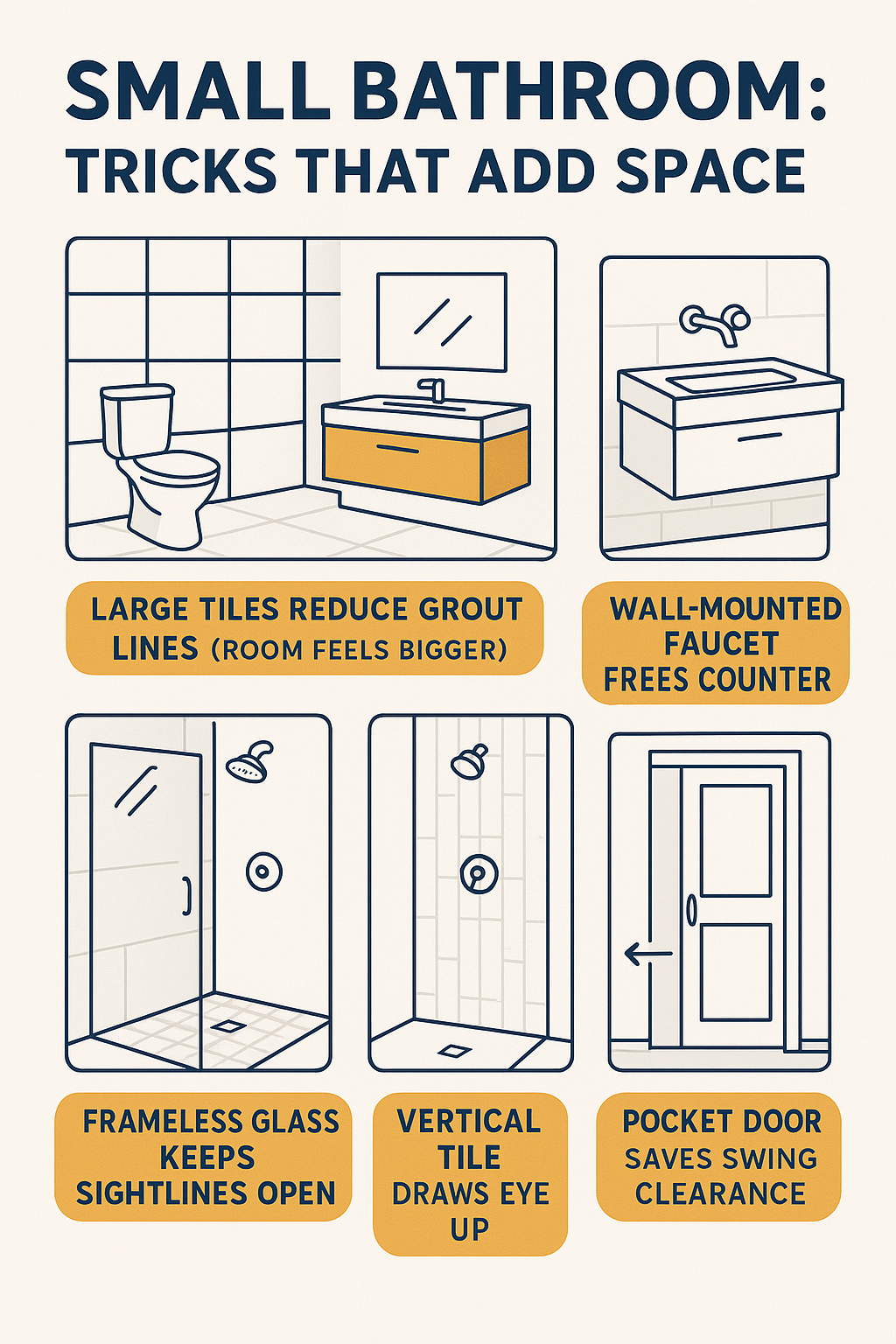
Swing clearance. The bathroom door and any interior doors (shower, vanity cabinet) need clearance to open fully without conflict. In a tight space, a pocket door or barn door on the bathroom entry can recover several square feet of usable floor area that a swinging door consumes.
Fixture sequence. In a standard three-piece or four-piece bathroom, the toilet is typically the least desirable visual element. Placing it at the far end of the room, behind the door swing, keeps it out of the primary sightline from the entry.
Wet zone separation. Even in small bathrooms, keeping the toilet and vanity dry zone separate from the shower or tub wet zone reduces the sense of crowding. A full-height glass panel as a divider accomplishes this without adding physical bulk.
Floor plan depth vs. width. A bathroom that is narrow and deep reads differently than one that is wide and shallow. Narrow-deep bathrooms benefit from fixtures mounted on the end wall to emphasize depth. Wide-shallow bathrooms benefit from fixtures distributed across the wide wall to balance the space.
Tile Strategy for Small Bathrooms
Tile is the dominant visual material in most bathrooms, which means tile decisions drive how the space reads more than any other single choice.
Large-format tile. Counterintuitively, large tile makes small spaces feel larger. Fewer grout lines mean less visual fragmentation of the floor or wall plane. A 60 x 60 cm or 45 x 90 cm floor tile in a light tone creates an expansive, uninterrupted surface that reads as spacious.
Continuous floor-to-wall tile. Running the same tile up the lower portion of the walls, or using the same tile in the shower and on the bathroom floor, eliminates the visual break at the base of the wall. This makes the floor plane appear to continue up and out, adding perceived depth.
Light grout. Matching grout colour to tile colour reduces the grid effect and helps large-format tile read as a continuous surface. Dark grout on small-format tile does the opposite — it emphasizes every joint and visually fragments the space.
Vertical tile orientation. Running rectangular tile vertically (portrait orientation) on the walls draws the eye upward and adds perceived ceiling height. This is particularly effective in bathrooms with standard 2.4 m ceilings.
Fixtures and Fittings That Save Space
Fixture selection has a direct impact on floor area and perceived spaciousness.
Wall-mounted vanity. A floating or wall-hung vanity with open space below the cabinet raises the visual floor line and makes the room feel taller and less boxed in. It also makes cleaning the floor significantly easier. The exposed floor below the vanity reads as additional floor space.
Wall-mounted toilet. A wall-hung toilet with an in-wall cistern saves 15–25 cm in floor depth compared to a floor-mounted toilet. In a bathroom where every centimetre matters, this is a meaningful recovery. The in-wall tank also eliminates the top-tank visual bulk.
Compact vanity depth. Standard vanity depth is 50–55 cm. Compact vanities at 40–45 cm depth are available without sacrificing useful counter space, and the difference is perceptible in a narrow bathroom.
Corner fixtures. A corner sink or corner shower unit uses otherwise dead space, particularly effective in powder rooms or three-piece bathrooms where the standard rectangular layout does not fit well.
Sliding or pocket shower doors. A hinged shower door sweeps into the bathroom and requires clearance. A bypass sliding door or frameless glass panel eliminates that clearance requirement entirely.
For a full renovation that addresses both layout and fixture choices, our team at Miracle Dream Homes can walk through the options during the design phase. See our bathroom renovation services for more on how we approach smaller bathrooms. For powder room-specific design, visit our powder room renovation page.
Lighting to Expand a Space
Poor lighting makes small bathrooms feel like closets. Good lighting makes them feel precise and intentional.
Layered lighting. A single overhead light creates shadows that make a bathroom feel smaller. Combining ambient overhead lighting with vanity-level task lighting eliminates shadows at face level and brightens the lower half of the room.
Recessed lighting. Recessed pot lights preserve ceiling height by eliminating the visual bulk of a surface-mounted fixture. In a bathroom with a lower ceiling, recessed lighting is a clear improvement over pendant or semi-flush fixtures.
Backlit mirror or medicine cabinet. A backlit mirror provides even face-level illumination and eliminates the shadow that a wall-mounted fixture above the mirror creates. A mirrored medicine cabinet adds the double benefit of storage without taking up counter space.
Mirror size. The larger the mirror, the more it reflects light and visually doubles the perceived depth of the space behind the viewer. In a small bathroom, a mirror that spans the full width of the vanity — or even the full wall — has a significant effect on how open the room feels.
Storage Without Adding Visual Bulk
Storage is a critical problem in small bathrooms because the instinct to add shelves, towel bars, and open storage often clutters the very space you are trying to open up.
Recessed niches. A tiled niche recessed into the shower wall or the wall above the toilet takes zero floor or counter space. It provides practical storage while maintaining clean wall planes.
Recessed medicine cabinet. A mirror-fronted medicine cabinet recessed into the wall between studs adds 10–12 cm of storage depth without projecting into the room. It functions as a mirror, so it serves two purposes at once.
Vanity with interior storage. Choosing a vanity with interior shelving or pull-out drawers consolidates bathroom storage inside the cabinet. Open shelves below a wall-mounted vanity look clean but accumulate dust and require organization to stay tidy.
Vertical storage. A tall, narrow storage tower placed between the toilet and the wall, or a tall cabinet built to the full ceiling height, uses vertical space rather than floor space.
Colour and Visual Cohesion
Colour reinforces the spatial effects of tile and lighting choices, but it does not replace them. A small bathroom in a dark colour done with full tonal cohesion can feel sophisticated rather than claustrophobic. A small bathroom in a light colour with clashing tile, grout, fixtures, and paint reads as busy and tight regardless of the palette.
The priority in a small bathroom is cohesion. When the tile, grout, wall paint, and fixture finish share a tonal relationship — not identical, but harmonious — the space reads as unified and larger than its actual footprint.
For reference on small bathroom design standards and best practices, NKBA Design Guidelines and CMHC’s housing guides provide the clearance minimums and functional standards that professional designers work from.
Frequently Asked Questions
What is the minimum size for a full bathroom?
A full bathroom (toilet, sink, tub or shower) functions in as little as 1.5 m x 2.1 m (5 x 7 feet), though 1.5 m x 2.4 m (5 x 8 feet) is more comfortable. Below these dimensions, fixture choices become constrained and layout options are limited.
Does large-format tile actually make a small bathroom look bigger?
Yes. Fewer grout lines reduce visual fragmentation of the floor plane, which creates a more continuous surface that reads as larger. This is most effective when grout colour matches the tile tone, eliminating the grid pattern.
Is a floating vanity worth the cost in a small bathroom?
Yes, in most cases. The visual floor space below a wall-mounted vanity makes the room feel taller and less cluttered. The cost difference over a floor-mounted vanity is modest, and the cleaning benefit is meaningful in a high-traffic bathroom.
Can a small bathroom have a walk-in shower?
Yes. Walk-in showers can be built in 90 x 90 cm footprints. In a small bathroom, removing a bathtub and replacing it with a walk-in shower is one of the most effective ways to increase functional floor space and improve the sense of openness.