
How to Choose a Bathroom Exhaust Fan: CFM, Sones, and Features
Bathroom exhaust fans are one of those products where the difference between a $40 builder-grade unit and a $150 quality fan is significant in daily experience. The $40 fan may meet minimum code requirements but it runs loud, exhausts less air than rated, and fails within 5–7 years. The $150 fan is quiet, performs consistently, and lasts 15+ years.
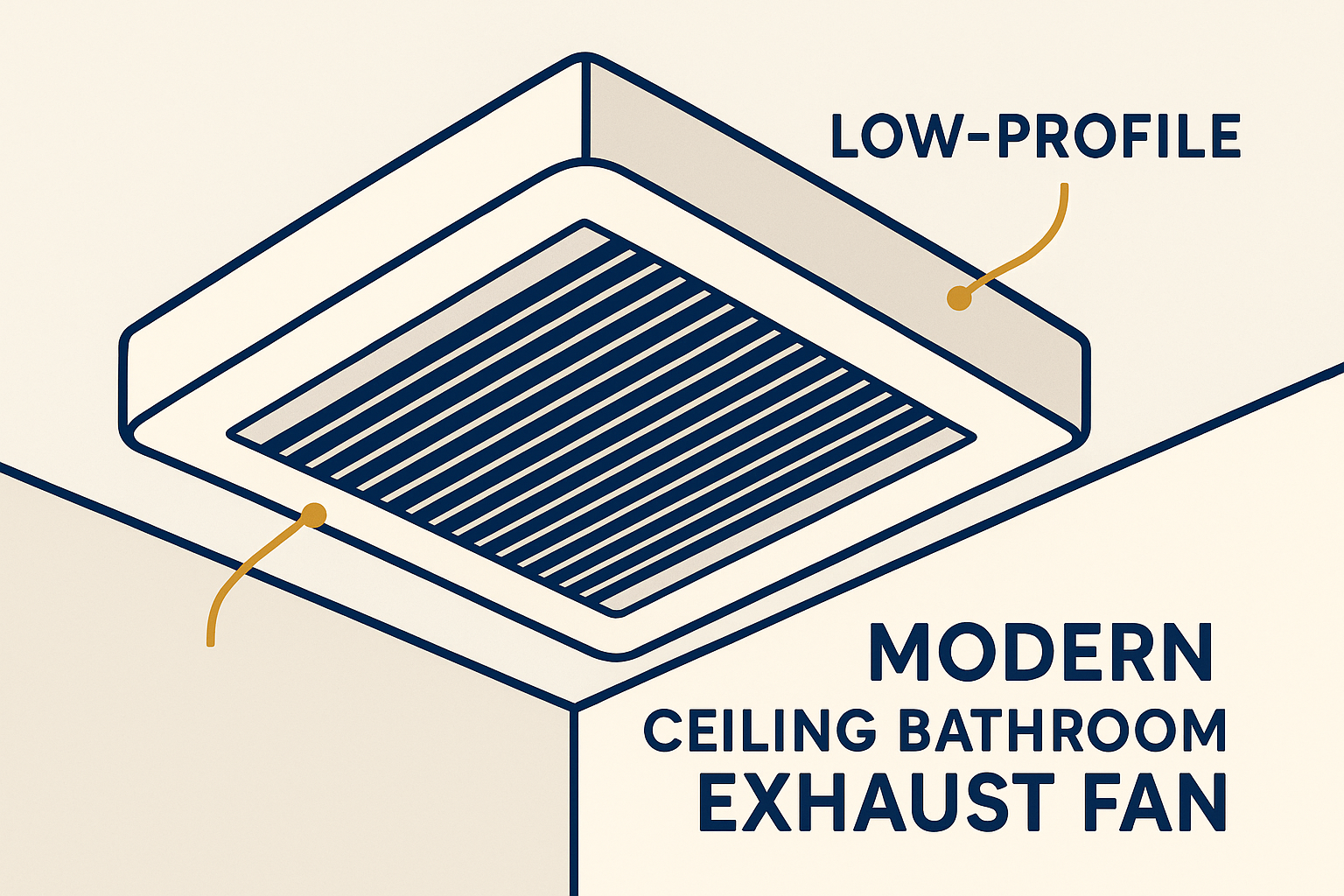
The purchasing decision involves two primary specifications — CFM capacity and sone rating — plus an assessment of additional features that add convenience. This guide covers each.
CFM: Matching Capacity to Your Bathroom
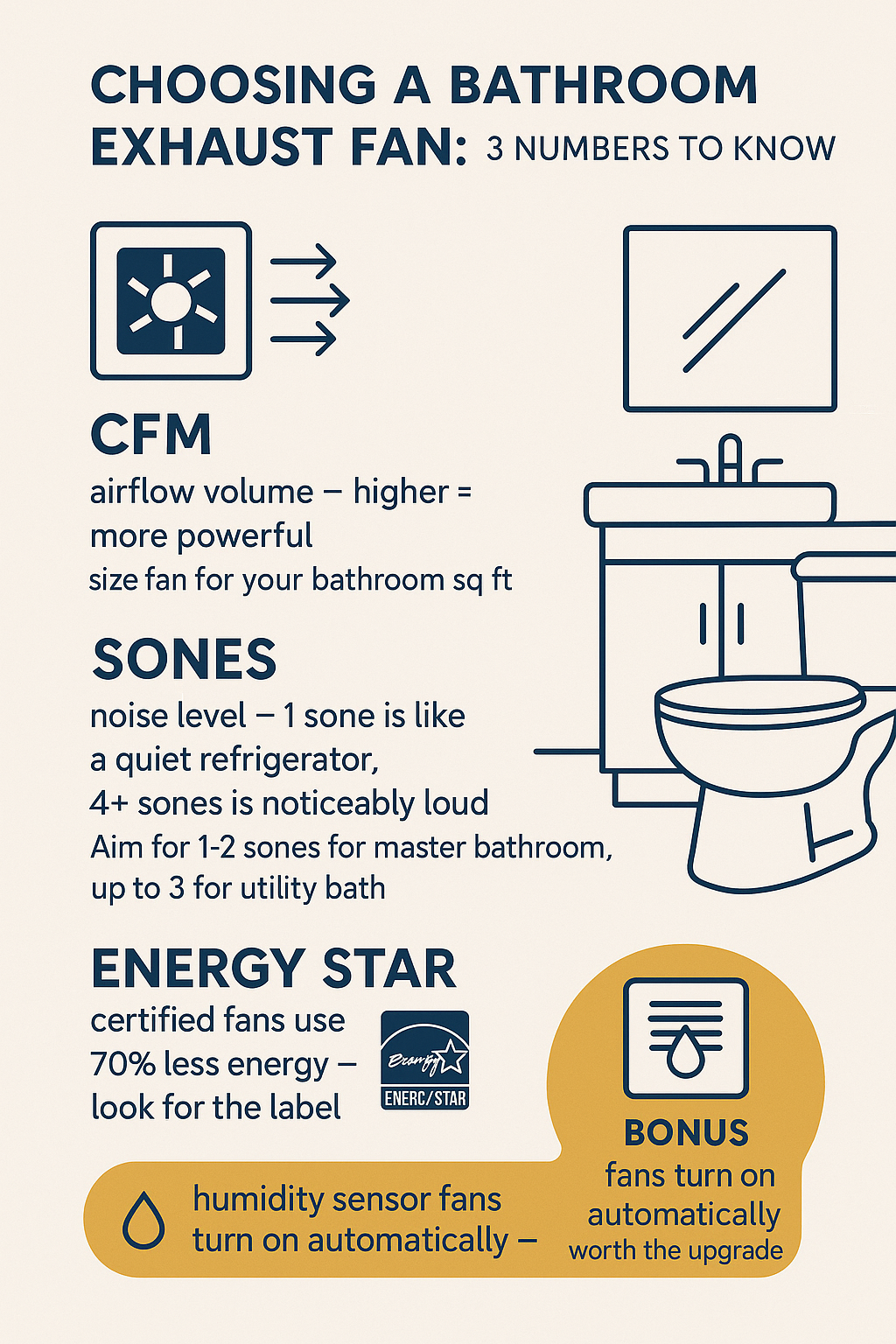
CFM (Cubic Feet per Minute) measures the volume of air the fan exhausts per minute. Higher CFM removes moisture from the bathroom faster and more effectively.
Sizing Your Fan
The basic rule: Select a fan with a CFM rating equal to or greater than the bathroom’s square footage.
| Bathroom size | Minimum CFM |
|---|---|
| Up to 50 sq ft (4.6 m²) | 50 CFM |
| 50–80 sq ft (4.6–7.4 m²) | 80 CFM |
| 80–100 sq ft (7.4–9.3 m²) | 100 CFM |
| 100–150 sq ft (9.3–14 m²) | 110–130 CFM |
| 150+ sq ft (14+ m²) | 130–200 CFM |
For bathrooms with a separate toilet compartment: Add 50 CFM for the toilet compartment to the base bathroom calculation.
For high-use bathrooms or steam showers: Increase the calculated CFM by 25–50%.
The Duct Efficiency Problem
Fan CFM ratings are tested under ideal conditions — a short, straight duct with no bends. In a real bathroom installation, the duct may be 3–5 metres long with 2–3 elbows. Each 90-degree elbow in a flex duct reduces airflow by approximately 5 CFM equivalent. A long, winding flex duct run on a 100 CFM fan may deliver only 60–70 CFM in actual operation.
The practical implication: when in doubt, size up. A fan rated 25–30% above the room-size calculation provides insurance against duct efficiency losses.
CFM for Specific Fixtures
The Home Ventilating Institute (HVI) recommends additional CFM for specific bathroom fixtures:
| Fixture | Recommended additional CFM |
|---|---|
| Bathtub | +50 CFM |
| Shower | +50 CFM |
| Whirlpool/jetted tub | +100 CFM |
| Toilet compartment | +50 CFM |
A primary ensuite with a large walk-in shower and a separate toilet compartment might realistically require 150–200+ CFM.
Sones: Measuring Fan Noise
Sones measure the perceived loudness of sound in a way that correlates with human hearing — doubling the sone rating is perceived as approximately twice as loud.
| Sone rating | Perceived loudness |
|---|---|
| 0.5 sones | Nearly silent (library quiet) |
| 1.0 sones | Very quiet — barely audible |
| 1.5 sones | Quiet — appropriate for bedroom bathrooms |
| 2.0–2.5 sones | Moderate — typical for mid-range fans |
| 3.0–4.0 sones | Loud — typical for builder-grade fans |
| 5.0+ sones | Very loud — common in old fans |
The standard to target: For a primary bathroom or ensuite, look for a fan rated at 1.5 sones or below. For a guest or secondary bathroom, 2.0–2.5 sones is acceptable.
Builder-grade fans at $40–$60 are typically rated at 3.0–5.0 sones. This is the hum that homeowners associate with bathroom fans — not a characteristic of the product category, but a characteristic of the budget tier.
Quality fans from Broan-NuTone, Delta Breez, Panasonic, or Fantech at $100–$250 are rated at 0.3–1.5 sones. The difference in daily experience is immediately apparent.
Features Worth Considering
Humidity Sensor
A humidity sensor automatically activates the fan when bathroom humidity exceeds a set threshold and turns it off when humidity returns to normal. No timer or manual operation required — the fan always runs as long as needed and no longer.
Best for: Primary bathrooms where consistent moisture management is a priority, households with varying usage patterns, and bathrooms where users consistently forget to run the fan long enough after showering.
Cost premium: $30–$80 above a comparable fan without humidity sensing.
Timer Function
A built-in timer in the fan itself activates at switch-on and runs for a preset interval (10, 20, or 30 minutes depending on the model). Alternatively, a timer wall switch (separate from the fan) provides this function for any fan.
Timer switches cost $20–$50 and are compatible with most fans. A built-in timer is a convenience that eliminates the need for a separate switch.
Combined Light and Fan
Exhaust fan/light combinations are extremely common in builder bathrooms — one box, one electrical box, one opening in the ceiling. They are practical for small bathrooms where ceiling real estate is limited.
The tradeoff: Combined units force the fan’s location to be where the light is needed, rather than over the wet zone where the fan should ideally be positioned. In a bathroom where the primary light is centred on the ceiling and the shower is in a corner, the fan is in the wrong position relative to the moisture source.
For primary bathrooms where ventilation performance matters, separate fan and lighting fixtures are the better approach. For secondary bathrooms and powder rooms, a combination unit is practical.
Motion and Occupancy Sensing
Some premium fans include motion sensing that activates the fan automatically when someone enters the bathroom and runs a post-occupancy cycle. Eliminates any user action requirement. Adds $50–$100 to the fan cost.
DC Motor Technology
Higher-end fans (Panasonic WhisperCeiling, Delta Breez line) use brushless DC motors that run significantly quieter and more energy-efficiently than AC motors. These fans are rated at 0.3–0.8 sones even at higher CFM ratings, and consume 10–20W vs. 30–50W for comparable AC-motor fans.
The energy efficiency saving over the fan’s lifespan is modest, but the noise reduction is significant.
For exhaust fan replacement and installation as part of a bathroom renovation in Ottawa, our team at Miracle Dream Homes handles fan selection and proper exterior duct routing. See our bathroom renovation page and our basement bathroom page for more on our renovation approach.
For HVI fan ratings and certified product listings, the Home Ventilating Institute (HVI) maintains a database of certified bathroom fans with verified CFM and sone ratings. Panasonic Ventilation and Broan-NuTone Canada are major suppliers in the Canadian market.
Frequently Asked Questions
How do I know what CFM bathroom fan to buy?
A general starting point: the fan’s CFM rating should equal or exceed the bathroom’s square footage in square feet. For a 75 square foot bathroom, a fan rated at 80–100 CFM is appropriate. Add 25–50% for steam showers, high-use bathrooms, or long duct runs that reduce delivered airflow.
What sone rating is considered quiet for a bathroom exhaust fan?
Fans rated at 1.5 sones or below are considered quiet. Premium fans from Panasonic (WhisperCeiling series) are rated at 0.3–1.0 sones — almost inaudible. Standard builder-grade fans typically run at 3.0–5.0 sones, which is the noticeable hum most people associate with bathroom fans. Upgrading to a 1.0-sone or lower fan is one of the most noticeable quality improvements in a bathroom renovation.
Is a humidity-sensing bathroom fan worth the extra cost?
Yes, particularly for primary bathrooms where consistent moisture management is a priority. A humidity-sensing fan eliminates reliance on user behaviour — the fan runs as long as needed, regardless of whether the occupant remembers to turn it on or leave it running after showering. The cost premium ($30–$80) is modest for the benefit.
Can I replace a bathroom exhaust fan myself?
Replacing an existing fan with a new fan in the same location and on the same circuit is within the capability of a competent DIYer. It involves disconnecting the old unit, connecting the new unit to the existing wiring, and securing the duct connection. If the replacement involves a different circuit, new duct routing, or a different location, a licensed electrician is required and an ESA permit applies.