
Walk-In Shower Design Ideas: From Minimalist to Luxury
Walk-in showers have replaced tub-shower combos as the preferred choice in most Ottawa bathroom renovations. They offer more usable floor space, easier cleaning, and a design range that goes from stripped-back functional to genuinely luxurious. The challenge is knowing what decisions actually matter and which details drive cost without adding much.
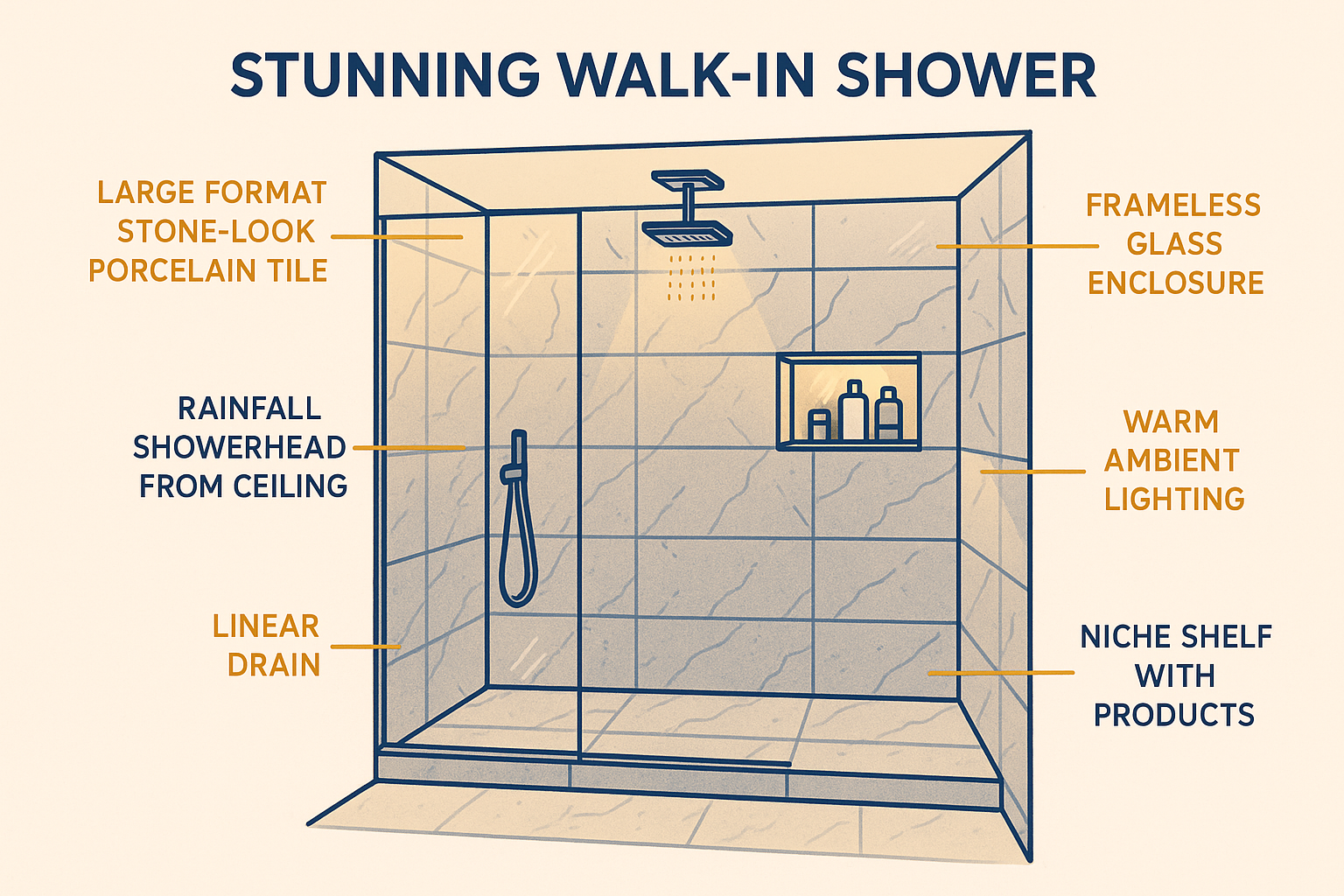
This guide covers the main design directions for walk-in showers, the layout decisions that affect daily use, and the features worth the investment.
What Makes a Walk-In Shower
A walk-in shower is defined by a low or zero threshold entry — no step to climb over, no door track to clean around. The floor transitions directly from the bathroom into the shower area, usually with a linear or centre drain recessed into the tile.
The absence of a step improves accessibility, reduces cleaning effort, and creates a visual flow that makes the entire bathroom feel more open. It also requires proper waterproofing beneath the tile — a detail that separates a well-built shower from one that will fail in five to ten years.
Walk-in showers range from compact 90 cm x 90 cm formats in smaller bathrooms to large open formats that take up a full corner of a primary ensuite. The design decisions change significantly with size.
Minimalist Walk-In Showers
The minimalist approach is defined by restraint: large-format tile, little or no pattern, frameless glass or an open-entry format, and a single fixture. This look suits contemporary and Scandinavian-influenced bathrooms and ages exceptionally well because there is nothing decorative to become dated.
Key elements:
– 60 cm x 120 cm or larger tile in a neutral tone (white, light grey, warm beige)
– Matching or same-tonal grout to minimize the grid effect
– Frameless glass panel or no enclosure at all in larger formats
– Wall-mounted rain head or single-function handheld
– Matte black or brushed nickel hardware
– Linear drain at the back wall
The linear drain is important in minimalist showers because it allows a continuous tile pattern across the floor without interruption. It also simplifies cleaning compared to a centre drain surrounded by tile cuts.
If the bathroom has limited natural light, a minimalist shower benefits from a light-reflective tile choice — large polished or satin-finish porcelain rather than matte stone.
Classic and Traditional Walk-In Showers
Traditional shower design uses smaller-format tile, more pattern, and warmer fixture finishes to create a layered, established look. This suits heritage homes, bathrooms with period details, and homeowners who prefer visual warmth over spare minimalism.
Key elements:
– Subway tile in 7.5 cm x 15 cm or 10 cm x 20 cm formats, often with a stacked or herringbone pattern
– Marble or marble-look tile on the floor with a pencil liner or border at the transition
– Semi-frameless or framed shower door with brushed brass, oil-rubbed bronze, or polished chrome
– Exposed-style fixtures with cross or lever handles
– Niche(s) recessed into the tile for storage
Traditional showers often use a contrasting accent tile at eye level — a decorative border, a mosaic band, or a pattern change — to break up the visual field and reference period design conventions.
Walk-In Shower Tile Patterns
The tile pattern has a large effect on the finished look. The same tile reads differently in a stack bond, offset brick pattern, herringbone, or vertical stack.
- Stack bond (tile stacked directly over tile with continuous grout lines): clean, contemporary, works well with large-format tile
- Offset/brick pattern (half-tile offset): the most common and forgiving pattern, works with almost any tile format
- Herringbone: adds visual movement, works best as an accent on one wall or as a floor tile rather than across all surfaces
- Vertical stack (tiles oriented vertically with stacked joints): adds height visually, good in showers with lower ceilings
Mixing patterns across surfaces — a different pattern on the floor than the walls — is common and adds design interest without becoming busy.
Features Worth the Investment
Not all shower features are equal. Some add genuine daily-use value; others are primarily aesthetic.
Linear drain. A worthwhile investment in any walk-in shower because it simplifies waterproofing, allows a continuous tile floor, and cleans more easily than a four-sided centre drain. The cost difference is modest relative to the full project.
Built-in niches. Recessing storage into the wall rather than using surface-mounted shelves is worth the extra tiling effort. Niches eliminate the visual clutter of corner shelves and hold up better over time. A tiled or stone-inset niche is both functional and finished.
Thermostatic shower valve. A thermostatic valve maintains a set water temperature regardless of what else is happening in the house — the toilet flush problem. It also allows multiple outlets (rain head, handheld, body jets) to operate simultaneously from a single valve. This is a meaningful quality-of-life upgrade in a primary ensuite.
Large-format floor tile. Fewer grout lines on a shower floor means easier cleaning. 30 cm x 60 cm or larger tiles with minimal grout joints are dramatically easier to maintain than small mosaic tiles, which require significant scrubbing.
For clients considering a tub-to-shower conversion — replacing an existing bathtub with a proper walk-in shower — this is one of the most popular renovations we complete. You can learn more about that process on our tub-to-shower conversion page.
Walk-In Shower Enclosure Options
How the shower is enclosed determines both the look and the maintenance requirement.
Frameless glass panel (open entry). No door at all — the shower is partially enclosed by a fixed glass panel. Works best in larger showers where water containment is not an issue. Easiest to clean, most modern look, no pivot point or track to maintain.
Frameless hinged door. Glass panel with a single frameless door. The most popular option in Ottawa renovations. Clean appearance, good water containment, no metal frame to clean around.
Semi-frameless. Framing only at the top and bottom track, not on the glass edges. Less expensive than fully frameless, still clean in appearance.
Framed door. Full metal frame around the glass panels. Lower cost, more visual presence, more maintenance around the frame tracks. Common in builder-grade bathrooms.
The shower enclosure should match the fixture finish — chrome with chrome, matte black with matte black. Mixed finishes can work intentionally, but accidental mismatches read as incomplete.
Layout Considerations
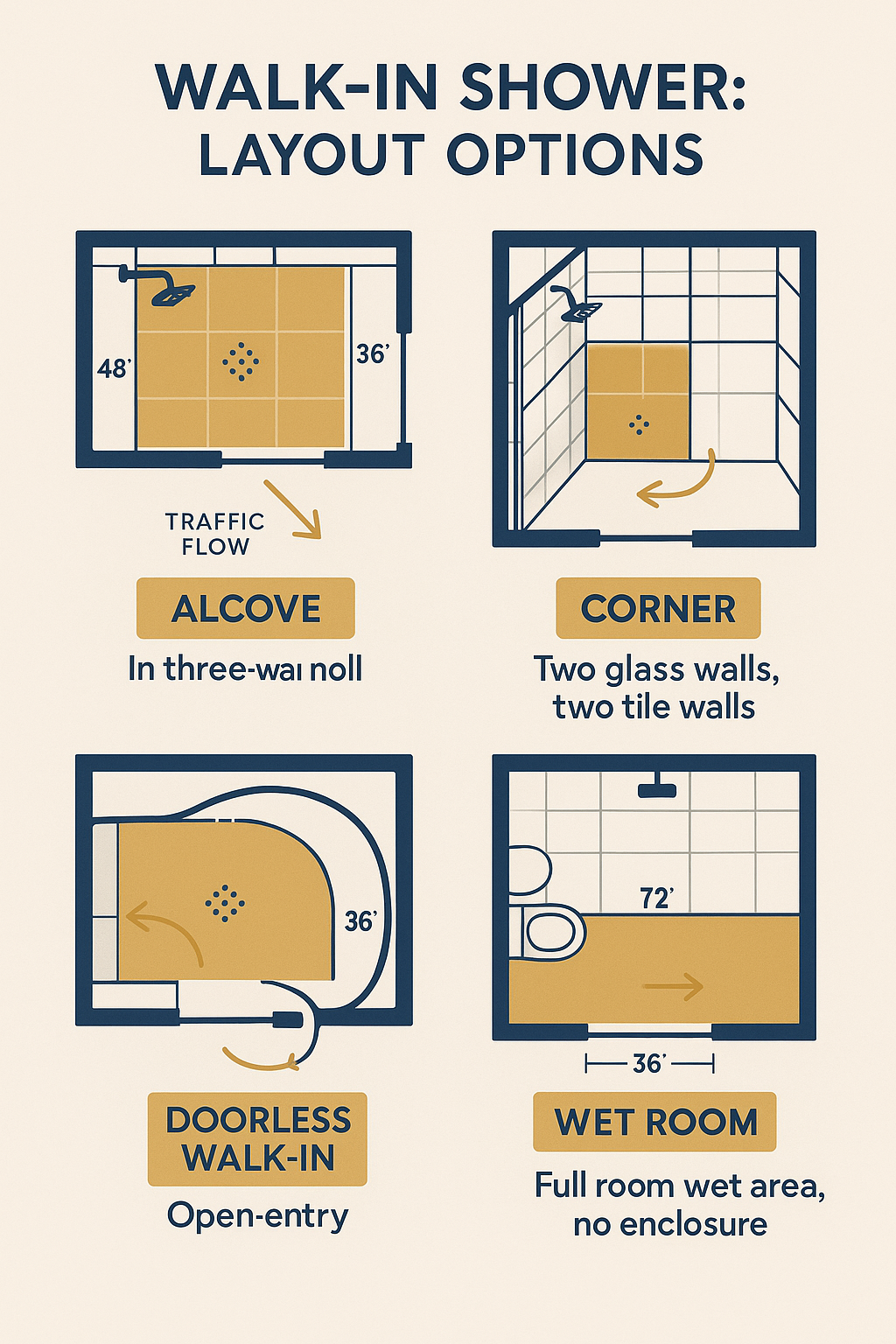
Walk-in shower layout affects how the space feels and how it functions day-to-day. The main decisions are:
Shower position relative to the door. A shower positioned across the room from the bathroom door creates natural separation between wet and dry zones. A shower placed immediately adjacent to the door requires careful waterproofing at the threshold.
Shower size. Smaller walk-in showers (90 x 90 cm) function well for single users. Anything intended for two people benefits from at least 120 x 120 cm. Shower benches, which add comfort and accessibility, require at minimum 120 cm in the bench dimension.
Bench placement. A tiled bench at the end of the shower or along one wall adds usability and can double as a shelf. It should be at a comfortable seated height — 45 to 50 cm — and pitched slightly toward the drain.
For a full walk-in shower renovation or a complete bathroom redesign in Ottawa, our team can work through layout options with you at the design stage. Learn more about our full bathroom renovation services.
For further reference on walk-in shower design standards, the National Kitchen and Bath Association (NKBA) publishes design guidelines used by professional bathroom designers across North America, and Houzz maintains an extensive photo library of completed projects.
Frequently Asked Questions
What is the minimum size for a walk-in shower?
The functional minimum is 90 cm x 90 cm. At that size, one person can shower comfortably, but there is little room for a bench or body spray additions. For a primary ensuite or a shower intended to replace a tub, 120 x 120 cm or larger is a better starting point.
Do walk-in showers require a door?
No. Open-entry walk-in showers with no door are fully functional when the shower is large enough — typically 120 cm or more in width — to contain water spray without enclosure. They require a linear or well-placed centre drain and sufficient distance from the bathroom entrance.
What tile is easiest to maintain in a walk-in shower?
Large-format porcelain tile with minimal grout joints is the easiest to maintain. Fewer grout lines mean less surface area for mildew to develop. Matte stone and small mosaic tiles have the most grout per square metre and require the most regular cleaning.
Is a thermostatic shower valve worth the cost?
For a primary ensuite shower, yes. A thermostatic valve eliminates temperature fluctuation from other water uses in the house, allows multiple outlets simultaneously, and typically adds $300–$600 to the fixture budget — a modest premium for a shower used daily.