
Non-Slip Bathroom Flooring: Best Options for Safety and Style
Every bathroom floor gets wet. A floor that provides adequate traction when dry but becomes slippery when wet is a slip hazard every time someone exits the shower or bath. Selecting flooring with appropriate slip resistance for wet conditions is a basic safety requirement — not an optional upgrade.
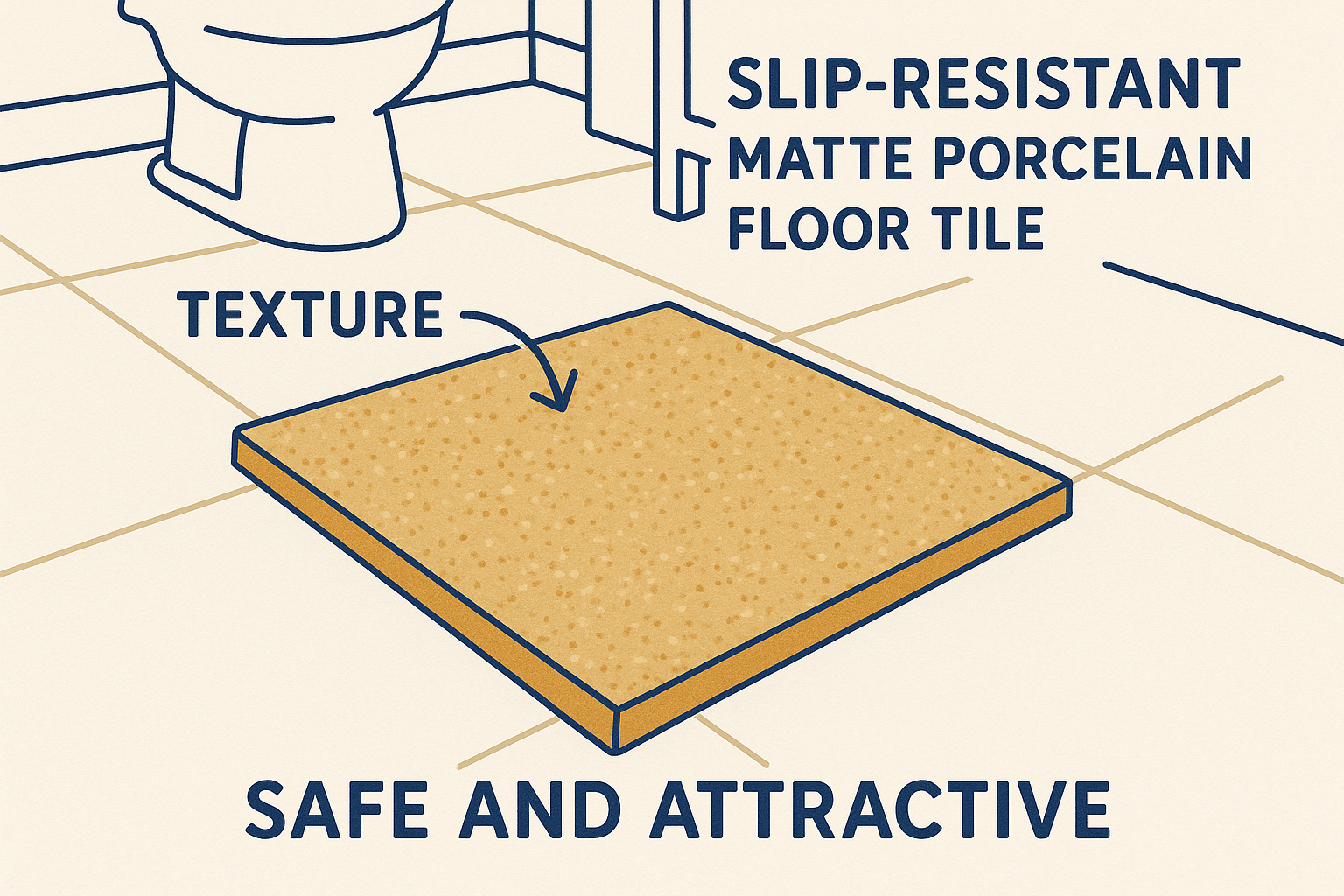
The good news is that slip-resistant bathroom flooring includes attractive, design-forward options across a wide range of budgets. Slip resistance does not mean sacrificing aesthetics.
How Slip Resistance Is Measured
DCOF (Dynamic Coefficient of Friction)
The most relevant slip resistance measure for bathroom flooring is the DCOF (Dynamic Coefficient of Friction) — the resistance to sliding when a foot is in motion, measured on a wet surface. DCOF is measured under the ANSI A137.1 standard.
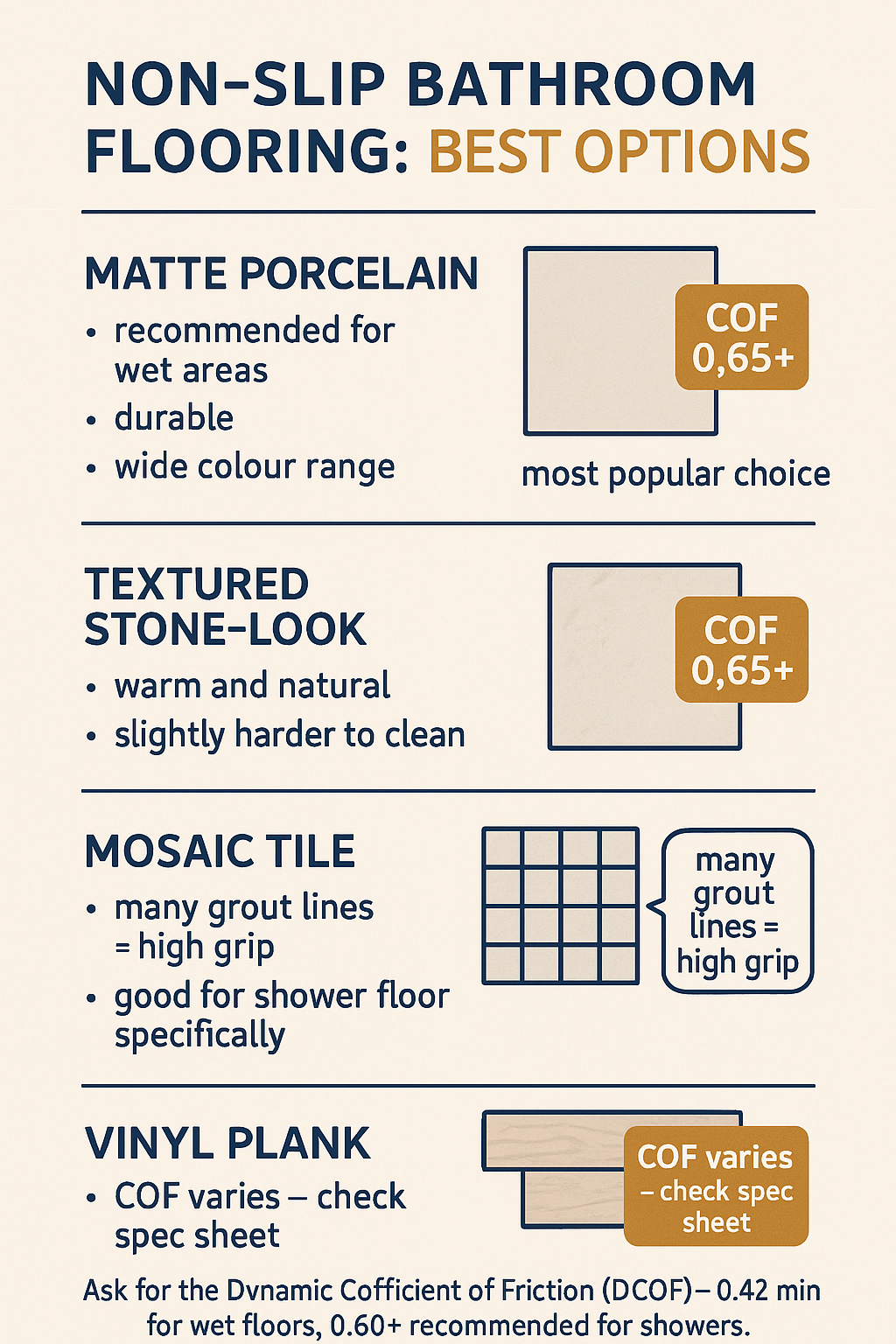
The minimum DCOF for a tile recommended for use in wet interior floors is 0.42. Tile with DCOF below 0.42 is appropriate only for dry conditions or wall applications.
For bathroom floors — particularly in the shower zone and the immediate area outside the shower — look for tile with a DCOF of 0.42 or above. Tile specifications include the DCOF rating in the product technical data. Ask your tile supplier for this information if it is not on the product packaging.
Coefficient of Friction (COF) — Static
COF (static, or SCOF) measures resistance when the foot is stationary. This measure has been largely superseded by DCOF in current standards, but older product specifications may reference COF. A COF rating of 0.60 or above was the traditional wet-area minimum; current DCOF 0.42 is the operative standard.
Pendulum Test Value (PTV)
In some European and UK-sourced tile products, slip resistance is expressed as a Pendulum Test Value. A PTV of 36+ is considered low slip risk for wet surfaces. This measure is less common in the Canadian market but appears on some imported tiles.
Best Flooring Options for Non-Slip Bathrooms
Porcelain Tile — Textured or Matte Finish
Porcelain tile with a textured surface or matte finish provides excellent slip resistance in wet conditions. The texture interrupts the water film between the foot and the tile surface, maintaining friction.
Textured porcelain: Surface texture is pressed into the tile during manufacturing. Products marketed for bathroom floors and outdoor use typically achieve DCOF 0.50–0.70+ in wet conditions.
Matte porcelain: A matte (non-polished) porcelain surface provides better traction than a polished or semi-polished finish. The unpolished surface retains micro-texture that increases wet friction.
Wood-look porcelain: Wood-look tile in a matte finish provides good traction, the appearance of wood planks, and the durability of porcelain. Popular in contemporary bathrooms where a softer aesthetic than standard tile is desired.
Avoid: Polished or high-gloss porcelain on bathroom floors. The polished surface reduces DCOF significantly — many polished tiles test below 0.42 when wet. Polished tile is appropriate for walls but not for wet floors.
Mosaic Tile
Mosaic tile — small-format tile (typically 25–50 mm square or smaller) set in a sheet — provides more grout lines per square foot than large-format tile. The grout joints create texture and micro-edges that improve traction.
Mosaic tile is a traditional choice for shower floors for exactly this reason: more grout lines equal more texture. Porcelain or natural stone mosaic in a shower floor provides excellent slip resistance without requiring a specifically textured tile surface.
Trade-off: More grout lines require more grout maintenance — regular cleaning and resealing to prevent discoloration and mildew.
Natural Stone — Honed or Brushed
Natural stone (slate, travertine, limestone, granite) in a honed or brushed finish — rather than polished — provides natural texture and reasonable wet traction. Slate in particular has natural surface variation that provides good grip.
Avoid: Polished marble or polished granite on bathroom floors. The polished surface is slippery when wet. Natural stone used on bathroom floors should be honed (matte, slightly textured) rather than polished.
Natural stone requires regular sealing (annually or as the sealer wears) to maintain stain and moisture resistance.
Vinyl Plank and Sheet Vinyl
Modern luxury vinyl plank (LVP) and sheet vinyl products designed for bathroom and wet-area applications provide good wet traction when the surface texture is maintained. The vinyl surface — when new and clean — provides adequate friction for bathroom use.
Consideration: Vinyl surfaces can become slippery when covered with soap film or body wash residue. Regular cleaning maintains the traction properties. Vinyl is more forgiving than tile in terms of surface feel (softer underfoot) and is warmer than tile in winter conditions.
For accessibility applications: Vinyl provides a softer surface if a fall does occur, which is a consideration in high-fall-risk bathrooms.
Anti-Slip Coatings and Treatments
An anti-slip coating or treatment can be applied to existing glazed tile or stone to increase wet-surface traction without replacing the flooring. These products (HTC Superfloor anti-slip, Sure Step, and others) chemically etch the tile surface or apply a microscopic grip texture.
Treatments are appropriate for existing floors where replacement is not practical. The traction improvement is real but temporary — retreatment every 1–3 years is required as the treatment wears. For a renovation, choosing the right tile is a permanent solution; a treatment is a maintenance-dependent fix.
In the Shower Zone Specifically
The shower floor is the highest-risk surface in the bathroom. For the shower floor tile selection specifically:
- DCOF 0.42 minimum; 0.50+ preferred
- Textured porcelain or mosaic tile
- Avoid large-format tile (60 × 60 cm or larger) on shower floors — fewer grout lines reduce traction and the larger format is harder to slope correctly
Outside the shower — the transition zone where wet feet exit — is the second-highest-risk surface. The bath mat placed in this zone provides a crucial traction layer. For households with seniors or higher fall risk, a bath mat with a non-slip backing placed consistently at the shower exit significantly reduces the fall risk at this transition.
For non-slip bathroom flooring as part of a complete renovation or tub-to-shower conversion in Ottawa, our team at Miracle Dream Homes advises on tile selection that combines safety performance with the design direction of the renovation.
For tile slip resistance standards, ANSI A137.1 (Specifications for Ceramic Tile) and the Tile Council of North America (TCNA) publish the current wet-surface slip resistance standards for residential tile applications.
Frequently Asked Questions
What DCOF rating do I need for a bathroom floor tile?
A minimum DCOF of 0.42 is the standard for wet interior floors per ANSI A137.1. For shower floors and the transition zone outside the shower — where wet bare feet are the normal condition — a DCOF of 0.50 or above provides additional margin. Ask your tile supplier for the DCOF specification of any tile you are considering for bathroom floor use.
Is large-format tile safe on bathroom floors?
Large-format tile (60 × 60 cm or larger) on bathroom floors can be safe if the tile has adequate surface texture and a DCOF rating above 0.42. However, large-format tiles provide fewer grout lines, and the grout lines are part of the traction texture. For shower floors specifically, smaller formats (30 × 30 cm or smaller) with more grout lines are generally safer. For the general bathroom floor outside the shower, large-format tile with a matte or textured finish is appropriate.
Does heated flooring affect slip resistance?
In-floor radiant heat does not affect the slip resistance of the tile surface itself. The tile’s DCOF rating is independent of its temperature. Warm tile does dry faster after minor splashing, which can marginally improve practical traction compared to a cold tile that stays wet longer — but the difference is minor and not a substitute for proper tile selection.
How do I make an existing slippery bathroom floor safer without replacing it?
Options include: applying an anti-slip chemical treatment to the existing tile surface (effective, requires reapplication every 1–3 years); placing non-slip bath mats in the highest-risk zones (shower exit, in front of the toilet); and applying non-slip adhesive strips to the shower floor. For a permanent solution, replacing the tile with a properly rated floor is the most reliable approach and is addressed during any full bathroom renovation.