
Large Format vs. Small Format Tile in the Bathroom: Pros and Cons
Tile format — the physical dimensions of each tile — affects the look of a bathroom more than most homeowners realize. It changes how spaces feel, how light moves across surfaces, how much maintenance is required, and what the installation demands. Both large-format and small-format tiles have distinct strengths, and the best choice often depends on which surface you are tiling and what you want that surface to do.
Defining the Formats
There is no universal standard for “large” vs. “small” tile, but in residential bathroom context:
- Small format: Under 15 x 15 cm. Includes mosaic tiles (25 mm, 50 mm, 100 mm), classic subway tile (75 x 150 mm), penny rounds, hexagons under 10 cm.
- Medium format: 15 x 15 cm to 45 x 45 cm. The most common residential range. Standard 30 x 30 cm floor tile and 20 x 40 cm wall tile fall here.
- Large format: 45 x 45 cm and above. Contemporary renovation standard. 60 x 60 cm, 60 x 120 cm, 75 x 150 cm, and 120 x 240 cm are common sizes.
- Oversized/slab: 120 x 240 cm and larger. Increasingly available in residential renovation; used as countertops, shower walls, and feature walls.
Large-Format Tile: The Case For
Visual Expansiveness
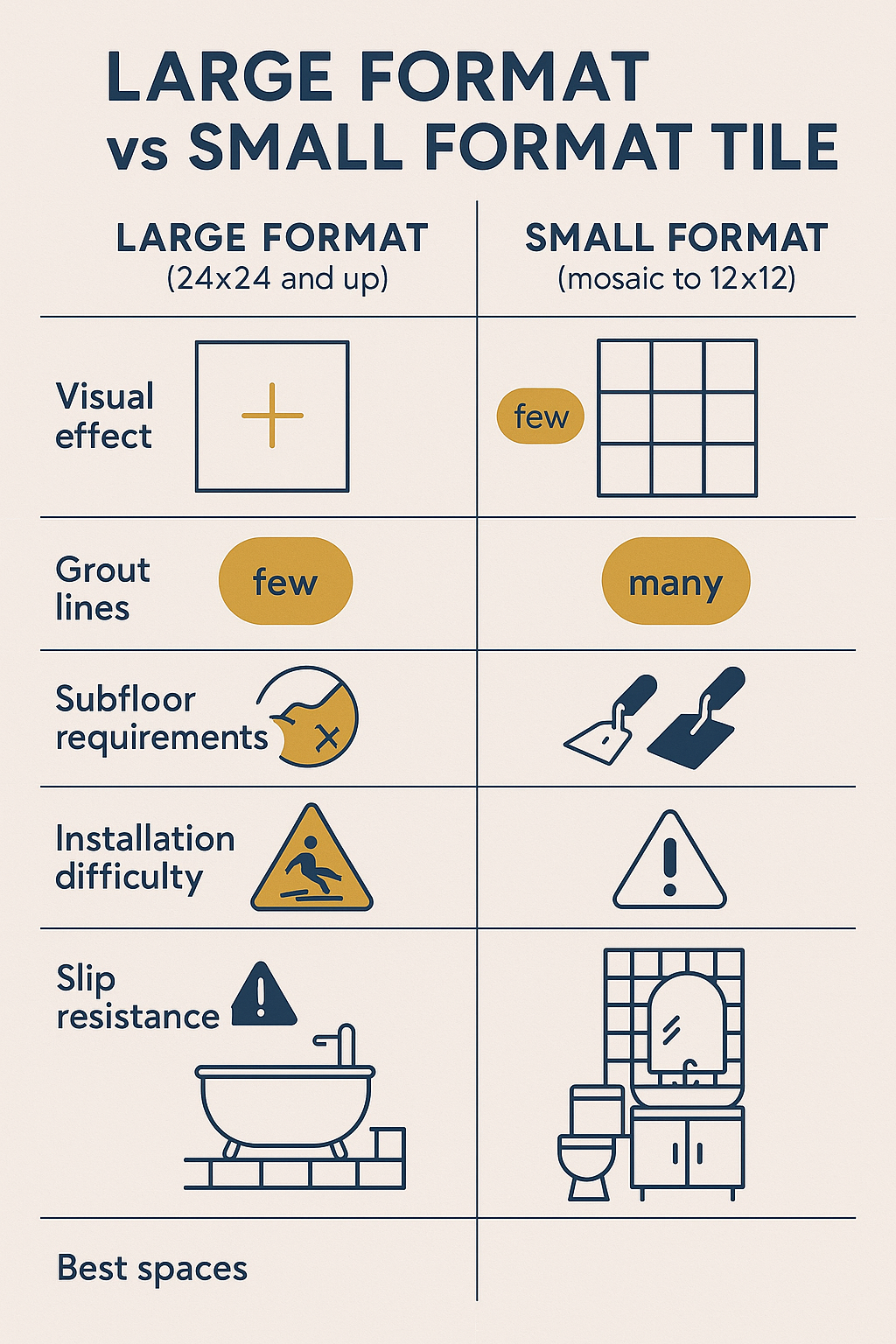
Fewer grout lines mean the eye travels uninterrupted across the tile surface. In a bathroom, this visual continuity makes the space feel larger and calmer. This effect is particularly pronounced on floors, where large tile creates a nearly seamless surface that reads as a single plane rather than a grid.
A 30 x 30 cm floor tile in a 1.5 x 2.5 m bathroom produces approximately 31 tiles and a corresponding grid of grout joints. A 60 x 120 cm tile in the same space produces approximately 5 tiles. The visual difference is substantial.
Easier Maintenance
Fewer grout lines mean less surface area for mildew, soap scum, and hard water deposits to accumulate. A large-format tile floor with tight grout joints requires significantly less cleaning effort than the same floor in small-format tile. Over the lifetime of a bathroom, this is a meaningful quality-of-life difference.
Contemporary Aesthetic
Large-format tile is the dominant look in contemporary and modern bathroom design. The clean, minimal surface it creates suits current design directions and photographs particularly well — relevant for homeowners with resale considerations.
Countertops and Feature Walls
Slabs and oversized tiles are increasingly used as vanity countertops, shower walls, and shower surrounds — essentially replacing quartz or stone slabs with a porcelain panel. The continuous surface is visually striking and eliminates the seams of smaller tile installations. Cost and installation are specialized but the result is genuinely premium.
Large-Format Tile: The Drawbacks
Substrate Requirements
Large-format tile requires a near-perfectly flat, rigid substrate. Any unevenness in the substrate becomes obvious with a large tile because the tile spans a larger area — a 60 x 120 cm tile laid over a surface that dips 2 mm will rock visibly. Substrate preparation is more demanding and more expensive.
Not for Shower Floors
As discussed in the bathroom floor tile guide, large-format tile on a shower floor creates slope problems. The tile must follow the 2% slope toward the drain, and large tiles that span the slope do not all sit at the same angle. Pooling water and uneven tile surfaces are the result. Small-format tile (mosaic, hexagon, 10 x 10 cm) is the correct choice for shower floors.
Higher Installation Cost
Large-format tile requires more precise handling, more careful layout planning, and — for the heaviest large-format porcelain — mechanical lifting equipment for installers. The tile itself is more expensive per piece, waste from cutting is proportionally greater, and the installation labour cost is higher.
Limited Pattern Options
Small format tiles offer diverse pattern possibilities — herringbone, basketweave, hexagon, subway in varied layouts — that derive their appeal from the repetition of many small units. Large-format tile is predominantly laid in stack bond or offset bond; complex pattern layouts are not compatible with large formats.
Small-Format Tile: The Case For
Design Character and Pattern
Small-format tiles produce design interest through the cumulative effect of pattern and texture. A herringbone marble mosaic floor, a white hex bathroom floor, or a subway tile shower wall all derive their appeal from the repetition and layout of small units. This design quality is not achievable with large-format tile.
Shower Floor Suitability
Small-format tile naturally follows the shower floor slope because each tile is small enough to set at a slightly different angle from its neighbour. A 50 mm mosaic tile sheet conforms to the shower floor slope perfectly. This is why mosaic and small hexagon tile remain the standard for shower floors.
Accessibility and Natural Feel
Small-format mosaic tile, when used on a shower seat, bench edge, or bath surround, creates a comfortable, rounded surface that large tiles cannot replicate. In accessibility-focused renovations, small tile on curved or contoured surfaces is the practical choice.
Flexible in Small Spaces
In very small bathrooms or powder rooms, a large-format tile can look out of scale — tile running off all four walls with few complete tiles visible. Small-format tile can be better scaled to compact spaces and allows more design freedom in terms of pattern direction and feature use.
Small-Format Tile: The Drawbacks
More Grout Lines
More grout lines mean more maintenance. A small mosaic tile floor has a large surface area of grout that accumulates mildew, mineral deposits, and soap scum. If minimal maintenance is a priority, small-format tile on large surfaces is a trade-off that requires honest consideration.
Dated Associations in Some Formats
Some small-format tiles have strong stylistic associations that can read as dated in current renovations: the 10 x 10 cm white ceramic tile ubiquitous in 1980s–1990s bathrooms, the pink-and-black checkerboard of the 1950s. These associations are not inherent to the format — subway tile is small-format and entirely timeless — but they are a consideration for period or resale-focused decisions.
Installation Labour for Complex Patterns
A herringbone mosaic or intricate pattern layout requires significantly more installation time than a simple offset pattern. This adds labour cost and extends installation time.
Summary: Which to Use Where
| Location | Best Format |
|---|---|
| Main bathroom floor | Large-format (60×60 cm or larger) |
| Shower floor | Small-format mosaic or hexagon (25–100 mm) |
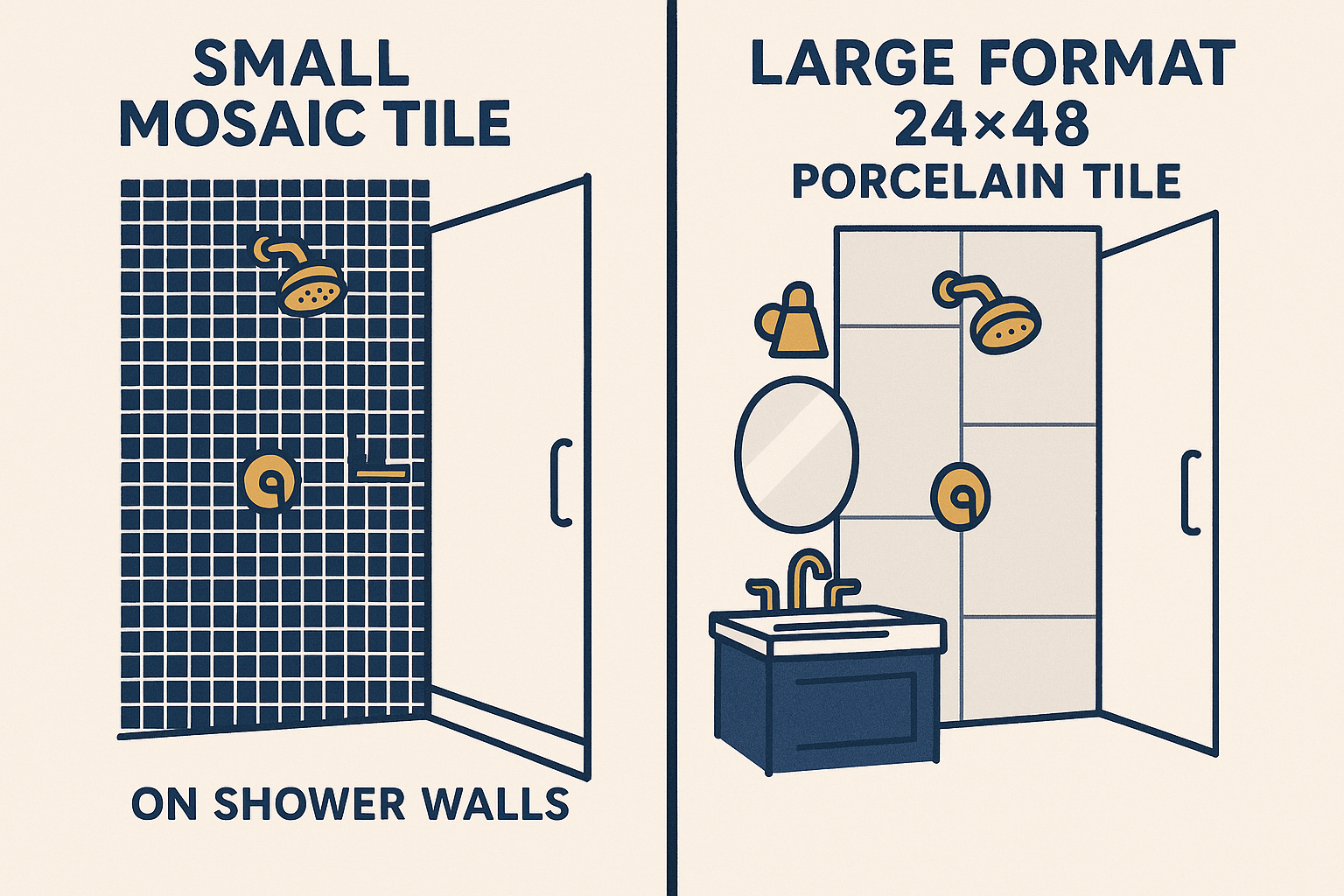
| Shower walls | Large-format for contemporary look; medium or small for traditional |
| Tub surround | Medium or large-format |
| Vanity wall/backsplash | Any — depends on desired look |
| Powder room floor | Small or medium — pattern opportunity |
| Feature wall | Large or oversized for minimal look; small for pattern |
For tile selection and installation as part of a complete bathroom renovation in Ottawa, our team at Miracle Dream Homes helps homeowners choose the right format for each surface. See our bathroom renovation service and our tub-to-shower conversion page for more detail on our process.
For tile format specifications, the Tile Council of North America (TCNA) and tile manufacturer technical literature provide detailed guidance on substrate requirements for large-format installations. LATICRETE International publishes specific installation guides for large-format tile.
Frequently Asked Questions
What tile format makes a bathroom look bigger?
Large-format tile makes bathrooms feel larger because fewer grout lines reduce visual fragmentation of the floor and wall planes. Matching grout colour to tile colour amplifies this effect. This applies on both floors and walls.
Can you mix large-format and small-format tile in the same bathroom?
Yes, and this is the standard approach in most bathrooms. Large-format tile on the floor and walls, with small-format mosaic on the shower floor, is a common combination. The key is that the different formats should share a tonal or stylistic relationship rather than appearing randomly selected.
Why is large-format tile not recommended for shower floors?
Shower floors must slope toward the drain at approximately 2% to drain properly. Large tiles cannot follow this slope because each tile spans a significant portion of the floor area — not all corners of the tile can sit at the same angle while maintaining the slope. The result is unstable tile, pooling water, and an uneven surface. Small-format tile naturally conforms to the slope.
Is large-format tile harder to install?
Yes. Large-format tile requires a flatter, more carefully prepared substrate. The tiles are heavier, harder to cut, and require more precise layout planning to avoid small cut pieces at perimeter walls. Professional installation is strongly recommended for large-format tile, particularly anything above 60 x 60 cm.