
Toilet Types Explained: One-Piece, Two-Piece, Wall-Hung, and More
The toilet is the one fixture every occupant of the home uses multiple times daily. Despite this, it is often chosen last — selected quickly after the tile and vanity decisions are made, based on price and colour alone. A more informed approach considers format, height, flushing mechanism, and bathroom compatibility, all of which affect daily comfort and long-term maintenance.
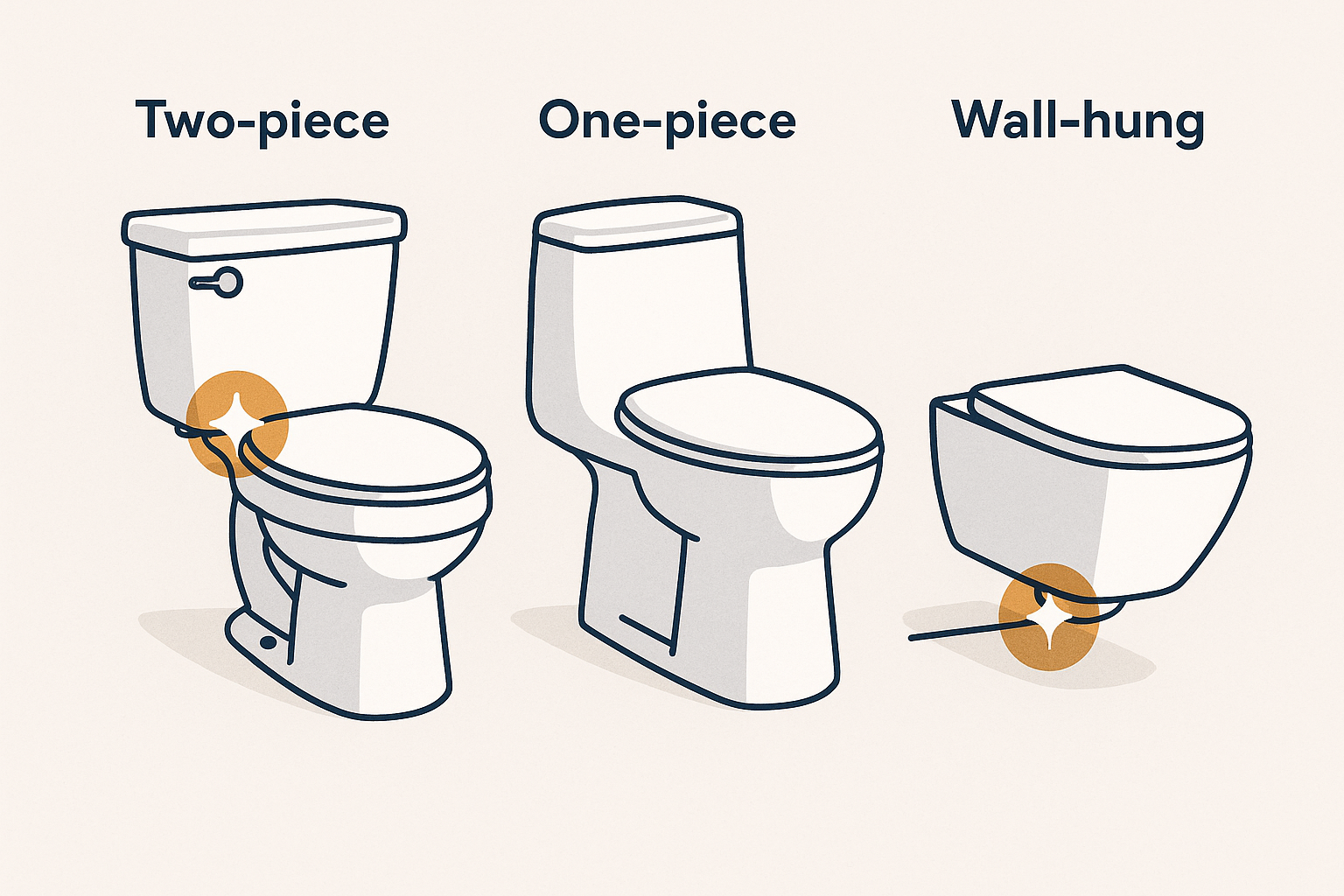
The Main Toilet Formats
Two-Piece Toilet
The two-piece toilet — a separate tank bolted to the bowl — is the most common toilet format in Canadian homes. It is widely available, easy to service (tank components are accessible and replaceable), and available across a broad price range from $200 to $800+.
Advantages:
– Lower cost than one-piece at comparable quality levels
– Easier to transport and install (two separate pieces are lighter to handle)
– Tank components (fill valve, flapper, flush handle) are simple to replace
Disadvantages:
– A seam between tank and bowl can collect grime
– Slightly more visible bulk from the separate tank profile
– Less streamlined in appearance than one-piece designs
Two-piece toilets are the practical choice for standard family bathrooms where serviceability and cost efficiency are priorities.
One-Piece Toilet
A one-piece toilet has the tank and bowl fused as a single ceramic unit with no joint between them. The profile is typically lower and sleeker than a two-piece.
Advantages:
– No seam between tank and bowl — easier to clean
– More streamlined profile
– Contemporary aesthetic
Disadvantages:
– Higher price at comparable quality ($400–$1,200 for quality one-piece toilets)
– Heavier and more difficult to handle during installation
– If the tank cracks, the entire unit must be replaced
One-piece toilets are a good choice for master ensuites and powder rooms where the visual profile matters and the higher price is justified by the application.
Wall-Hung Toilet
A wall-hung toilet has the bowl mounted to the wall with no floor contact. The cistern (tank) is concealed inside the wall cavity in a pre-fabricated in-wall carrier frame. Water supply and flush actuation run through the wall, and the flush button is typically a face plate on the wall above the bowl.
Advantages:
– The bowl floats off the floor — makes the bathroom feel more open
– Easier floor cleaning (no base around which to clean)
– The in-wall cistern is almost entirely silent
– Height of the bowl is adjustable within the carrier frame — useful for accessibility
– Saves approximately 25 cm of floor depth vs. floor-mounted toilets
Disadvantages:
– Higher total cost — in-wall carrier frame ($400–$800) plus bowl ($300–$800) plus installation labour
– Servicing the concealed cistern requires wall access (typically through the flush actuator plate)
– Requires wall construction capable of housing the in-wall carrier — this is typically planned at renovation scope
Wall-hung toilets are a premium choice for bathrooms where clean aesthetics and accessible floor area are priorities. They are increasingly common in Ottawa renovation projects for primary ensuites and modern bathrooms.
Smart Toilets and Integrated Bidet Toilets
Smart toilets integrate bidet functionality, seat heating, automatic lid operation, air drying, and deodorizing into a single unit. They range from bidet toilet seats that retrofit onto standard bowls ($300–$800) to fully integrated smart toilet units ($1,500–$5,000+).
The bidet toilet seat retrofit is a practical middle ground: it adds bidet functionality to an existing toilet installation without replacing the toilet itself, and requires only a nearby GFCI electrical outlet.
Integrated smart toilets — TOTO Washlet series, Kohler Veil, Duravit SensoWash — represent the premium end of toilet specification and are increasingly requested in Ottawa ensuite renovations.
Toilet Height: Standard vs. Comfort Height
Standard Height (38–40 cm seat height)
Standard toilet seat height is 38–40 cm from floor to seat top. This is the traditional height, appropriate for children and shorter adults. For average-height adults, the lower seat height means more knee flexion when seated.
Comfort Height / ADA-Compliant (43–48 cm seat height)
Comfort height toilets have a seat height of 43–48 cm — close to standard chair height. They are preferred by taller adults, people with mobility limitations, and seniors. The higher seat reduces the effort of sitting down and standing up.
For bathrooms designed with aging-in-place or accessibility considerations in mind, comfort height toilets are the appropriate standard. Most current one-piece and two-piece toilet lines offer both heights in the same design.
Bowl Shape: Round vs. Elongated
Round bowls: More compact front-to-back depth (approximately 43 cm from the wall to the front of the bowl). Appropriate for smaller bathrooms and powder rooms where floor space is limited.
Elongated bowls: Deeper front-to-back (approximately 48 cm). More comfortable for most adults due to the larger seating area. Standard choice in bathrooms with adequate clearance.
Flush Mechanisms
Single Flush
Single-flush toilets use the same volume of water for every flush. Traditional single-flush toilets used 13 litres per flush. Current WaterSense-certified single-flush toilets use 4.8 litres per flush (LPF), meeting both Canadian water efficiency standards and modern performance requirements.
Dual Flush
Dual-flush toilets offer two options: a reduced-volume flush for liquid waste (typically 3 litres) and a full-volume flush for solid waste (typically 4.8–6 litres). They are standard on most current toilet lines and are required in some provincial building codes for new construction.
Over the lifespan of the toilet, dual-flush operation reduces water consumption compared to single-flush — relevant for Ottawa homeowners on municipal water billing.
The Rough-In Measurement
The rough-in distance — from the finished wall to the centre of the toilet drain flange — must match the toilet specification. The standard in Canadian homes is 30 cm (12 inches). Older homes may have 25 cm (10 inch) or 35 cm (14 inch) rough-ins.
Buying a toilet with the wrong rough-in means the toilet will not fit properly against the wall — either it cannot be pushed far enough back (gap between tank and wall) or it sits too far forward. Always measure the existing rough-in before purchasing a replacement toilet.
Our team at Miracle Dream Homes confirms rough-in dimensions and helps select the appropriate toilet for each bathroom type as part of the renovation process. Learn more at our bathroom renovation page or our powder room renovation page.
For Canadian water efficiency standards and WaterSense certification, Natural Resources Canada and the Environmental Protection Agency WaterSense Program provide product labelling and performance standards used in the Canadian market.
Frequently Asked Questions
What is the difference between a comfort height and a standard height toilet?
Standard height toilets have a seat height of 38–40 cm. Comfort height (or ADA-height) toilets have a seat height of 43–48 cm, which is close to standard chair height. Comfort height toilets are easier for taller adults, seniors, and people with mobility limitations to use, and are the recommended choice for aging-in-place bathrooms.
Are wall-hung toilets reliable?
Yes. Wall-hung toilet in-wall carrier systems are engineered to support static loads well beyond residential use requirements (typically 400+ kg static load rating). The concealed cistern uses the same valve and flush mechanism components as floor-mounted toilets — the same serviceability applies. The main difference is that accessing the cistern requires going through the actuator plate rather than lifting a tank lid.
How do I know what rough-in measurement my bathroom has?
Measure from the finished wall (not the baseboard) to the centre of the toilet floor bolt. If baseboard is in place, measure from the wall surface behind it. The most common measurement in Canadian homes is 30 cm (12 inches). Confirm this before selecting a replacement toilet.
What is the most water-efficient toilet available?
High-efficiency toilets using 3–4.8 litres per flush are the current standard. Some premium units (TOTO Drake, American Standard Champion) flush effectively at 3 LPF with dual-flush configuration. WaterSense-certified toilets meet EPA performance criteria for bowl clearance effectiveness at the rated flush volume.