
Preventing Hard Water Stains in the Bathroom
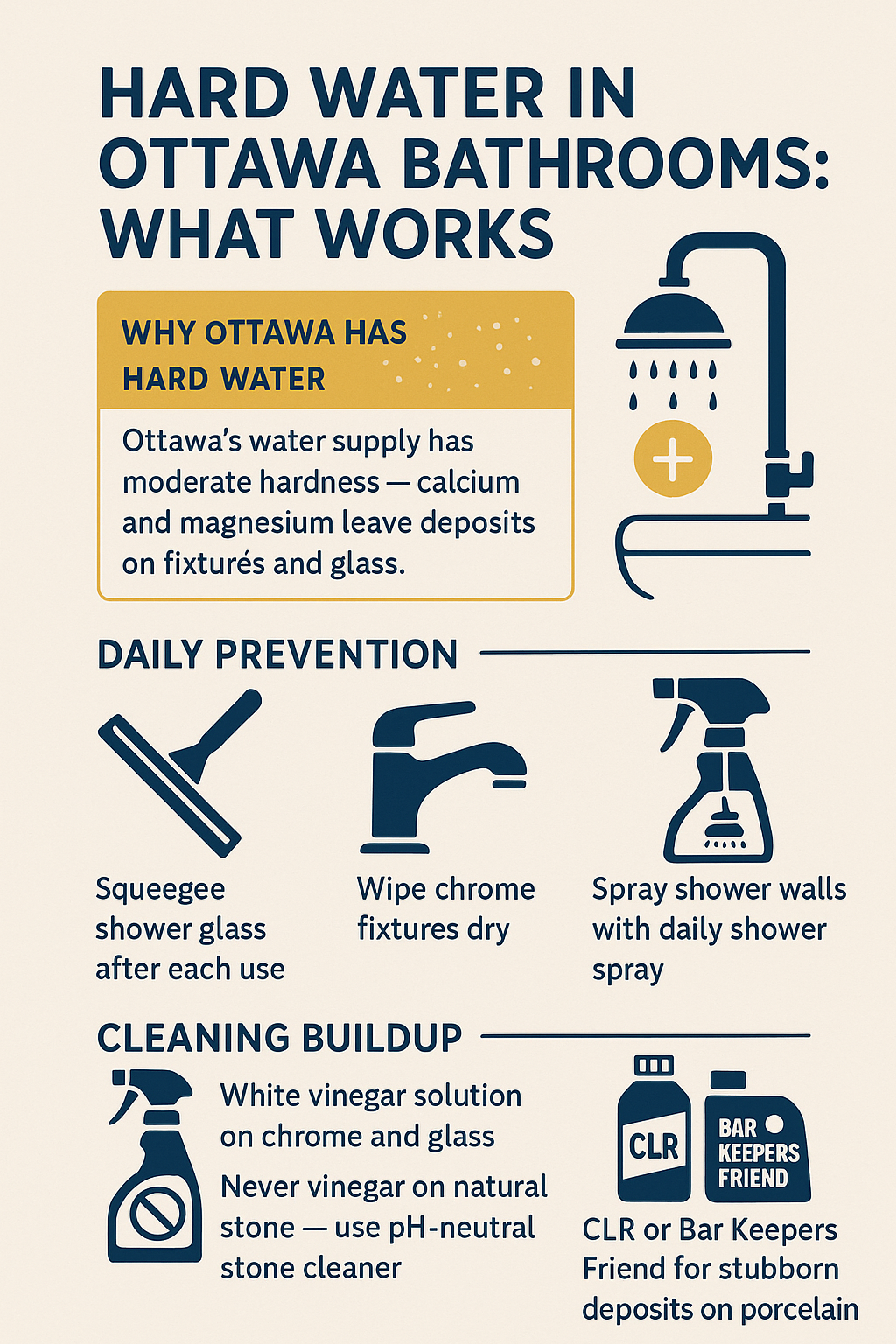
Hard water stains — also called limescale, mineral deposits, or calcium buildup — are one of the most common cosmetic maintenance challenges in Ottawa bathrooms. The City of Ottawa’s municipal water supply has moderate mineral content (hardness), which means that when water evaporates from tile, glass, and fixtures, it leaves behind calcium carbonate and magnesium deposits that appear as white, grey, or chalky buildup.
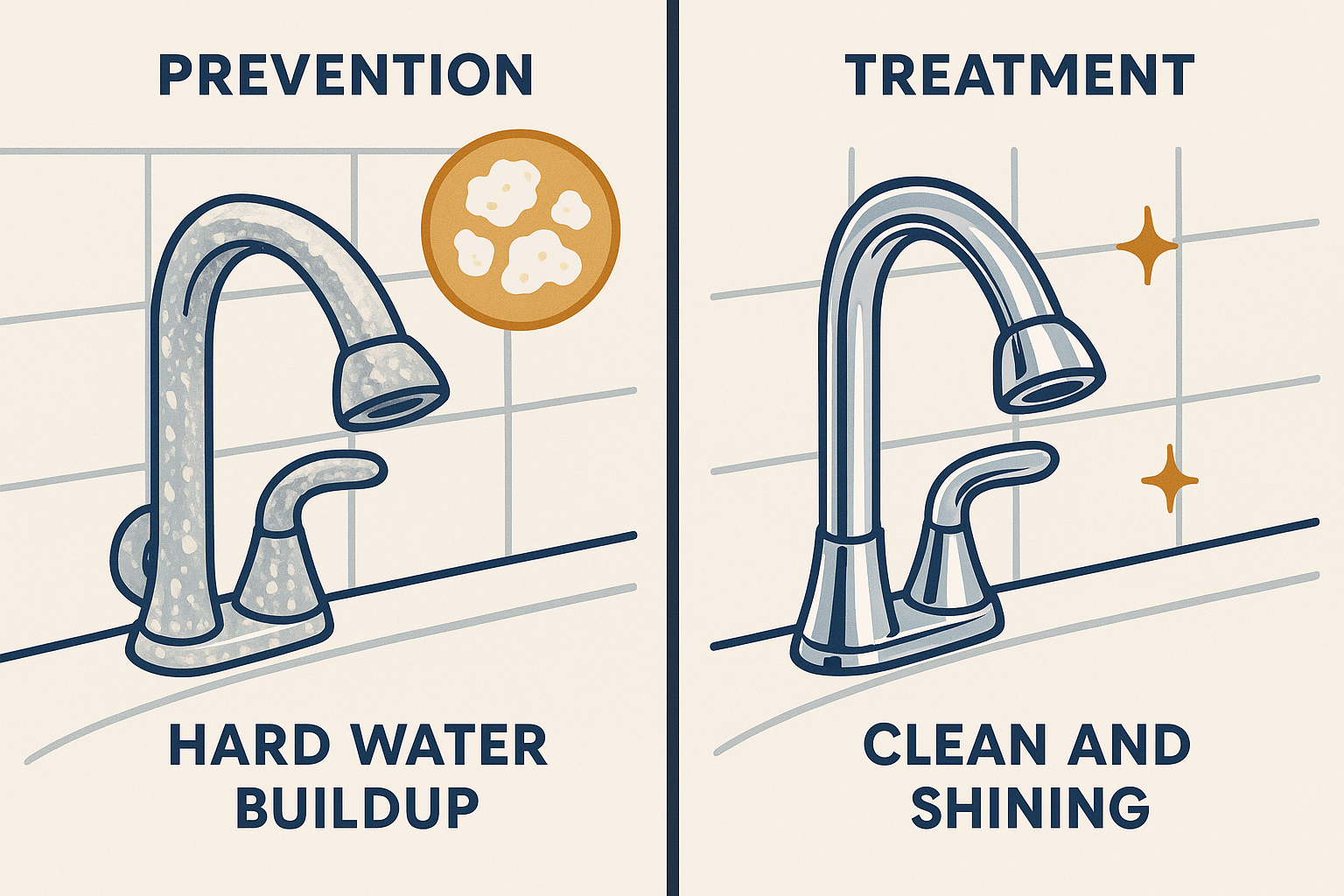
Understanding what causes the deposits and how to remove and prevent them makes bathroom maintenance significantly easier.
What Hard Water Stains Are
Hard water contains dissolved minerals — primarily calcium and magnesium carbonate. When hard water lands on a surface and evaporates, the dissolved minerals remain behind as a deposit. The more water that evaporates from a surface, the faster deposits accumulate.
In a bathroom, the surfaces most affected are:
– Glass shower doors and panels (the most visible accumulation point)
– Tile and grout in the shower zone
– Chrome and polished fixtures (faucets, showerheads, towel bars)
– Toilet bowl, particularly under the rim
– Sink basin
The deposits appear as white or off-white spots, haze, or rings on glass, and as white or chalky buildup on grout, tile surfaces, and around fixture bases.
Removing Existing Hard Water Stains
From Glass (Shower Doors and Panels)
Glass is the surface where hard water deposits are most visible. The deposits appear as a white haze or rough texture when the glass is dry, and as spots when wet.
Light deposits (recent, 1–4 weeks):
– White vinegar applied undiluted to the glass with a sponge or cloth, left for 5–10 minutes, then scrubbed and rinsed. The acetic acid in vinegar dissolves calcium carbonate deposits.
– A paste of baking soda and white vinegar applied to the glass, scrubbed with a non-scratch pad, then rinsed.
Heavy deposits (months of accumulation):
– A commercial hard water remover (CLR Calcium Lime & Rust, Lime-A-Way, Bar Keepers Friend) applied per manufacturer instructions. These products contain stronger acids (hydrochloric, sulfamic, or citric) that dissolve established deposits more effectively than vinegar.
– Apply the product, allow the specified contact time, scrub with a non-scratch pad (not steel wool, which scratches glass), and rinse thoroughly.
– For very heavy deposits, repeat the application.
Do not use: Steel wool, abrasive scrubbing pads, or abrasive powder cleaners on glass — these scratch the glass surface and make it more prone to future deposit accumulation.
From Tile and Grout
For mineral deposits on ceramic and porcelain tile:
– White vinegar solution (equal parts vinegar and water) for light deposits
– Commercial descaler for heavy accumulation
On natural stone (marble, travertine, limestone): Do not use acid-based cleaners. Vinegar, CLR, Lime-A-Way, and similar acid products dissolve the calcium carbonate in the stone itself, causing permanent etching (dull, rough spots). Use only pH-neutral cleaners on natural stone. For deposits on natural stone, a poultice or professional stone treatment is required.
From Fixtures
Mineral deposits on chrome faucets and showerheads:
– Wrap the fixture in a cloth soaked in white vinegar, or fill a plastic bag with vinegar and attach it over the showerhead nozzle. Leave for 30–60 minutes.
– Scrub with a soft brush (old toothbrush) to remove loosened deposits.
– Rinse and dry.
A clogged showerhead from mineral buildup typically has reduced flow from specific nozzles. The vinegar soak usually restores full flow.
Preventing Hard Water Stains
Prevention is significantly easier than removal of accumulated deposits. These practices reduce buildup rate substantially:
Squeegee After Every Shower
The single most effective prevention technique: using a squeegee to wipe water off the glass, tile, and fixture surfaces after every shower. Water sitting on a surface and evaporating leaves deposits; water removed by squeegeeing before it evaporates does not.
A squeegee kept inside the shower (hanging from the door handle or a wall hook) makes this habit easy to maintain. 30–60 seconds per shower prevents the buildup that otherwise requires 30 minutes to remove.
Dry Fixtures After Use
Wiping faucets, showerheads, and fixture surfaces dry after use prevents water from evaporating on these surfaces. A small microfibre cloth kept at the vanity makes this practical.
Hydrophobic Glass Coating
Rain-X (formulated for shower glass) and similar hydrophobic treatments applied to glass surfaces cause water to bead and sheet off rather than spreading in a film. The beading behaviour means less water evaporates on the glass surface, and what evaporates leaves smaller spot deposits that are easier to clean.
Apply a hydrophobic treatment to shower glass every 2–3 months. Most treatments require clean, dry glass (free of existing deposits) before application.
Ventilation
Better ventilation — running the exhaust fan effectively during and after showering — reduces the overall humidity in the bathroom and accelerates drying of surfaces. A drier shower between uses accumulates deposits more slowly because less water remains to evaporate on surfaces.
Water Softener
A whole-house water softener removes the calcium and magnesium minerals from the water supply before it reaches the bathroom. This eliminates hard water deposits entirely. Water softeners require an installation investment ($1,500–$3,500 for a quality residential system) and ongoing maintenance (salt replenishment), but they solve the hard water problem at its source for the entire home — bathroom, kitchen, laundry, and water heater.
For Ottawa households with heavy hard water accumulation that requires frequent cleaning, a water softener is worth considering as a long-term solution.
Shower Filter
A shower-specific filter installed on the showerhead supply line reduces mineral content in the shower water. These filters are less comprehensive than whole-house softeners — they address only the shower, not the entire plumbing system — but they are significantly less expensive ($50–$150) and require only cartridge replacement every few months.
For bathroom renovation services in Ottawa, including glass and tile specification that is appropriate for Ottawa’s water hardness, our team at Miracle Dream Homes advises on finishes and glass treatments that reduce the maintenance burden. See also our tub-to-shower conversion page for shower renovation information.
For Ottawa municipal water quality data including hardness levels, the City of Ottawa Water Quality Report publishes annual water quality data including mineral content that affects hardness.
Frequently Asked Questions
How hard is Ottawa’s municipal water?
Ottawa’s municipal water hardness varies by source and season. The City of Ottawa’s water quality reports typically show hardness in the range of 80–120 mg/L as CaCO3 — classified as moderately hard. This level is sufficient to produce visible hard water deposits in active bathrooms, particularly on glass surfaces, within 2–4 weeks of use without preventive maintenance.
Does white vinegar damage shower grout?
White vinegar (5% acetic acid) is safe for use on ceramic and porcelain tile grout for periodic cleaning of mineral deposits. However, frequent or prolonged contact with vinegar can gradually degrade the cement binder in unsanded and sanded grout. Use vinegar as a targeted treatment for deposit removal, not as a daily cleaner. For regular cleaning, pH-neutral bathroom cleaners are preferable. Never use vinegar on natural stone tile or grout.
Are hard water stains the same as soap scum?
No, though they often appear together. Hard water deposits are mineral scale (calcium carbonate) left by evaporating water. Soap scum is a different compound — a reaction between soap (fatty acids) and the minerals in hard water that produces a white, waxy film. Both build up on the same surfaces and often appear simultaneously, but they respond differently to cleaners: acid cleaners remove mineral scale; surfactant cleaners and mechanical scrubbing remove soap scum. Many bathroom cleaners are formulated to address both.
How do I remove hard water stains from a natural stone shower?
Natural stone (marble, travertine, limestone) is acid-sensitive — acid cleaners that remove mineral deposits from porcelain also etch and damage the stone surface. For mineral deposits on natural stone, use a pH-neutral stone cleaner and mechanical scrubbing. For severe deposits, a professional stone cleaning or a calcium deposit poultice formulated for natural stone (products from Aqua Mix or similar stone care brands) may be needed. Prevention is especially important on natural stone: squeegee after every shower and apply a stone sealer regularly.