
Walk-In Showers for Seniors: Safety Features, Design, and Costs
A walk-in shower — specifically, a shower with a curbless entry and adequate clearance — is the most commonly requested aging-in-place bathroom upgrade in Ottawa. The combination of no step-over barrier, slip-resistant surfaces, grab bar support, and a built-in bench creates a shower that is genuinely safe and accessible for seniors and people with limited mobility, without looking like a medical installation.
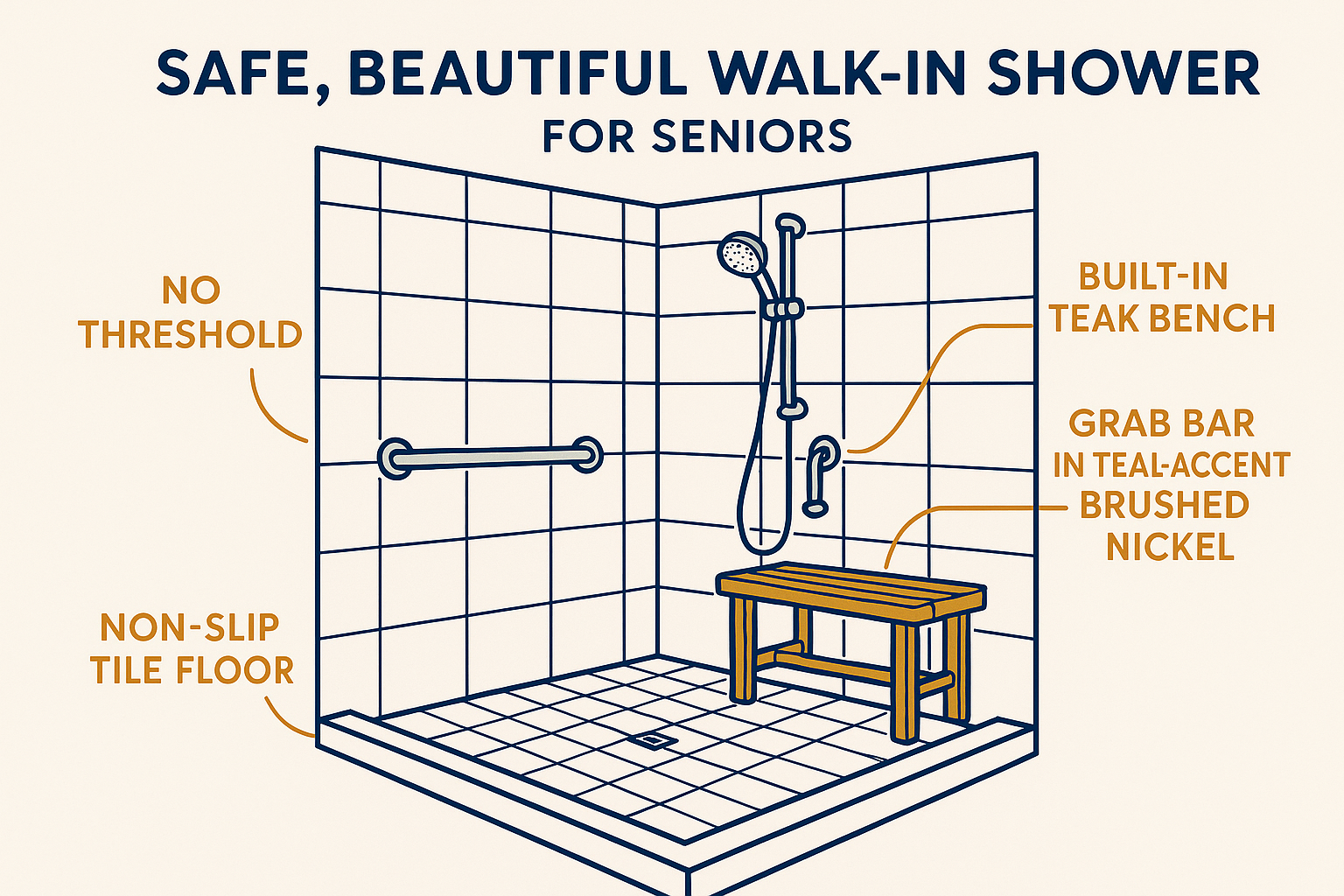
Most of what makes a walk-in shower safer for seniors is also what makes it a better shower for everyone. The features described here benefit any household member, regardless of age or mobility.
The Problem with Standard Showers and Tubs
A standard tub requires the user to step over a 400–500 mm rim — one leg at a time — while wet and often holding a rail that may or may not be properly anchored. This is the highest-fall-risk activity in the average home for adults over 65.
A standard shower with a 100–150 mm curb requires less clearance but still demands balance on a slippery wet surface. A tub-shower combination addresses bathing flexibility but retains all the tub entry risks.
For households with seniors or anyone with reduced balance, the tub or curbed shower represents an ongoing risk that accumulates over years of daily use. A walk-in shower with curbless entry eliminates the most dangerous moment of the daily shower routine.
What Defines a Safe Walk-In Shower for Seniors
Curbless Entry
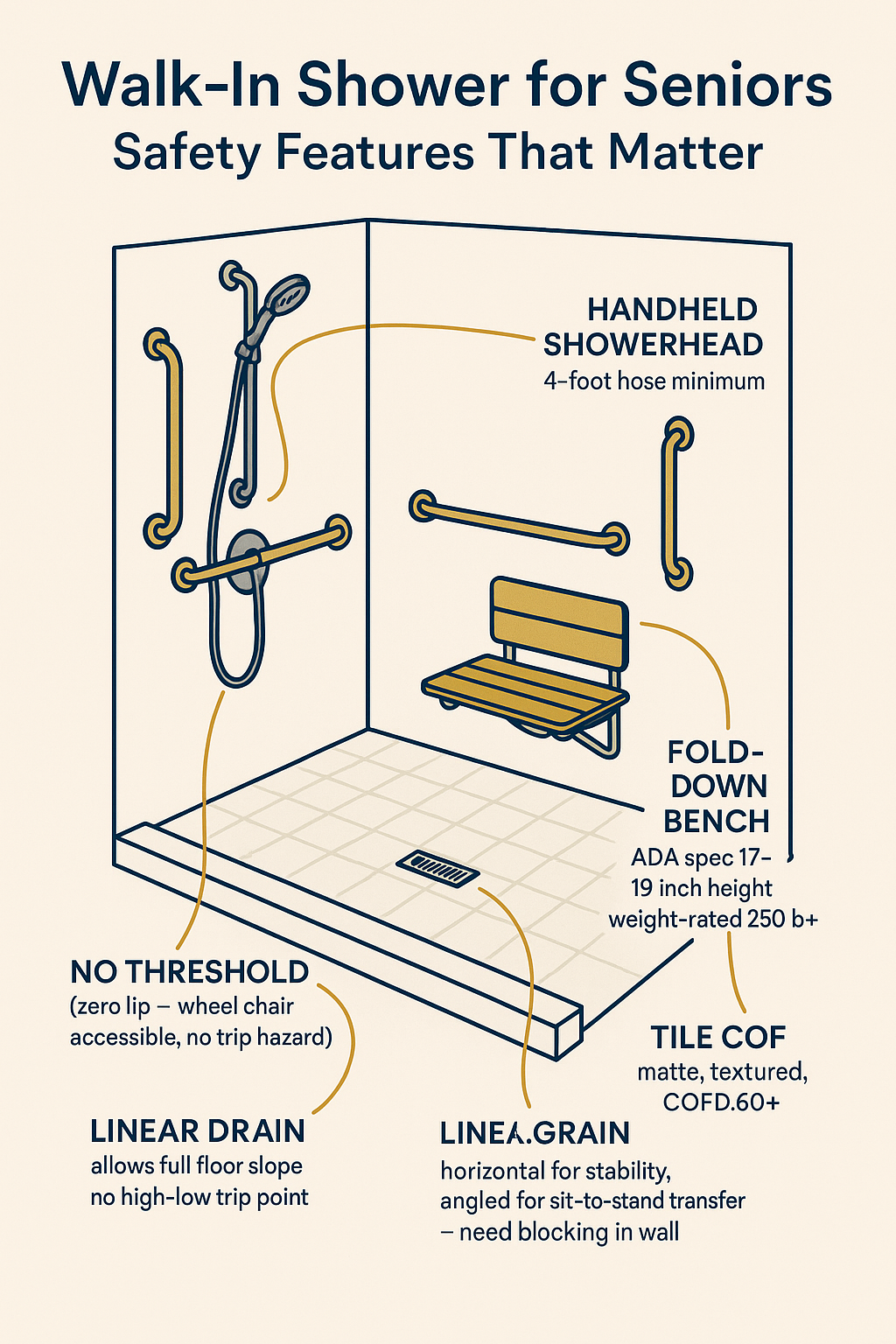
The entry transition is the highest-risk moment. A curbless shower — floor level continuous from the bathroom floor to the shower floor — removes the step-over entirely. Water containment is handled by the shower floor slope (a minimum 2% gradient toward the drain) and, if necessary, a low water dam or linear drain positioned at the entry threshold.
A curbless entry also accommodates a shower wheelchair or shower commode if needed in the future. Planning for this possibility during renovation (specifying a minimum 900 mm wide entry) costs nothing extra compared to specifying a narrower opening.
Slip-Resistant Flooring
The shower floor is wet during every use. Porcelain tile with a textured surface and a DCOF (Dynamic Coefficient of Friction) rating above 0.42 provides the minimum slip resistance for a wet shower floor. Mosaic tile — 50 × 50 mm or smaller — provides more grout lines and more texture than large-format tile, which increases slip resistance but also increases grout maintenance.
A bath mat on the bathroom floor outside the shower provides an additional grip surface at the exit point, where the user transitions from a wet surface to a dry floor.
Grab Bars
Properly anchored grab bars are the most effective fall prevention feature in a shower. They provide support during the specific moments of highest risk: stepping in and out, transitioning between standing and seated, and recovering from a balance loss.
Recommended placement for a senior walk-in shower:
- A horizontal grab bar at 840–915 mm (33–36 inches) from the floor on the wall adjacent to the entry — provides support during entry and exit
- A second horizontal bar at the same height on the back wall of the shower — provides support while washing
- A vertical bar at 1,370–1,680 mm (54–66 inches) at the entry point — provides a gripping point for entry and exit
- If a bench is used, a bar above and beside the bench supports the transition from seated to standing
Grab bars must be anchored into solid blocking in the wall framing — not into drywall or tile adhesive alone. During a renovation, 19 mm plywood blocking panels are installed between studs before tiling to provide anchoring points for bars installed now or in the future.
Shower Bench
A built-in shower bench — tiled, at 430–480 mm seat height and at least 450 mm deep — allows the user to shower seated. This is valuable for:
- Users who cannot stand for the duration of a shower
- Users recovering from surgery or injury
- Users with balance limitations who feel safer seated
- Any user who simply prefers a seated option
A fold-down bench provides the same function in a smaller shower footprint — the bench folds up when not in use, preserving clearance.
A shower bench also serves as a surface for setting items (shampoo, soap, a foot to shave legs) — it benefits any user, not only seniors.
Hand-Held Showerhead
A hand-held showerhead on a slide bar — with a flexible hose of at least 1.5 m — allows the user to control the shower spray from a seated position, rinse specific areas without moving under the fixed showerhead, and direct water away from the face and head during washing. This is a simple and inexpensive feature that significantly improves shower usability for seniors.
The slide bar allows the showerhead to be positioned at any height, accommodating both standing and seated use and users of different heights.
Adequate Clearance
A minimum 900 mm × 900 mm shower interior provides enough space for a shower chair or commode. A 1,200 mm × 1,200 mm shower is more comfortable and accommodates an attendant if assisted showering is needed. In a walk-in shower without a door (open entry with a glass panel), the entry clearance is whatever the opening width allows.
Walk-In Shower vs. Walk-In Tub
Walk-in tubs — pre-fabricated tubs with a door that seals shut before filling — are marketed heavily as accessibility solutions. However, they have a significant practical problem: the user must enter the tub, close the door, and wait for it to fill. When finished, the tub must drain before the door can be opened. This means sitting in a cooling tub for 10–15 minutes waiting for it to drain.
In practice, most seniors who purchase walk-in tubs find them inconvenient and return to showering. A walk-in shower with a bench, grab bars, and a hand-held showerhead provides safety without the wait-to-drain constraint. For most Ottawa homeowners planning an aging-in-place bathroom, a walk-in shower is the more practical and cost-effective solution than a walk-in tub.
Cost for a Walk-In Shower for Seniors in Ottawa
A tub-to-shower conversion in Ottawa, converting a standard alcove tub-shower to a walk-in shower with senior-friendly features:
Standard scope (curbless, tile, grab bars, bench, hand-held showerhead): $12,000–$20,000
Premium scope (frameless glass, quality tile, built-in bench, full grab bar installation): $18,000–$28,000
These ranges include demolition, waterproofing, tile, frameless glass (if specified), plumbing fixture replacement, and grab bar installation into proper blocking. For a full bathroom renovation in Ottawa that addresses the complete bathroom rather than only the shower, add the cost of vanity, toilet, and associated finishes.
For Canadian residential accessibility standards, CSA Group B651 and the Rick Hansen Foundation Accessibility Certification provide the standards used for accessible shower design in residential renovation.
Frequently Asked Questions
What is the minimum size for a walk-in shower for a senior?
A minimum interior dimension of 900 mm × 900 mm provides enough room for a shower chair and basic manoeuvring. A 1,200 mm × 1,200 mm shower is more comfortable and accommodates a caregiver if assisted showering is ever needed. When space allows, designing for 1,200 mm × 1,800 mm is the standard for a genuinely accessible shower that also feels spacious for everyday use.
Do walk-in showers require a door?
No. A walk-in shower without a door — using a fixed glass panel to contain spray — is the most accessible shower configuration because there is no door to operate or door swing to clear. The open entry design requires the shower to be at least 1,200 mm wide so the user can be far enough from the entry that spray does not escape. For smaller showers, a hinged or sliding door provides water containment; frameless or semi-frameless glass with a low threshold is appropriate.
How many grab bars does a senior shower need?
A minimum of two grab bars in the shower: one horizontal bar at 840–915 mm on the entry wall, and one on the back wall at the same height. A third vertical bar at the entry point adds support during the entry and exit movement. If a shower bench is included, add a fourth bar above and beside the bench. More bars in the correct positions are better than fewer — the cost difference between two and four bars is modest.
Is a curbless shower harder to keep clean?
No — most homeowners find curbless showers easier to clean than showers with a curb. There is no curb to scrub around, no track to clean, and the floor is a continuous surface. The floor slope toward the drain is minimal (2%) and not noticeable underfoot. The only cleaning consideration unique to a curbless shower is ensuring the floor outside the shower stays dry — a bath mat or squeegee habit addresses this.