
Getting Bathroom Renovation Quotes: What to Ask and What to Watch For
A bathroom renovation quote is only useful if it reflects the actual scope of work you want done. The most common reason homeowners end up over budget or disappointed mid-project is not contractor dishonesty — it is that the quote was written against a different scope than what the homeowner expected.

This guide covers how to prepare for quotes, what a complete quote should include, how to compare quotes properly, and the warning signs that indicate a contractor or quote you should walk away from.
Before You Call for Quotes
The time you spend preparing for contractor consultations determines the quality of the quotes you receive. A contractor who walks through a bathroom and is told “we want to renovate the bathroom” will quote differently than one who is given a clear, specific scope.
Prepare before your first consultation:
- Photograph every surface — all four walls, the floor, the ceiling, and every fixture
- Measure the room dimensions and write them down
- Note the location of existing plumbing (where the toilet, sink, and shower/tub rough-ins are)
- Note any known issues: soft floor areas, visible mould, past leaks, outdated plumbing or electrical
- Create a short list or photo board of what you want the finished bathroom to look like
- Know your approximate budget range — even a broad range helps a contractor calibrate a proposal
The more specific your preparation, the more comparable and meaningful the quotes you receive will be.
How Many Quotes Do You Need?
For any project over $8,000–$10,000, get at least three quotes. Three quotes give you a market reference point that lets you assess whether a quote is in line with the local market, high, or suspiciously low.
Two quotes are not enough — if they differ significantly, you have no third reference to evaluate which is more accurate. One quote tells you nothing comparative.
Above $25,000, three quotes are a minimum. For complex or premium renovations, four to five quotes may be appropriate to find the right combination of quality, communication, and price.
What a Complete Bathroom Renovation Quote Must Include
A professional quote is not a number on a page. It is a document that describes the work, the inclusions, the exclusions, and the basis for the price. You should be able to read the quote and know exactly what you are getting.
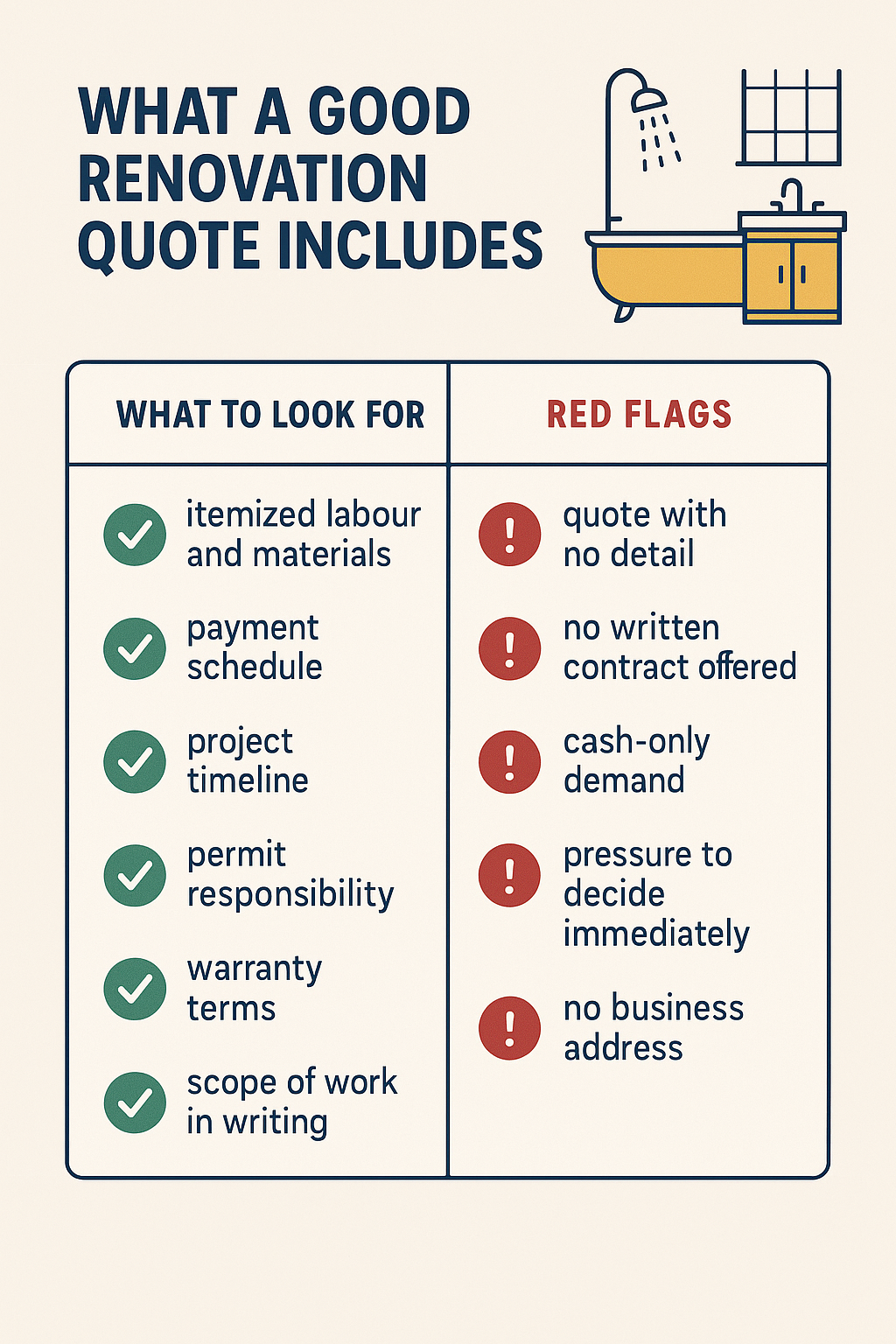
A complete quote includes:
Scope of work. A specific description of what will be demolished, what will be installed, and where. “Complete bathroom renovation” is not a scope description. “Demolish existing tile and fixtures, waterproof shower walls, install client-supplied 30×60 cm porcelain floor tile, install new vanity at existing rough-in location, install new toilet and shower fixtures” is a scope description.
Labour breakdown (or total labour cost). Either a line-item labour breakdown or a clear total labour cost that you can evaluate against the hourly rates and scope.
Material allowances or specified materials. The quote should either specify exact materials (product name, model, quantity) or state a material allowance per category. “Tile allowance: $4,000 for supply and delivery” lets you understand what material quality is assumed. “Tile included” tells you nothing.
What is explicitly excluded. Any professional quote should list what is not included: permit fees, appliance supply, items to be supplied by the homeowner, and unforeseen conditions (with a description of how those are handled).
Payment schedule. Payments tied to milestones — deposit at signing, progress payment at rough-in completion, payment at tile completion, final payment at project completion — are standard. Payment schedules that require more than 30–40% upfront are unusual and warrant discussion.
Warranty terms. Workmanship warranty duration and what it covers. One to two years on workmanship is standard in the Ottawa market.
Start date and estimated duration. Not a binding commitment, but a reasonable estimate that reflects the contractor’s current workload.
How to Compare Quotes Properly
Do not compare totals. Compare scopes.
Two quotes for the same bathroom: $16,500 and $22,000. Before concluding the lower quote is a better value, confirm:
- Does the lower quote include permit fees? Does the higher one?
- What is the material allowance in each? Is the lower quote based on a $3/sq ft tile allowance while the higher one uses $8/sq ft?
- Does both quotes include waterproofing of the shower? This is sometimes excluded.
- Does both quotes include the exhaust fan replacement?
- Are both quotes using licensed trades for plumbing and electrical?
Once you have aligned the scopes, the comparison becomes meaningful. Often a quote that appears lower is based on lower material allowances or excluded items.
Questions to Ask Every Contractor
Are you licensed and insured? A contractor working on a bathroom renovation in Ontario should carry general liability insurance (minimum $2 million) and WSIB coverage. Ask for certificates of insurance. Verify the WSIB account is active at wsib.ca.
Will plumbing and electrical work be performed by licensed trades? The names of the licensed plumber and electrician should be available before work starts.
Who will be on-site daily? On larger projects, a project manager who is not the person doing the physical work should be supervising. Understand who is doing the tile work, who is doing the plumbing, and who is responsible for overall site management.
How do you handle unforeseen conditions? The answer should describe a change order process — written documentation of the additional work and cost, homeowner sign-off before work proceeds.
Can you provide references from recent bathroom projects? A contractor who completed bathroom renovations in Ottawa in the past 12 months should be able to provide 2–3 references. Following up with references is worth the 10-minute call.
Warning Signs in a Quote
No written quote. Verbal quotes protect no one. Any renovation over $1,000 should have a written agreement.
Quote that is dramatically lower than others. A quote that is 30–40% below comparable quotes is almost always explained by excluded scope, unlicensed trades, or under-priced labour that will be recovered through change orders.
Request for very large upfront deposit. A deposit of more than 40% of the project total, or full payment upfront, is unusual and a risk indicator.
No mention of permits. For renovations that require permits, a contractor who does not raise permits may be planning to work without them.
Pressure to sign immediately. A reputable contractor does not need to pressure you into a decision. Time to review a quote with your household is entirely reasonable.
Our team at Miracle Dream Homes provides detailed, line-item quotes for every project. Our bathroom renovation page explains our process, and our tub-to-shower conversion page covers one of the most common specific scopes we quote.
For guidance on contractor selection in Ontario, the Better Business Bureau Ottawa and HomeStars both provide contractor verification tools and review platforms.
Frequently Asked Questions
How long should I wait to get all my quotes before deciding?
Allow 2–3 weeks to get three quotes. Schedule all consultations before you start reviewing, so you are comparing them against a common benchmark rather than deciding after each one. If a contractor cannot provide a quote within 1–2 weeks of the consultation, their schedule may not accommodate your project timeline.
Should I tell each contractor what the other quotes are?
You do not need to share specific numbers. You can tell a contractor you have received other quotes and ask if there is anything in their quote they can review. Most reputable contractors will not significantly alter their quote for competitive reasons — their price reflects their real costs. A contractor who drops their price 20% when they hear a competitor’s number may have been padding the first figure.
What if all three quotes are higher than my budget?
The scope needs to change. Return to each contractor and ask: “Given a budget of $X, what scope could you deliver?” A good contractor will help you identify where to scale back — tile tier, fixture allowances, scope reduction — to bring the project in at your number. If the scope reduction required to hit your budget eliminates the improvements you wanted, your budget needs to adjust.
Is it normal to pay a deposit before work starts?
Yes. A deposit of 20–30% at contract signing is standard and appropriate — it covers materials ordering and reserves the contractor’s schedule. Deposits above 40% are higher than standard and should be discussed before signing.