
How Long Does a Bathroom Renovation Take: A Realistic Timeline
One of the most common questions during a bathroom renovation consultation is: how long will I be without a bathroom? The honest answer is that it depends significantly on scope, and that most timelines have more to do with trades sequencing and material lead times than with the physical construction time itself.
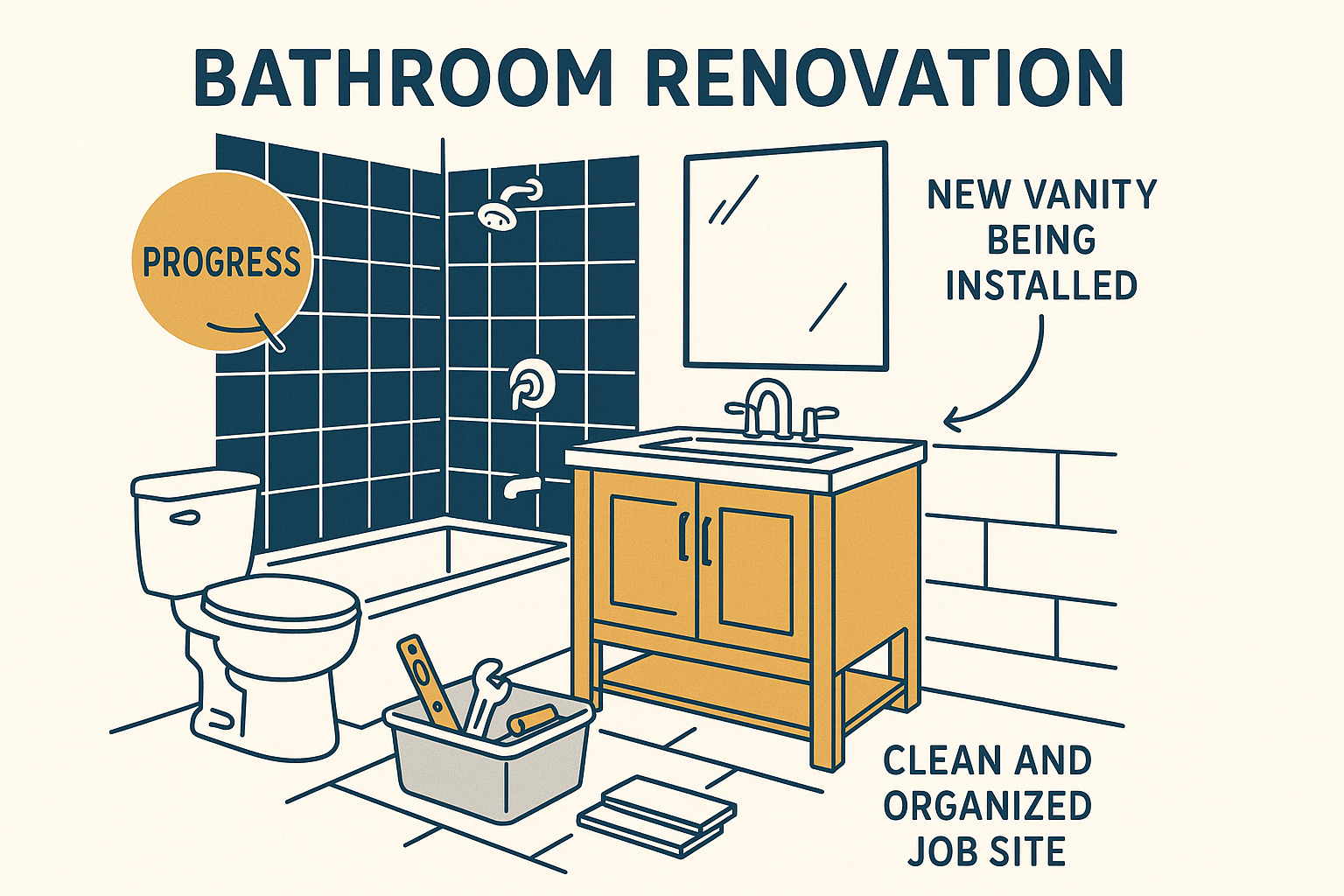
This guide provides realistic timelines for different renovation types and explains the factors that most commonly extend a project beyond the original estimate.
The Phases of a Bathroom Renovation
Every bathroom renovation moves through the same sequence of phases, regardless of scope. Understanding the phases helps you understand the timeline — and where delays actually come from.
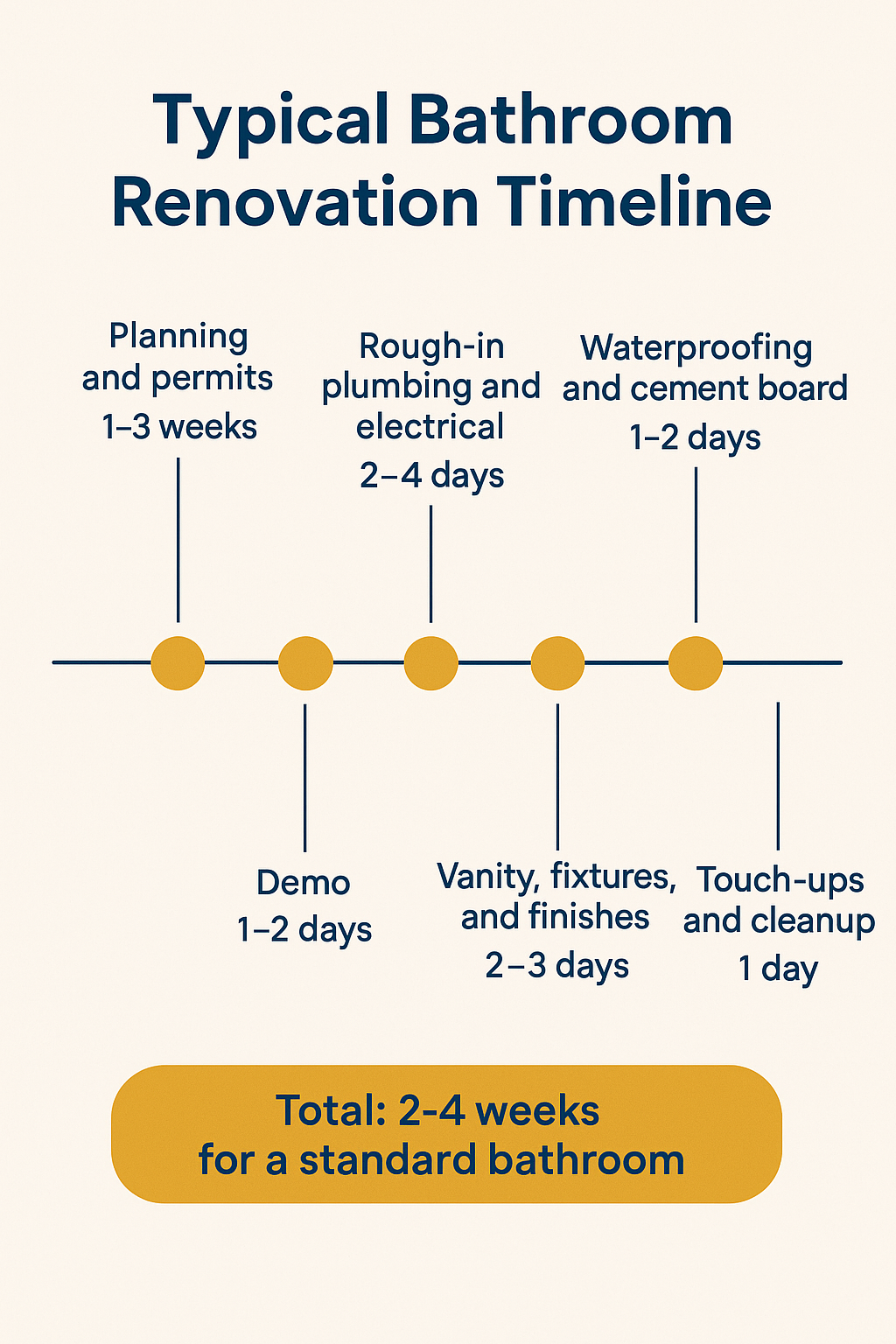
Phase 1: Pre-Construction Planning (2–8 weeks)
This phase happens before anyone touches your bathroom. It includes:
– Design decisions finalized
– Materials selected and ordered (tile, vanity, fixtures, countertop)
– Contractor contract signed
– Permit application submitted and approved (if required)
– Start date confirmed
The pre-construction phase is routinely longer than homeowners expect. Material lead times are the primary driver: stock tile from a local supplier can be ready in days; special-order tile from a domestic or European manufacturer can take 4–8 weeks. Permit processing in Ottawa typically runs 5–15 business days for standard residential renovation permits.
If materials are in stock and no permit is required, pre-construction can compress to 2–3 weeks. For custom materials or permit-required scope, plan 4–8 weeks.
Phase 2: Demolition (0.5–2 days)
A full bathroom gut — removing all tile, fixtures, drywall or cement board, and vanity — typically takes 0.5 to 1.5 days for a standard 4-piece bathroom. Larger bathrooms with multiple elements or difficult access may take 2 days.
Demolition is fast. The phase that follows it is where the schedule complexity begins.
Phase 3: Rough-In (1–5 days)
After demolition, rough-in work proceeds: plumbing, electrical, and framing adjustments. The duration depends entirely on scope.
- No rough-in changes (plumbing and electrical stay in place): Rough-in inspection of existing conditions, minor adjustments, 0.5–1 day.
- Minor plumbing adjustments (supply line repositioning, shut-off valve additions): 1–2 days.
- Significant plumbing changes (toilet or shower relocation, new drain line): 2–5 days.
- New electrical circuit additions (heated floor thermostat, GFCI upgrades, new lighting circuit): 1–2 days.
When rough-in is complete and a permit is in place, a rough-in inspection is required before closing walls. This inspection adds 0.5–2 days of scheduling time depending on city inspector availability.
Phase 4: Substrate and Waterproofing (1–2 days)
After rough-in inspection, the substrate (cement board or equivalent) is installed on shower walls and the floor, and the shower wet zone is waterproofed. This is a full cure period — most waterproofing membranes require 24–48 hours before tile can be installed. This built-in wait period is not time that can be compressed.
Phase 5: Tile Installation (2–5 days)
Tile installation time depends on the surface area, tile format, and pattern complexity.
- Standard 4-piece bathroom, 30×30 cm floor tile + 10×20 cm wall tile, offset pattern: 2–3 days.
- Large-format tile (60×120 cm) requiring precise levelling: 3–4 days.
- Complex patterns (herringbone, mixed formats, mosaic accents): 4–5 days.
- Full shower tile with floor, three walls, and ceiling: Add 1–2 days.
After tile is installed, grout is applied and requires 24–48 hours of cure time before the space is wet. This adds another built-in wait.
Phase 6: Fixtures and Finishing (1–3 days)
After tile is grouted and cured, fixtures are installed: vanity, toilet, shower valve trim, faucet, lighting, mirror, exhaust fan, accessories. A full fixture installation day for a standard bathroom takes 1 day. Larger bathrooms with custom millwork, heated floor thermostat installation, or complex lighting add 1–2 days.
Caulking all joints — tub-to-tile, floor-to-wall, vanity-to-wall — is done at this stage. Caulk requires 24 hours cure before exposure to water.
Phase 7: Touch-Up and Walkthrough (0.5–1 day)
A final walkthrough with the homeowner identifies any items for touch-up. Punch-list items are typically completed within 1 day.
Total Timeline by Project Type
Cosmetic refresh (no tile replacement, fixture swap only)
– Pre-construction: 1–2 weeks
– Construction: 2–3 days
– Total elapsed time: 2–3 weeks
Surface renovation (full tile replacement, same rough-in locations)
– Pre-construction: 2–4 weeks
– Construction: 7–10 working days
– Total elapsed time: 4–6 weeks
Full renovation with minor plumbing changes
– Pre-construction: 3–5 weeks (permit included)
– Construction: 10–14 working days
– Total elapsed time: 6–8 weeks
Full renovation with layout changes
– Pre-construction: 4–8 weeks
– Construction: 12–18 working days
– Total elapsed time: 8–12 weeks
What Causes Delays
Material backorders. The most common cause of pre-construction delay. A tile or vanity that is listed as available can go on backorder after ordering. Confirm lead times at the time of order and have a contingency material in mind.
Permit processing delays. The City of Ottawa processes residential renovation permits within standard windows, but supplementary information requests or unusual scope can extend processing. Apply early.
Unforeseen conditions. Subfloor rot, mould, and plumbing issues discovered at demolition extend the rough-in phase. A 10–15% budget contingency should be matched by a schedule contingency of 3–5 working days for a standard renovation.
Inspection scheduling. Required inspections (rough-in plumbing, electrical) depend on city inspector availability. At busy periods, waits can run 2–5 business days.
Cure time is fixed. Waterproofing and grout cure times cannot be shortened. Any schedule that does not account for 24–48 hours between waterproofing and tile, and between tile and grouting, will produce quality problems.
At Miracle Dream Homes, we provide a detailed project schedule at the outset of every bathroom renovation and basement bathroom renovation, with milestones for each phase so homeowners know exactly where the project stands at every stage.
For reference on Ontario building permit timelines, the City of Ottawa Building Services portal provides current processing times and application instructions.
Frequently Asked Questions
How long will I be without a bathroom during a renovation?
For a full gut renovation, the bathroom is non-functional for construction for 10–14 working days (2–3 weeks). For a cosmetic refresh, 2–3 days. Most homeowners with a second bathroom manage comfortably. If this is the only bathroom in the home, phased construction — completing the toilet and sink before finishing the shower — can reduce the fully non-functional period.
What is the longest part of a bathroom renovation?
Pre-construction is often the longest phase — material ordering, permit processing, and schedule coordination. The actual construction of a full bathroom renovation typically runs 2–3 weeks of working time. Homeowners who rush through pre-construction selection often end up waiting for materials after walls are open.
Can a bathroom renovation be done in a week?
A cosmetic renovation — new toilet, vanity, and fixtures without tile replacement — can be completed in 2–3 days. A full tile and fixture renovation cannot be safely done in a week. Waterproofing and grout cure times alone require 3–4 days built into the schedule. A contractor who promises a complete gut renovation in 4–5 days is either not including cure time or skipping waterproofing.
Does winter affect bathroom renovation timelines in Ottawa?
Not significantly for interior work. Bathroom renovation is entirely an indoor scope and is not directly affected by weather. The only weather-related factor is exhaust fan duct installation through an exterior wall or roof — which is practical in any season but more comfortable for the crew in warmer months.