
GFCI Outlets in Bathrooms: What They Are and Why They Matter
If you look at a bathroom outlet and see two small buttons labelled TEST and RESET, you are looking at a GFCI outlet. If your bathroom has standard outlets without these buttons, the electrical installation may not meet current safety requirements.
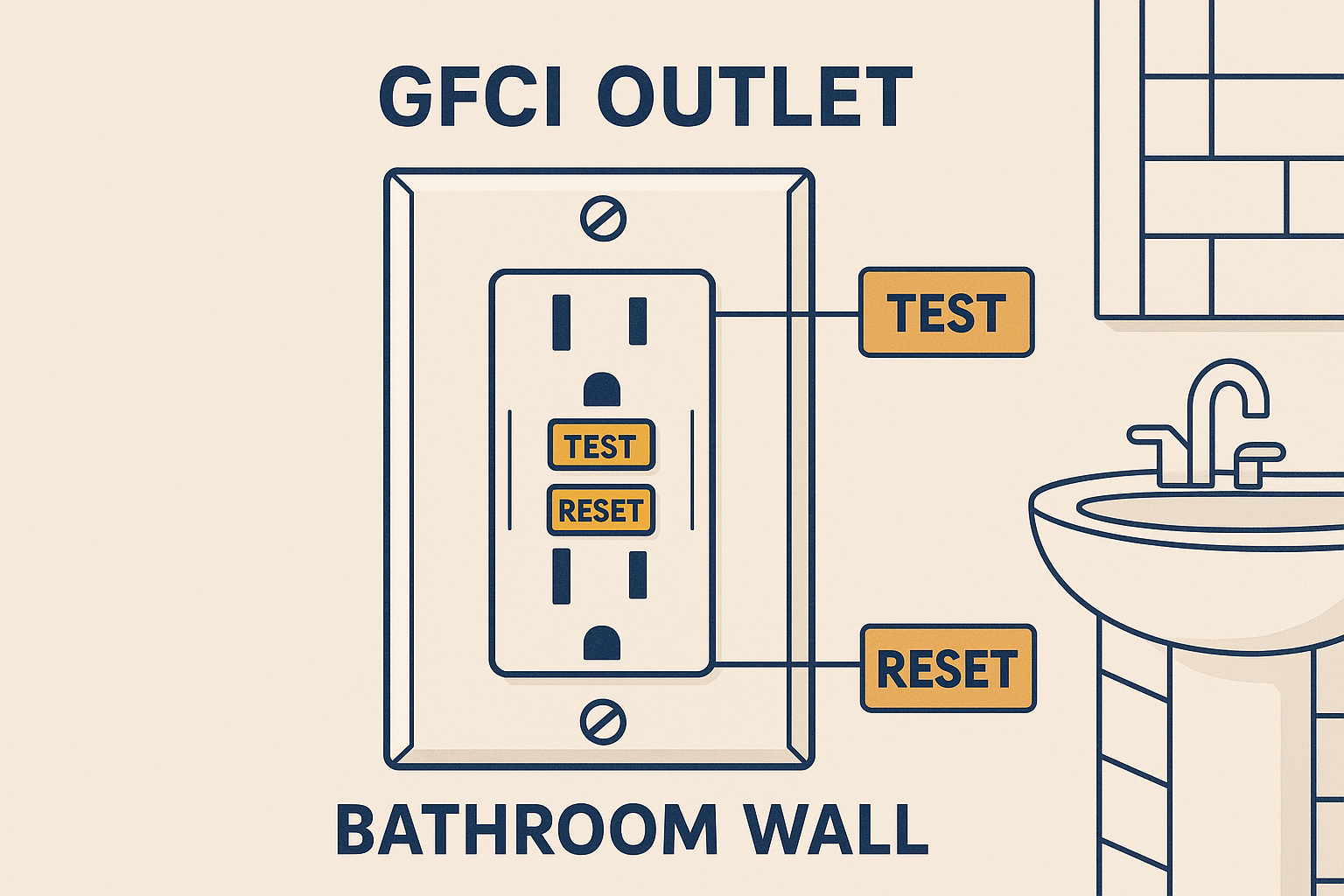
GFCI protection is a requirement in Ontario bathroom electrical installations, not an optional upgrade. Understanding what it does and why it matters is straightforward — and understanding why yours might be tripping helps you diagnose problems without immediately calling an electrician.
What GFCI Means
GFCI stands for Ground Fault Circuit Interrupter. A ground fault is an unintended electrical path between a current-carrying conductor and a grounding surface — including a person’s body.
In a bathroom, the risk is specific: water is a conductor, and bathrooms contain water everywhere — from a wet hand touching an outlet, to a hair dryer falling into a sink or bathtub. When electricity takes an unintended path through water or through a person, the result is shock, burn, or electrocution.
A standard circuit breaker is designed to respond to large current overloads and short circuits. It does not respond fast enough to protect a person from electrocution — the current involved in a fatal ground fault is much smaller than what trips a standard breaker.
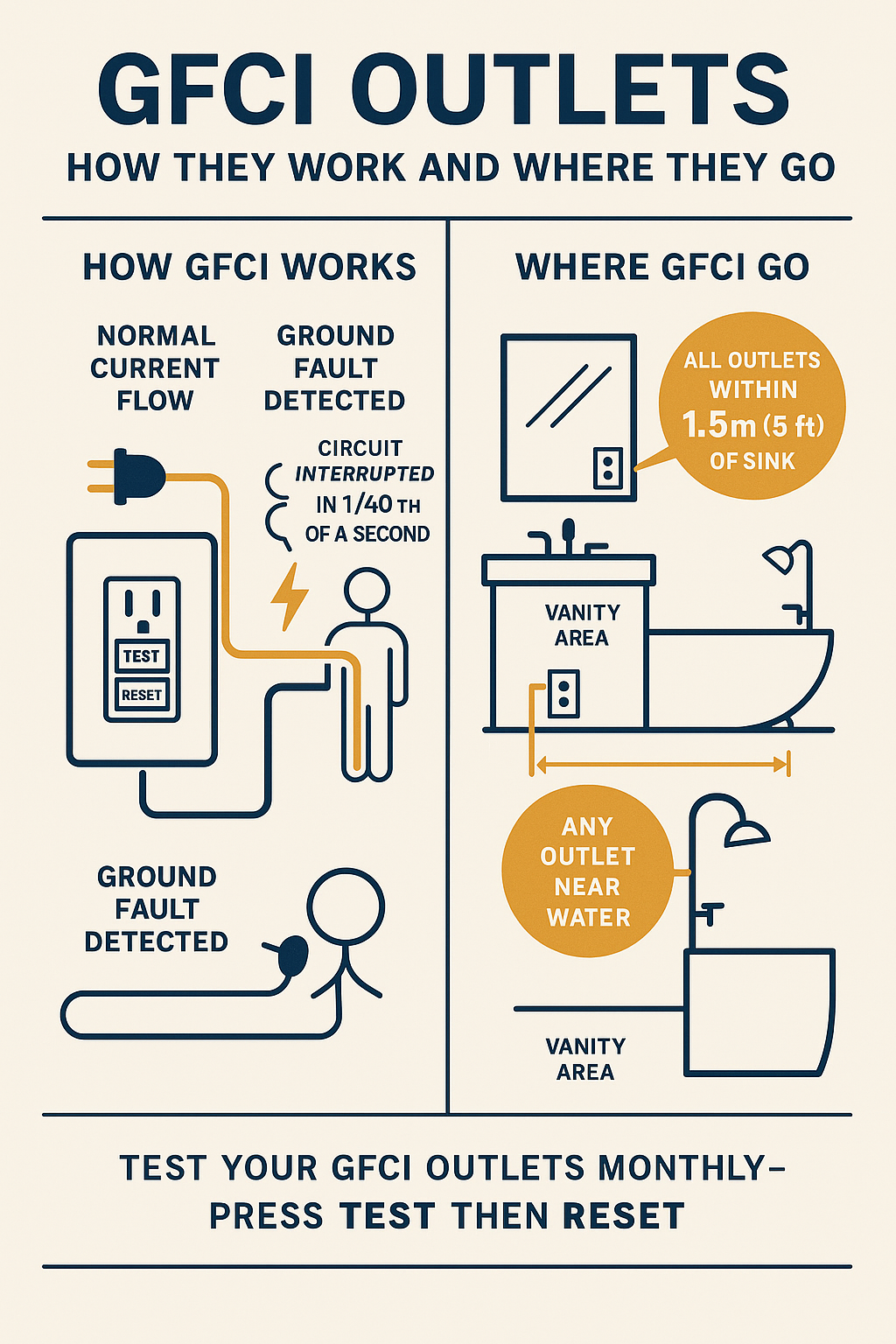
A GFCI outlet monitors the current flowing out on the hot wire and the current returning on the neutral wire. Under normal conditions, these are equal. When current is leaking to ground — through water, through a person, or through a fault in an appliance — the difference is detected within milliseconds, and the GFCI trips, cutting power before the current has time to cause serious injury.
GFCI protection responds to ground faults as small as 5 milliamps (0.005 amperes) — far below the threshold of dangerous shock to most people, and far below the 15-20 amp threshold of a standard circuit breaker.
Where GFCI Protection Is Required
Under the Ontario Electrical Safety Code (OESC), GFCI protection is required for:
- All bathroom receptacles (outlets) within 1.5 metres of a bathtub or shower
- All bathroom receptacles in new construction and renovated circuits, regardless of distance from water
The practical result: every outlet in every Ontario bathroom should be GFCI-protected. Older homes often have standard outlets installed before this requirement was in effect — they are not grandfathered for safety purposes and should be updated.
GFCI protection is also required in other wet areas: kitchen countertops within 1.5 m of a sink, garages, unfinished basements, outdoor outlets, pool and spa areas.
Types of GFCI Protection
There are three ways to provide GFCI protection in a bathroom:
GFCI Outlet (Receptacle): The most familiar type — a receptacle with TEST and RESET buttons on the face. Installing a GFCI outlet provides protection at that outlet and, if wired correctly, can protect additional downstream outlets on the same circuit.
GFCI Circuit Breaker: A GFCI breaker installed at the electrical panel protects every outlet and fixture on that entire circuit. From the outlet’s perspective, there is no visible difference — standard outlets on the circuit are protected at the panel level. When the GFCI trips, the breaker at the panel must be reset.
Combination AFCI/GFCI Breaker: Newer versions combine Arc Fault Circuit Interrupter (AFCI) protection — which detects dangerous arcing conditions that can cause fires — with GFCI protection. Required in many new construction applications.
Why Your GFCI Keeps Tripping
A GFCI outlet that trips repeatedly is detecting a ground fault. The cause is either:
A fault in an appliance: The most common cause. A hair dryer, electric shaver, or other appliance with internal moisture damage, worn insulation, or a developing fault will repeatedly trip a GFCI when plugged in. Test by removing the appliance — if the GFCI stops tripping, the appliance is the problem.
Moisture in the outlet or wiring: Water infiltration at the outlet location — particularly in bathrooms where steam condenses on cold surfaces — can cause a GFCI to trip. If the bathroom was recently exposed to significant moisture, allow it to dry and test again.
An overloaded circuit: A circuit with too many high-draw appliances running simultaneously may trip the GFCI (or the breaker). Hair dryers in particular draw 1,500–2,000 watts — a significant load.
A wiring fault: If the GFCI trips with nothing plugged in, or after replacing appliances, there may be a wiring fault in the circuit itself. This requires investigation by a licensed electrician.
The outlet is at the end of its lifespan: GFCI outlets have a lifespan of 10–15 years. An old GFCI outlet that trips on nuisance faults may simply need replacement.
Testing Your GFCI Outlets
Every GFCI outlet should be tested monthly. The test is simple:
1. Press the TEST button — the power to the outlet should cut off immediately.
2. Press the RESET button — power should restore.
If the outlet does not respond to the TEST button, or does not reset, the GFCI mechanism has failed and the outlet needs replacement. A failed GFCI provides no protection.
This test takes 30 seconds and should be part of regular home maintenance, particularly in bathrooms with older electrical installations.
Upgrading Bathroom Outlets to GFCI
Upgrading a standard bathroom outlet to a GFCI outlet is one of the more accessible electrical tasks in a home — it involves replacing the outlet itself, which a homeowner can do with appropriate care. The existing wiring stays in place; only the outlet device changes.
For a complete bathroom renovation, a licensed electrician replaces or verifies all outlets and adds GFCI protection where required as part of the electrical scope. In Ottawa, electrical work beyond simple outlet replacement requires ESA notification and inspection.
For renovation projects that include electrical upgrades, our team at Miracle Dream Homes coordinates all required ESA work as part of the full bathroom renovation process. For basement bathroom additions where all electrical is new, see our basement bathroom renovation page.
For technical guidance on GFCI requirements, the Electrical Safety Authority (ESA) provides homeowner-friendly resources on Ontario electrical safety requirements, and CSA Group publishes the Canadian electrical product standards that GFCI devices must meet.
Frequently Asked Questions
How do I know if my bathroom outlet is GFCI-protected?
A GFCI outlet has TEST and RESET buttons on the face of the outlet itself. If your outlet has no buttons, it may still be GFCI-protected if it is downstream from a GFCI outlet or a GFCI circuit breaker at the panel. Test by plugging in a simple lamp and pressing TEST on the nearest GFCI outlet or resetting breakers to identify the protection source.
Can a GFCI outlet protect multiple outlets on the same circuit?
Yes. When a GFCI outlet is wired with the additional outlets connected to the LOAD terminals (not the LINE terminals), all downstream outlets on that circuit are protected by the single GFCI device. This is common in bathroom wiring — one GFCI outlet near the vanity protects additional outlets on the same circuit.
Is it safe to use an outlet in the bathroom without GFCI protection?
No. An unprotected outlet in a bathroom is a code violation and a safety risk. The risk is not primarily from normal use — it is from fault conditions (appliance failure, water contact with a live appliance) where GFCI protection is the difference between a tripped outlet and electrocution. Upgrading to GFCI protection is a simple, low-cost safety measure.
How often should GFCI outlets be replaced?
GFCI outlets have a typical lifespan of 10–15 years. Test regularly using the TEST/RESET function. If the outlet fails to respond to the test button, replace it immediately — a failed GFCI provides no protection. In bathrooms with older wiring, proactive replacement of GFCI devices over 15 years old is a reasonable precaution.