
DIY vs. Hiring a Contractor: What You Can Do Yourself in a Bathroom Reno
Every bathroom renovation involves some work that is DIY-friendly and some that is not. The distinction is not just about skill level — it involves legal licensing requirements, warranty implications, insurance considerations, and the practical reality of what happens when something goes wrong in a confined wet environment.
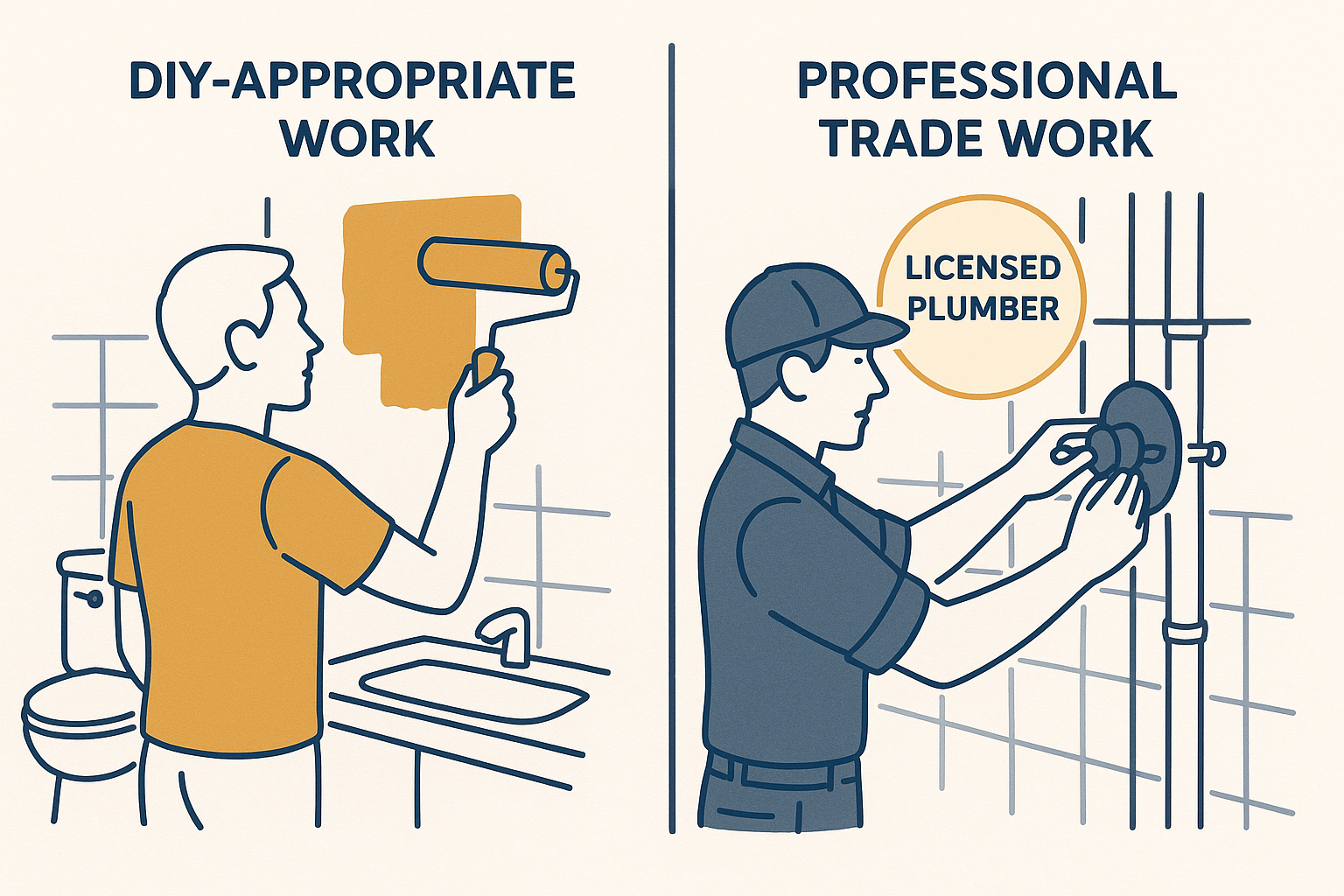
This guide clarifies what bathroom work homeowners can reasonably do themselves, what legally requires a licensed trade in Ontario, and where the cost-benefit of DIY often does not work out the way homeowners expect.
What the Law Requires in Ontario
Ontario’s trades licensing framework distinguishes between work that requires a licensed trade and work that does not.
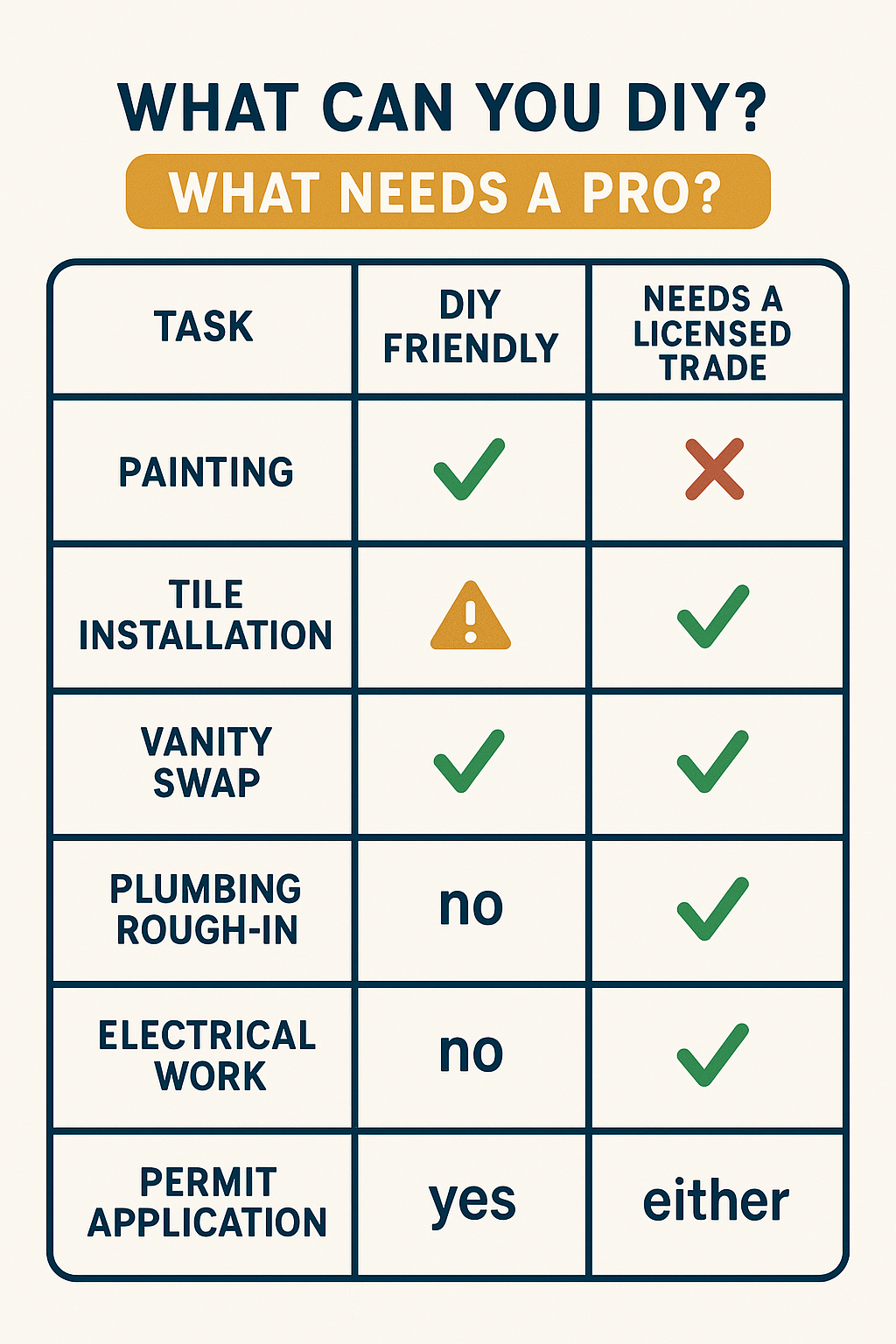
Plumbing: Any work on supply or drain lines — installing new fixtures, moving existing rough-in, connecting a new toilet or shower — requires a licensed plumber. An owner can do plumbing work on their own primary residence under Ontario regulation, but only if the work is inspected and passed by the local authority having jurisdiction (AHJ). Unpermitted plumbing work is a significant liability.
Electrical: Electrical work in Ontario must be performed by a licensed electrician and inspected by the Electrical Safety Authority (ESA). Homeowners can perform limited electrical work on their own home but ESA inspection is required. Adding circuits, installing GFCI outlets, or installing light fixtures in a bathroom all require ESA notification and inspection.
HVAC/Gas: Gas work requires a licensed gas fitter. No DIY.
General carpentry and finishing: No licensing requirement. Homeowners can perform their own demolition, drywall, painting, trim, and accessory installation.
Tile setting: No licensing requirement in Ontario. Tile setting is one of the more accessible DIY bathroom tasks for homeowners with patience and time.
Tasks That Are Genuinely DIY-Friendly
Demolition
Demolition of existing tile, drywall, and cabinetry does not require licensing. This is physically demanding but straightforward. The cost to have demolition performed by a contractor is typically $300–$800 for a standard bathroom — a task a homeowner can complete in a weekend.
Caveats: Asbestos in floor tile adhesive or ceiling texture (possible in pre-1980 homes) must be tested and properly abated before any demolition. Do not assume older materials are safe without testing.
Painting
Bathroom painting does not require licensing and is a straightforward DIY task. Use a bathroom-specific paint with mould resistance and a satin or semi-gloss finish that handles moisture and cleaning.
Installing Accessories
Towel bars, toilet paper holders, hooks, mirrors, and shelving that do not require new electrical or plumbing connections are fully DIY-accessible. Correct anchoring matters — towel bars and grab bars in particular need to be anchored into studs or with appropriate wall anchors.
Tile Setting (With Preparation)
Tile setting is achievable for a DIY homeowner who is willing to research properly. The technical requirements — a level and flat substrate, correct thinset selection, appropriate grout for the application, adequate waterproofing in wet areas — are learnable. The main risk is taking shortcuts: insufficient substrate preparation, incorrect thinset coverage, or inadequate wet-area waterproofing.
For a backsplash or a bathroom wall that does not get direct water contact, DIY tile work is lower risk. For a shower floor or walls that will be in direct contact with water daily, DIY waterproofing and tile installation carries meaningful risk if done incorrectly.
Vanity and Mirror Installation
Replacing a vanity with one in the same location — disconnecting and reconnecting existing supply shut-off valves and the drain — is something a competent homeowner can manage. The key is shutting off water properly and ensuring the drain connection is correctly secured. Vanity installations that involve new rough-in or moving the drain do require licensed work.
Mirror installation is a straightforward DIY task.
Tasks That Require Licensed Trades
Plumbing Rough-In and Connection
Moving drain lines, installing new rough-in for a shower or toilet in a new location, or connecting a new shower valve to supply lines requires a licensed plumber. Plumbing errors in a bathroom — particularly drain slope errors — are not immediately visible and produce chronic backup, odour, and eventually structural damage.
Electrical Work
Adding a circuit for a heated floor, installing GFCI outlets, running a new lighting circuit, or installing a bathroom exhaust fan on a new circuit requires a licensed electrician and ESA inspection. The moisture environment in a bathroom makes electrical safety non-negotiable.
Shower Waterproofing (for Occupied Showers)
Waterproofing is technically not a licensed-trade-only task, but the consequences of an error are severe enough that most homeowners should not attempt it without significant experience. A failed waterproofing membrane behind a shower allows water to saturate the wall cavity over years, producing mould, structural damage, and eventually a failed tile installation requiring full gut renovation.
The cost of professional waterproofing in a shower is modest — $200–$400 in labour above the tile installation cost. The cost of a failed DIY waterproofing job discovered 5 years later is a complete shower rebuild.
The Real Cost-Benefit of DIY
Homeowners who assume they will save money through DIY often underestimate:
Material waste. Tile cutting errors during learning produce waste. Ordering insufficient tile means potential stock-matching issues. Tile installation professionals order with appropriate waste margins; first-time DIY installers frequently over- or under-order.
Time cost. A tile setter who does 20 square metres a day will take 2 days for a full bathroom. A homeowner doing it for the first time may take 2–3 weekends. The opportunity cost of that time is real, particularly in a home where the bathroom is out of commission throughout.
Redo cost. Poorly installed tile — inadequate coverage, inconsistent grout joints, lack of proper levelling — is not cosmetically acceptable in a renovation you paid for. Fixing it after the fact often means re-demo and re-tile. The money saved on labour is spent on the redo.
Warranty and insurance implications. Unpermitted work and DIY plumbing or electrical may void home insurance coverage for related claims. A water damage claim arising from a DIY plumbing connection without a permit is a meaningful insurance risk.
Where DIY Adds the Most Value
Demolition: High labour savings, low risk, minimal skill requirement.
Painting: Easy, low risk, meaningful labour savings.
Accessory installation: Towel bars, shelving, mirrors, toilet paper holders — easy and saves $200–$400 in contractor labour.
Tile setting on non-wet surfaces: A floor-to-ceiling tile installation on a vanity wall with no direct water exposure is a manageable DIY project for someone with time and patience.
For work that requires licensed trades or involves the shower wet zone, our team at Miracle Dream Homes handles every stage under one roof — plumbing, electrical, waterproofing, tile, and finishing — so you are not coordinating multiple contractors and inspections. Learn more at our bathroom renovation page or our powder room renovation page.
For Ontario trade licensing requirements, Ontario College of Trades and Electrical Safety Authority provide authoritative guidance on what requires a licensed trade.
Frequently Asked Questions
Can a homeowner do their own plumbing in Ontario?
Ontario regulation allows homeowners to do plumbing work on their own principal residence, but the work must be inspected and passed by the local authority having jurisdiction. This is not the same as a licensed plumber doing the work, and unpermitted plumbing creates liability at resale and for insurance claims. Most homeowners are better served by hiring a licensed plumber.
Does replacing a toilet require a plumber?
Swapping a toilet with a new one in the same location — disconnecting and reconnecting the existing supply line and bolting to the existing flange — does not require a licensed plumber in most cases. If the flange is damaged or the drain location is changing, a licensed plumber is required.
Is it legal to install your own bathroom tile in Ontario?
Yes. Tile installation does not require a licensed trade in Ontario. However, waterproofing in shower wet zones, while not licensed-trade-only, carries significant risk if done incorrectly and should be approached with care.
What bathroom renovation work requires an ESA inspection in Ontario?
Any new electrical circuit, new outlet, or new light fixture in a bathroom requires ESA notification and inspection. Replacing an existing light fixture like-for-like without new wiring generally does not require an inspection, but confirming with the ESA directly is advisable.