
Freestanding Tub vs. Built-In Tub: Which Should You Choose?
The bathtub decision divides homeowners more than almost any other fixture choice. A freestanding tub is a design statement — the kind of bathroom feature that drives renovation decisions on its own. A built-in tub is practical, familiar, and a proven format for families and high-use bathrooms. The right choice depends on how you actually use the bathroom, not just how you want it to look.
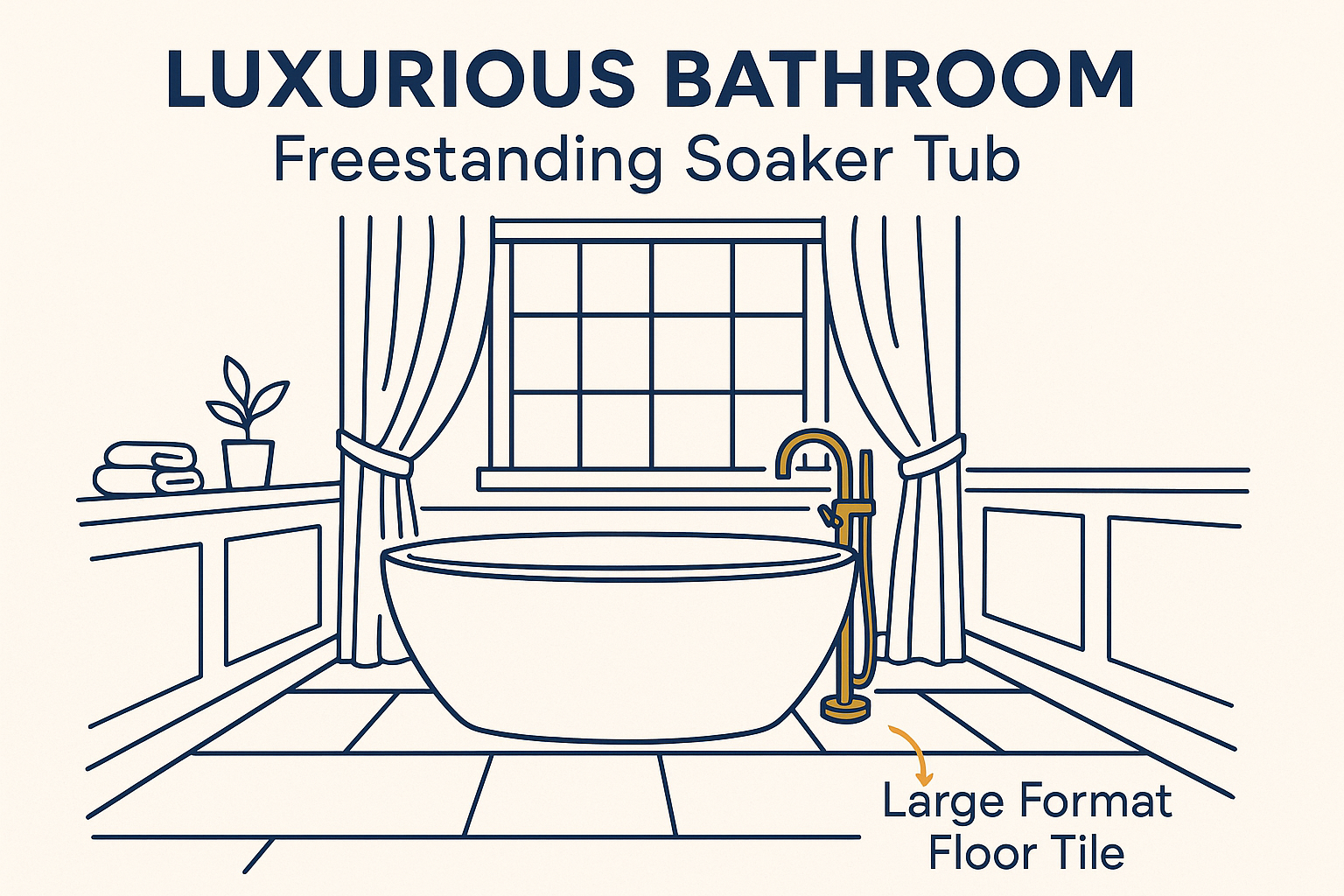
This guide compares both types across the factors that matter: space requirements, cleaning, cost, installation, and long-term value.
What Is a Freestanding Tub?
A freestanding tub stands on its own — it does not attach to any wall. It sits in open floor space, with all four sides visible and accessible. The tub supply and drain connect through the floor rather than through a wall-mounted or deck-mounted fixture.
Freestanding tubs come in a wide range of formats:
- Clawfoot. The classic Victorian style, with decorative feet that lift the tub off the floor. Often cast iron, sometimes acrylic. A period design choice that suits traditional or heritage-influenced bathrooms.
- Pedestal or slipper. Modern oval or rectangular tubs with a low integrated base rather than feet. The most popular contemporary freestanding format. Available in acrylic, stone resin, and cast iron.
- Flat-bottom. Rectangular tubs designed to sit flush to the floor or close to it. More minimal in appearance, easier to enter than a curved slipper tub.
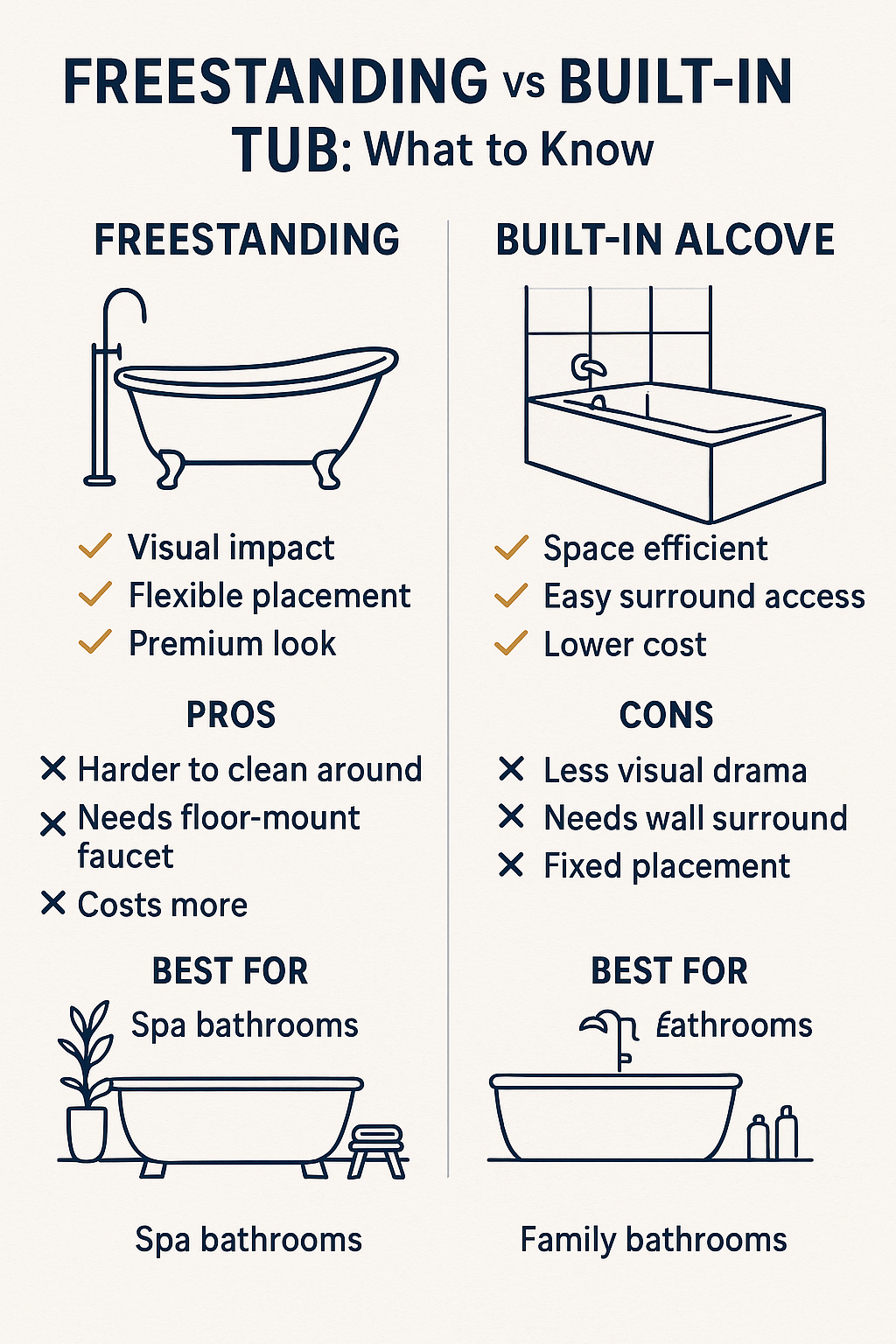
The defining characteristic across all of these is that the tub is the visual centrepiece of the bathroom. It requires space — both the footprint of the tub and clear floor around all sides.
What Is a Built-In Tub?
A built-in tub is set into a three-sided alcove or platform. The standard alcove tub — which accounts for the majority of bathtubs in Canadian homes — fits between two end walls and one back wall, with one long edge forming the edge of the tub deck.
Built-in tub types include:
- Alcove. Three walls on three sides, open on the fourth. The standard format. Usually paired with a shower-tub combo and a curtain or sliding door.
- Drop-in. The tub body drops into a custom-built platform or surround. The platform is finished in tile or stone. More design flexibility than an alcove install.
- Corner. A triangular or rectangular tub designed for installation into a corner. A space-efficient choice for bathrooms where an alcove position is not possible.
Built-in tubs are fully functional from day one of a renovation — the format is predictable, the supply and drain connections are standard, and the surrounding surround or tile provides storage and stability.
Space Requirements
The space requirement is where many freestanding tub decisions stall.
A standard alcove tub fits a 150 x 75 cm footprint. The surrounding walls handle three sides, so no additional clear floor area is needed. The bathtub fits into the bathroom plan without taking space from circulation or other fixtures.
A freestanding tub requires:
– The tub footprint (typically 165 x 75 cm to 180 x 85 cm for most contemporary models)
– Clearance on all four sides — typically 30–45 cm minimum — for safe entry and for the visual effect to read correctly
– A dedicated floor-mounted or ceiling-mounted supply for the faucet, which requires planned rough-in
This means a freestanding tub realistically needs a clear space of approximately 2.5 m x 1.5 m, not counting any adjacent fixtures. In a primary ensuite of at least 10–12 square metres, a freestanding tub is viable. In a smaller bathroom, it typically means removing another fixture to make room.
Cost Comparison
Freestanding tub cost. A quality acrylic freestanding tub starts around $800–$1,500 CDN. Stone resin or cast iron models range from $2,000 to over $8,000. Add a floor-mounted freestanding faucet at $400–$1,200. Installation requires floor rough-in for supply and drain, which adds labour cost. Total installed cost: $2,000–$12,000+ depending on material and faucet selection.
Built-in tub cost. A quality acrylic alcove tub starts around $400–$900. Installation is straightforward — standard rough-in, surround material, and a fixture on the tub deck or wall. Total installed cost: $1,000–$4,000 for a standard alcove install, more for a tiled drop-in with a premium platform.
The freestanding tub consistently runs higher in both the fixture cost and the installation cost, primarily because of the floor rough-in requirement and the faucet specification.
Cleaning and Maintenance
This is where freestanding tubs consistently underperform expectations.
With four exposed sides and open floor access, a freestanding tub requires cleaning around and beneath the entire unit. Hair, dust, and cleaning product residue accumulate along the floor line, particularly in the gap between the tub base and the floor. Some flat-bottom models sit close enough to the floor that this gap is difficult to clean effectively.
A built-in alcove tub has only one exposed long edge. The surrounding walls and surround simplify cleaning and eliminate the around-the-tub floor maintenance requirement.
The verdict on cleaning: Built-in tubs are meaningfully easier to maintain. Freestanding tub owners who did not anticipate the floor cleaning requirement often cite it as their main complaint.
Installation Complexity
Built-in alcove tubs follow a predictable installation sequence: tub set in alcove, surround tiled or panelled, fixtures installed on the wall or deck. Standard plumbing rough-in locations are used. Any competent renovation contractor handles this routinely.
Freestanding tubs require:
– Floor supply and drain rough-in positioned precisely to the tub’s installation location
– Floor-mounted faucet installation (typically a floor-mounted or deck faucet beside the tub)
– Proper floor reinforcement if installing cast iron (which weighs 100–180 kg empty)
– Sealing the floor connection point
In a renovation context, if plumbing is already in the wall for an existing alcove tub, switching to a freestanding tub requires moving supply lines — an added cost.
Resale Value
Both choices are broadly neutral for resale, but with some nuance.
A high-quality freestanding tub in a large ensuite adds visible appeal and is widely considered a luxury feature. It photographs well and appeals to buyers who want a spa-like primary bathroom.
A well-tiled alcove tub with a quality shower-tub combo is standard expectation in a family home. Absence of any tub — for example, replacing both the tub and shower with a walk-in shower only — can affect resale in homes where young families are the primary buyer pool.
If the goal is a tub-free bathroom and you are considering converting to a walk-in shower, our tub-to-shower conversion service covers what that process involves and what it costs.
Which Should You Choose?
Choose a freestanding tub if:
– You have a large primary ensuite (10+ square metres) where the tub is the design centrepiece
– You are willing to plan around the floor rough-in requirement
– Budget is not a primary constraint
– You or your household regularly uses the tub — the experience of soaking in a freestanding tub is genuinely better
Choose a built-in tub if:
– The bathroom is a family bathroom used daily by multiple people
– The primary use is bathing children or practical bathing, not soaking
– Space is limited and every square foot matters
– You want the most budget-efficient format with the least cleaning effort
For help working through this decision as part of a full bathroom renovation, our team at Miracle Dream Homes can walk you through options during the design consultation. Visit our bathroom renovation page to learn more.
For specification details on tub materials and dimensions, the Canadian Standards Association (CSA) sets the standards for plumbing fixtures used in Canadian residential construction, and manufacturer resources from TOTO and Kohler provide detailed product comparisons.
Frequently Asked Questions
Is a freestanding tub harder to install than a built-in tub?
Yes. A freestanding tub requires floor rough-in for the supply and drain, which often means moving existing plumbing if converting from an alcove tub. Built-in alcove tubs use standard wall rough-in that is already in place in most homes.
Do freestanding tubs require special floors?
Heavy freestanding tubs — particularly cast iron models — may require floor reinforcement to handle the added weight, especially on upper-floor installations. Acrylic freestanding tubs are significantly lighter and typically do not require structural modification.
Can I add a shower to a freestanding tub?
Yes, though it requires planning. A ceiling-mounted shower head above a freestanding tub is the most common approach. A hand-held shower attached to the floor-mounted faucet is an alternative. Neither solution is as enclosed as a built-in shower-tub combo, so water containment (shower curtain, nearby drain placement) needs to be addressed.
What is the most durable freestanding tub material?
Cast iron is the most durable — essentially indefinite lifespan with proper care. Stone resin (a composite of stone dust and resin) is durable and warm to the touch. Acrylic is the lightest and least expensive but more susceptible to scratching and discolouration over 10–15 years of use.