
Does a Basement Bathroom Need Special Ventilation?
Ventilating a basement bathroom is more complicated than ventilating an upper-floor bathroom, and more consequential when done poorly. Basements are already the most humidity-prone area of a home — below-grade concrete absorbs ground moisture year-round, and cold basement air creates ideal condensation conditions. Adding a bathroom to this environment without addressing ventilation properly leads to chronic moisture problems that go beyond the bathroom itself.
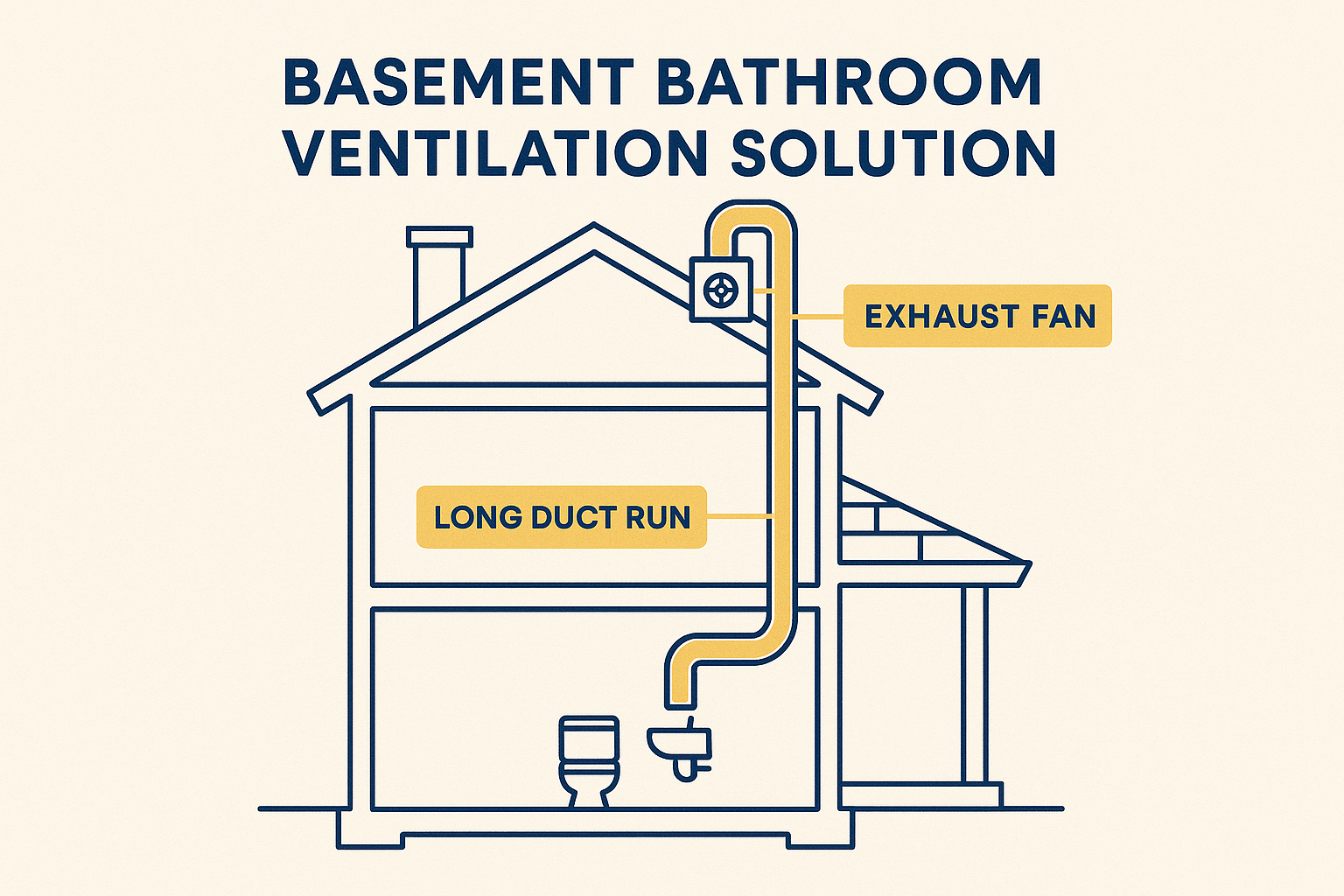
The short answer to the headline question: yes, a basement bathroom requires special consideration for ventilation, and in most cases the installation is more involved than a standard bathroom fan.
Why Basement Ventilation Is Different
Duct routing to the exterior is longer and more complex. An upper-floor bathroom exhaust fan can duct upward through the ceiling and exit through the roof or a short run to a soffit or gable. A basement bathroom fan must route the duct upward through wall cavities, floor assemblies, or a dedicated chase to reach the exterior — a duct run that is typically 4–6 metres or more.
Cold duct runs produce condensation. In an Ottawa winter, a duct carrying humid bathroom exhaust through an exterior wall or uninsulated space is a cold duct. Warm moist air meeting a cold duct surface condenses inside the duct — the moisture that was supposed to exit the home stays in the duct. If significant condensation accumulates, it drains back into the fan housing or drips at duct joints.
Basement air quality is already sensitive. Many Ottawa basements have radon mitigation systems, sump pit areas, or other air quality concerns. A bathroom fan that creates negative pressure in the basement without adequate make-up air can affect the operation of naturally drafting combustion appliances (furnaces, water heaters) or radon systems.
Below-grade walls are cold. Condensation forms readily on basement walls in winter. A bathroom generating additional humidity in a below-grade space with poor ventilation accelerates moisture problems throughout the basement, not just the bathroom.
What the Code Requires
The Ontario Building Code requires mechanical ventilation in any bathroom without an operable exterior window, with a minimum exhaust rate of 25 litres per second (approximately 50 CFM).
A basement bathroom typically does not have a window that qualifies as operable for ventilation purposes. Even when a basement window is present, it is often a small hopper window that does not provide adequate natural ventilation. Mechanical exhaust is required in virtually all basement bathroom installations.
The duct must terminate to the exterior — not into the basement floor space, crawl space, or attic.
Duct Routing Options for Basement Bathrooms
Through-Wall Exterior Duct
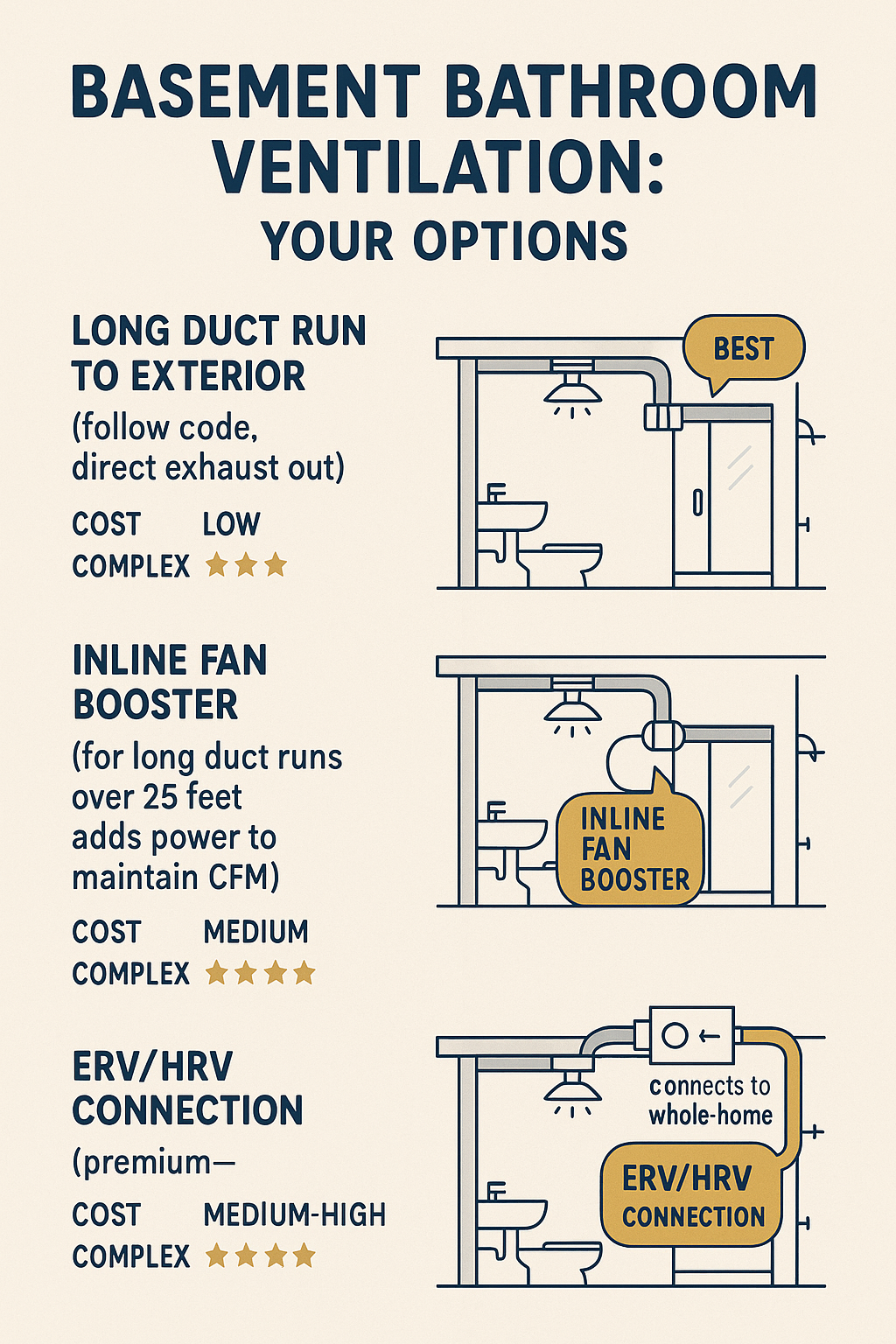
If the basement bathroom is on an exterior wall, a straight duct run through the wall to an exterior vent cap is the simplest option. The duct run is short (30–60 cm through the wall), there are no elbows in the duct run, and performance is close to the fan’s rated CFM.
Requirements:
– The wall penetration must be sealed against air and water infiltration
– The exterior vent cap must be sealed against cold-air backdraft (a dampered vent cap that closes when the fan is off)
– The duct should be insulated within the wall to reduce condensation
Vertical Duct Run to Roof or Soffit
If the bathroom is in the interior of the basement with no adjacent exterior wall, the duct must run upward through the floor assembly and either exit through the roof or a wall vent at the main floor level.
This involves:
– A vertical duct rise through the first-floor ceiling and wall
– Coordination with framing to find a duct path that does not conflict with joists, plumbing, or electrical
– A roof or wall penetration at the upper level
Longer duct runs require a more powerful fan to compensate for increased static pressure. For duct runs over 3 metres with multiple elbows, increase the fan CFM rating by 25–50% over the room-size calculation.
Dedicated Inline Fan
For basement bathrooms with long duct runs, an inline duct fan — a fan installed in the duct itself rather than at the ceiling — can provide the extra capacity needed to push air through a long run. The ceiling unit is a simple grille (no fan motor); the inline fan does the work in the duct.
This approach produces very quiet operation at the ceiling grille (the motor noise is distant in the duct) and is effective for long basement duct runs.
Makeup Air Consideration
A basement bathroom exhaust fan creates negative pressure in the basement when it runs. If the basement is relatively air-tight, this negative pressure must be relieved by makeup air entering from somewhere. In most residential basements, enough air infiltration exists through the structure that makeup air is not a separate requirement.
However, in basements with tight air sealing or where combustion appliances (furnace, water heater) are present, the relationship between exhaust fans and combustion air should be reviewed. A licensed HVAC professional or building energy auditor can assess this if there is a concern.
Insulating the Exhaust Duct
In a cold climate like Ottawa, the basement-to-exterior duct run should be insulated to prevent condensation inside the duct. Use duct insulation wrap or pre-insulated flex duct:
- For duct runs within the building envelope but through unheated spaces (attic, exterior wall): minimum R-4 insulation on the duct
- For duct runs in the basement mechanical space: rigid metal duct is preferred over flex duct (less resistance, easier to clean, less vulnerable to kinking)
A condensation problem in a basement exhaust duct typically indicates the duct is not insulated, is kinked or blocked, or the exterior vent cap damper is stuck open allowing cold backdraft.
For complete basement bathroom installation — including ventilation planning, duct routing, and fan specification — our team at Miracle Dream Homes handles the full scope. See our basement bathroom renovation page for information on our approach, and our main bathroom renovation page for whole-home renovation projects.
For basement ventilation standards and moisture management guidance specific to Canadian climates, Canada Mortgage and Housing Corporation (CMHC) and the National Research Council of Canada publish technical guidance on residential ventilation in cold climates.
Frequently Asked Questions
Does a basement bathroom need a special exhaust fan?
Not a special fan type, but special consideration for fan selection and duct installation. A fan rated 25–50% higher than the room-size calculation accommodates the airflow reduction from longer basement duct runs. The duct installation — routing, insulation, and exterior termination — requires more planning in a basement than in an upper-floor bathroom.
Can a basement bathroom exhaust fan vent through the floor?
No. Exhaust ducts must terminate to the exterior of the building. They cannot vent into the sub-slab space, crawl space, adjacent basement area, or any enclosed space. The duct must reach an exterior wall vent, soffit vent, or roof vent.
Why does my basement bathroom fan produce condensation?
Condensation in a basement exhaust fan or duct is almost always caused by a cold duct path that is not insulated. Warm moist bathroom air contacts the cold duct surface and water condenses before reaching the exterior. Insulating the duct run and ensuring the exterior vent cap damper closes properly when the fan is off are the primary fixes.
Is ventilation required if the basement bathroom has a window?
Under the Ontario Building Code, an operable exterior window satisfies the minimum natural ventilation requirement for a bathroom. However, in Ottawa’s climate, opening a basement window for 20 minutes after a shower in January is not practical — mechanical ventilation is the functional standard for year-round moisture control regardless of window presence.