
Barrier-Free Shower Design: What It Means and How It Works
A barrier-free shower is a shower with no physical obstacles to entry or use — no curb to step over, no threshold to navigate, no door that requires manipulation. The shower floor is continuous with the bathroom floor. Entry is as simple as walking into the shower space.
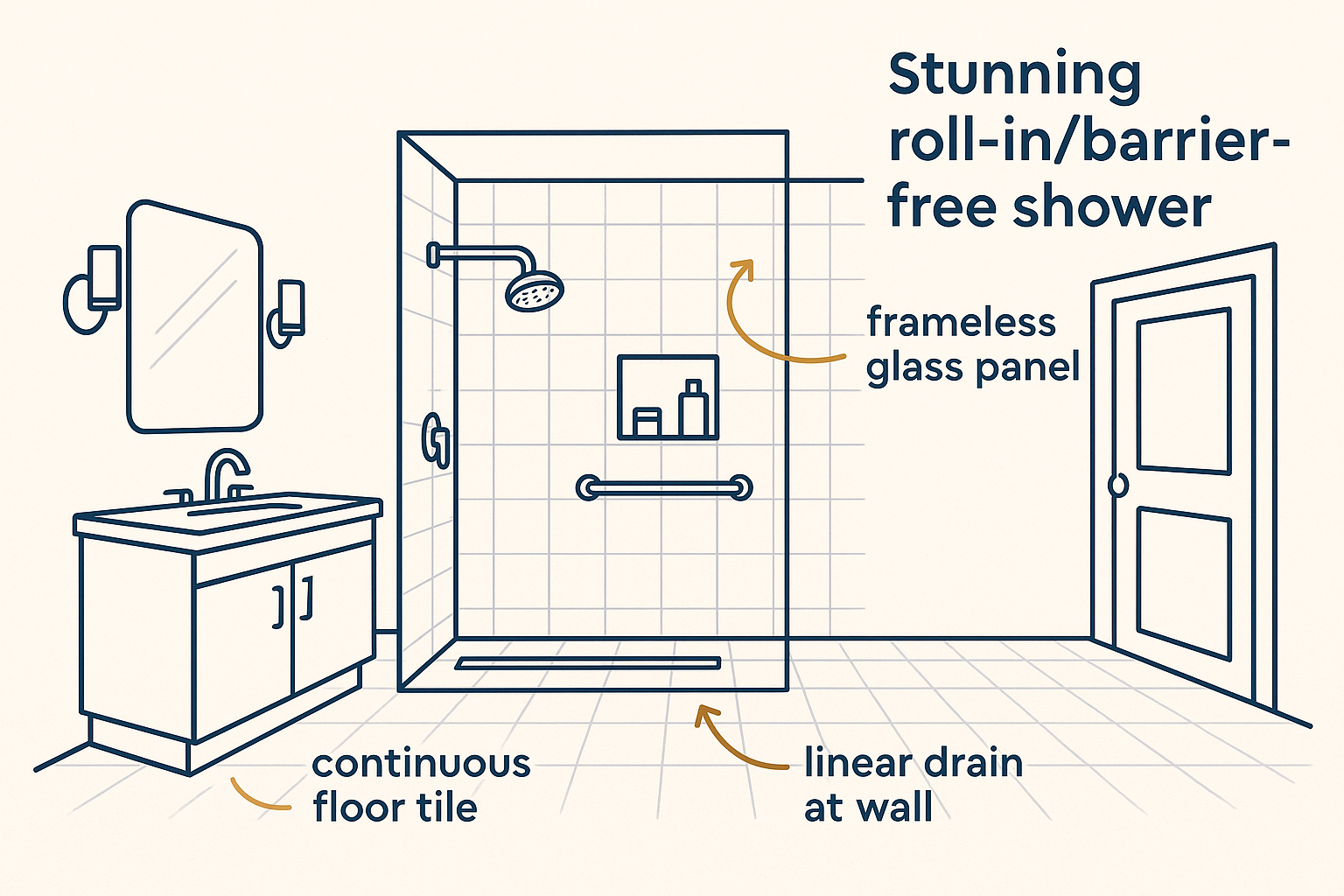
The term “barrier-free” comes from accessibility design standards and refers specifically to the absence of physical barriers that would prevent or hinder use by a person with a mobility limitation. But barrier-free showers have become a mainstream design standard in contemporary bathroom renovation — not only for accessibility reasons, but because they are visually cleaner, easier to clean, and simply better showers.
What Makes a Shower Barrier-Free
No Curb or Threshold
The defining feature of a barrier-free shower is the absence of a curb at the shower entry. In a standard shower installation, a 100–150 mm curb (raised threshold) forms the perimeter at the entry — it contains water and demarcates the shower zone. This curb requires stepping over it on every entry and exit.
In a barrier-free installation, the shower floor is at the same level as the bathroom floor, or very close to it. Water containment is achieved through:
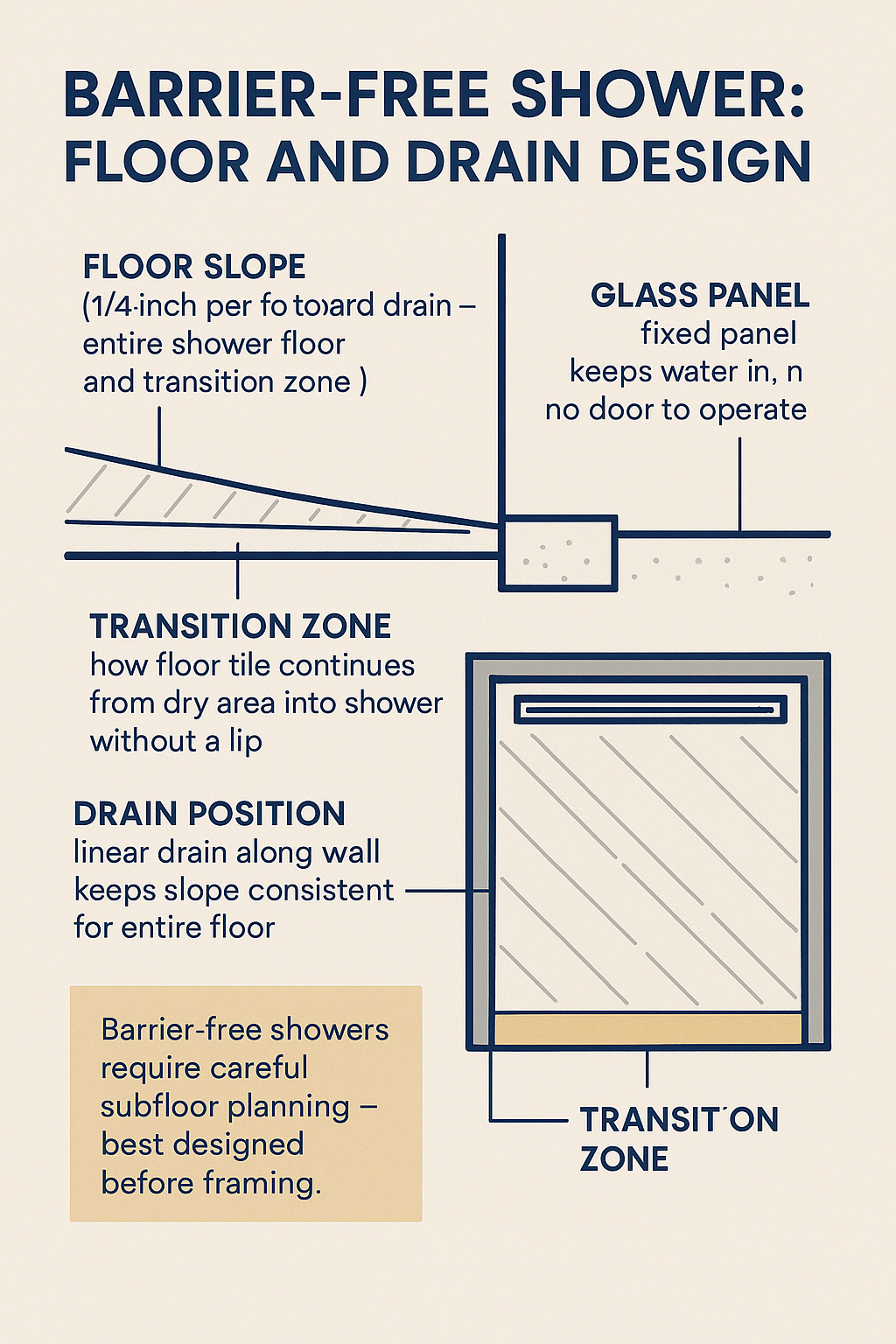
- Floor slope: The shower floor slopes toward the drain at a minimum 2% gradient, directing water away from the entry threshold
- Linear drain at threshold: A linear drain positioned at or near the shower entry collects water before it reaches the bathroom floor
- Point drain placement: A traditional point drain positioned at the lowest point of a multi-directional sloped floor
- Water dam: A minimal 6–12 mm water dam (essentially flush with the floor) at the threshold — the lowest possible physical barrier
Truly barrier-free showers use a linear drain at the threshold with no physical dam, creating a completely level floor transition.
Entry Width
A barrier-free shower entry width of at least 900 mm allows wheelchair access. For a fully wheelchair-accessible shower (intended to accommodate a shower wheelchair or commode), the interior dimension needs to be a minimum 900 mm × 900 mm, and ideally 1,200 mm × 1,200 mm or larger.
If wheelchair access is not a current requirement but is a future possibility, designing for a 900 mm entry width adds no cost during construction. Retrofitting a wider entry into an existing tiled shower requires demolition.
Floor Continuity and Drain Design
Barrier-free showers require careful drain placement and floor slope design that is planned before tile installation. The slope must direct water toward the drain without creating a perceptible tilt underfoot across the shower floor. This requires:
- Pre-sloped shower pan (a pre-formed substrate that incorporates the correct slope)
- Or mortar bed sloped by the tile setter to the specified gradient
- Or a trench/linear drain that allows the floor to slope in one direction rather than four (simpler slope design)
Linear drains — channel-shaped drains that run the width of the shower — are particularly compatible with barrier-free design because they allow a single slope from one wall to the drain channel, which is easier to execute and creates a floor that feels flat to the user.
Glass Panel, Not a Door
A barrier-free shower without a door — using a fixed glass panel to deflect spray — is the fully accessible configuration. The panel is anchored to the floor and wall or ceiling, and the shower is entered by walking past the panel end.
This configuration requires the shower to be wide enough that the entry opening is far enough from the showerhead zone that spray does not escape readily. In practice, a shower 1,200 mm or wider with the showerhead on the back wall works well without a door.
If a door is needed (for a narrower shower, or for water containment), a pivot door or hinged door with no threshold — opening into the bathroom rather than a curb-mounted frame — maintains the barrier-free entry while containing water.
Barrier-Free vs. Roll-In Shower
A roll-in shower is a specific type of barrier-free shower designed to accommodate a shower wheelchair that rolls directly into the shower space without being transferred to a shower chair.
A roll-in shower requires:
– Interior dimensions of at least 900 mm × 1,500 mm (ideally 1,200 mm × 1,800 mm) to accommodate the wheelchair and allow an attendant to assist
– Absolutely level floor transition — no dam, no threshold, no lip of any height
– Drain design that does not create a hazard for wheelchair wheels
– Turning radius of 1,500 mm in the bathroom area outside the shower entry
Most residential aging-in-place shower renovations do not need to meet roll-in standards — they need to meet barrier-free walking entry standards, which are less demanding. Roll-in configuration is appropriate for households with a current need for wheelchair shower access.
Waterproofing in Barrier-Free Construction
A barrier-free shower requires waterproofing that extends beyond the standard shower zone because there is no curb stopping water from spreading. The waterproofing membrane must cover:
- The full shower floor and walls to minimum 200 mm above the wet zone
- The floor area around the threshold, to a minimum 200 mm beyond the entry on the bathroom floor side
This extended waterproofing protection ensures that any water that escapes the shower zone during normal use does not reach the substrate below the tile. Sheet membrane systems (Schluter Kerdi, Wedi, Laticrete Hydro Ban) extend continuously across the transition zone, providing a watertight surface regardless of floor slope variations.
When Barrier-Free Makes Sense
Barrier-free shower design makes sense in:
- Aging-in-place renovations where the homeowner is planning for current or future mobility changes
- Primary ensuites in contemporary renovations where the clean visual of a curbless floor is desirable independent of accessibility
- Any shower renovation where the homeowner prefers the ease of cleaning a continuous floor surface
- Homes with current wheelchair users where roll-in access is a functional requirement
For tub-to-shower conversions in Ottawa, barrier-free design adds minimal cost to the standard scope — the drain placement and floor slope are specified during the design phase before any substrate work begins.
For new bathroom additions with accessibility requirements, see our bathroom addition page.
For residential accessibility standards governing barrier-free shower design in Canada, CSA Group B651 specifies clearances, drain requirements, and entry widths for accessible shower installations. The National Building Code of Canada governs accessible design requirements for commercial and multi-unit residential applications.
Frequently Asked Questions
What is the difference between a barrier-free shower and a walk-in shower?
“Walk-in shower” is a general term for any shower you walk into rather than stepping over a high tub rim — it includes showers with a low curb. A “barrier-free shower” specifically means no curb, threshold, or physical barrier at the entry. All barrier-free showers are walk-in showers; not all walk-in showers are barrier-free. In renovation context, barrier-free refers specifically to curbless construction with a continuous floor level.
Does a barrier-free shower require a drain cover that won’t catch wheelchair wheels?
Yes, if wheelchair access is planned. Standard round point drains can catch wheelchair casters. A linear drain — particularly a slot drain or grate drain with narrow openings parallel to the wheelchair travel direction — provides a smooth surface that wheelchair wheels cross without catching. Drain grate selection is part of the accessible shower specification.
How do you prevent water from spreading outside a barrier-free shower?
Water containment in a barrier-free shower relies on correct floor slope and drain placement. The shower floor slopes at minimum 2% toward the drain; this keeps water moving toward the drain during normal shower use. A linear drain at the threshold position is the most effective option — it collects water at the exact point where it would cross into the bathroom floor. Proper waterproofing extended into the transition zone protects the substrate even if minor water escape occurs.
Is a barrier-free shower more expensive than a standard shower?
Not significantly. The additional cost comes from drain selection (linear drains cost more than standard point drains: $200–$600 for the drain assembly) and extended waterproofing material in the transition zone ($100–$200). The labour to slope and install the floor is comparable to a standard shower. Over the project total, the incremental cost of a barrier-free entry is typically $500–$1,000 — a modest addition to a $12,000–$25,000 shower renovation scope.